Clinical Trial
. 2013 Sep 15;19(18):5227-39.
doi: 10.1158/1078-0432.CCR-13-0489. Epub 2013 Aug 9.

Predicting response to bevacizumab in ovarian cancer: a panel of potential biomarkers informing treatment selection

Affiliations
Clinical Trial

Predicting response to bevacizumab in ovarian cancer: a panel of potential biomarkers informing treatment selection

Fiona Collinson et al. Clin Cancer Res. .

Abstract

Purpose: The aim of this study was to identify and validate novel predictive and/or prognostic serum proteomic biomarkers in patients with epithelial ovarian cancer (EOC) treated as part of the phase III international ICON7 clinical trial.

Experimental design: ICON7 was a phase III international trial in EOC which showed a modest but statistically significant benefit in progression-free survival (PFS) with the addition of bevacizumab to standard chemotherapy. Serum samples from 10 patients who received bevacizumab (five responders and five nonresponders) were analyzed by mass spectrometry to identify candidate biomarkers. Initial validation and exploration by immunoassay was undertaken in an independent cohort of 92 patients, followed by a second independent cohort of 115 patients (taken from across both arms of the trial).

Results: Three candidate biomarkers were identified: mesothelin, fms-like tyrosine kinase-4 (FLT4), and α1-acid glycoprotein (AGP). Each showed evidence of independent prognostic potential when adjusting for high-risk status in initial (P < 0.02) and combined (P < 0.01) validation cohorts. In cohort I, individual biomarkers were not predictive of bevacizumab benefit; however, when combined with CA-125, a signature was developed that was predictive of bevacizumab response and discriminated benefit attributable to bevacizumab better than clinical characteristics. The signature showed weaker evidence of predictive ability in validation cohort II, but was still strongly predictive considering all samples (P = 0.001), with an improvement in median PFS of 5.5 months in signature-positive patients in the experimental arm compared with standard arm.

Conclusions: This study shows a discriminatory signature comprising mesothelin, FLT4, AGP, and CA-125 as potentially identifying those patients with EOC more likely to benefit from bevacizumab. These results require validation in further patient cohorts.


Figures

Figure 1
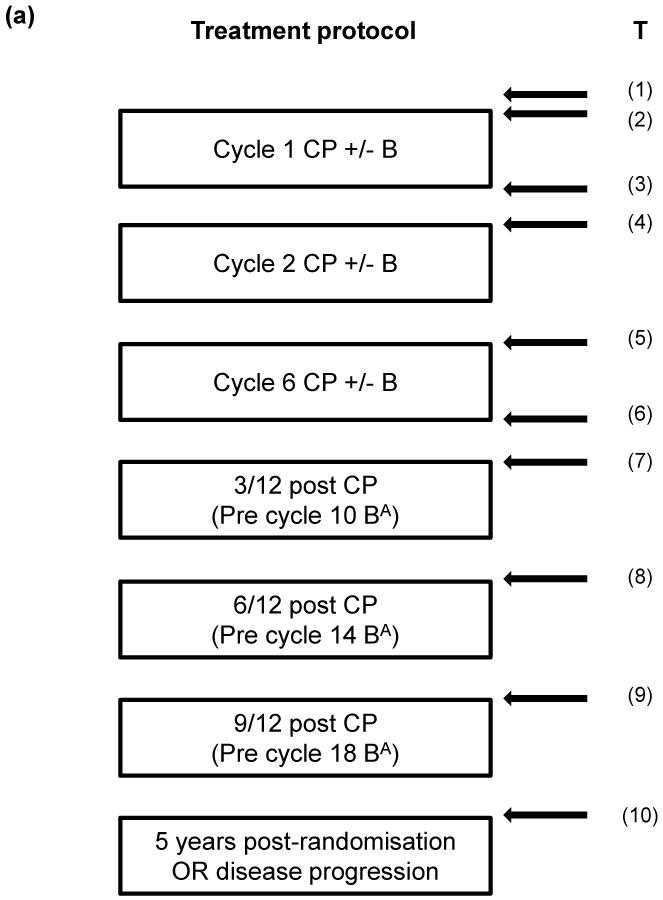
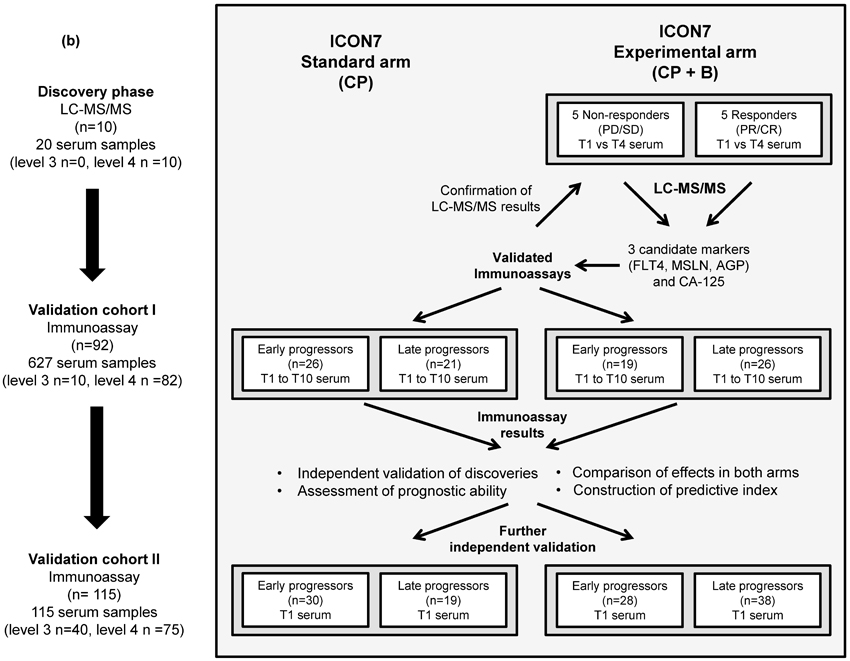
Figure 1. Timing of serum samples as part of the ICON7 trial and schematic diagram describing discovery and validation experiments
(a). For patients consenting to level 4 sample collection, samples were taken pre-cycle 1 (T1 and T2), post-cycle 1 (T3), pre-cycles 2 (T4) and 6 (T5), post-cycle 6 (T6) and at 3, 6 and 9 months from completion of chemotherapy (T7-T9) and at either 5 years from randomisation or at progression (whichever occurred first) (T10). For patients consenting to level 3 sample collection, samples were taken pre-cycle 1 (T1), pre cycles 2 and 6 (T4 and T5) and at either 5 years from randomisation or at progression (whichever occurred first) (T10). A total of 226 patients consented to levels 3 or 4 with a further 536 patients consenting to the use of fresh-frozen paraffin embedded tissue and/or blood samples for genomic DNA analysis; (b). Discovery and validation experiments showing number of patients and serum samples and sample time points examined at each stage. B = bevacizumab; C = carboplatin; P = paclitaxel; Aexperimental arm only. PR and CR = partial and complete response respectively, PD and SD = progressive and stable disease respectively.
Figure 1
Figure 1. Timing of serum samples as part of the ICON7 trial and schematic diagram describing discovery and validation experiments
(a). For patients consenting to level 4 sample collection, samples were taken pre-cycle 1 (T1 and T2), post-cycle 1 (T3), pre-cycles 2 (T4) and 6 (T5), post-cycle 6 (T6) and at 3, 6 and 9 months from completion of chemotherapy (T7-T9) and at either 5 years from randomisation or at progression (whichever occurred first) (T10). For patients consenting to level 3 sample collection, samples were taken pre-cycle 1 (T1), pre cycles 2 and 6 (T4 and T5) and at either 5 years from randomisation or at progression (whichever occurred first) (T10). A total of 226 patients consented to levels 3 or 4 with a further 536 patients consenting to the use of fresh-frozen paraffin embedded tissue and/or blood samples for genomic DNA analysis; (b). Discovery and validation experiments showing number of patients and serum samples and sample time points examined at each stage. B = bevacizumab; C = carboplatin; P = paclitaxel; Aexperimental arm only. PR and CR = partial and complete response respectively, PD and SD = progressive and stable disease respectively.
Figure 2
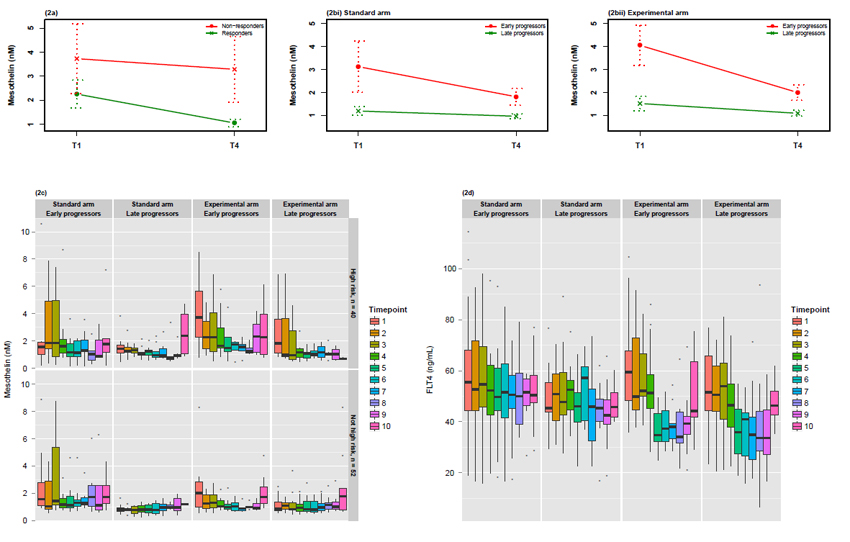
Figure 2. Relationship between mesothelin and response to treatment and the kinetics of change in FLT4 related to treatment in validation cohort I
(a) Longitudinal changes in mesothelin between time points 1 and 4 in responders and non-responders in the discovery cohort as determined confirmed by ELISA. Longitudinal changes in mesothelin between time points 1 and 4 in early and late progressors in the validation cohort in the standard arm (b)[i] and experimental arm (b)[ii] measured by immunoassay. Data points are the mean with dotted lines representing ± standard error. (c) Relationship between mesothelin and response to treatment by risk of progression status in validation cohort. Longitudinal box plots* showing changes in mesothelin concentration across the sample time points in early and late progressors in the standard and experimental arms for patients at high risk of progression and patients not at high risk of progression (high risk of progression defined as FIGO stage IV disease or FIGO stage III disease AND >1.0cm residual disease after debulking surgery). (d) Longitudinal box plots* showing changes in FLT4 median concentration over time points in ICON7 sampling. Panels show early and late progressors in terms of PFS in standard and experimental arms of trial. *Box plots show median, interquartile range (IQR) and 1.5×IQR. Dots represent outliers (defined as greater/less than 1.5×IQR).
Figure 3
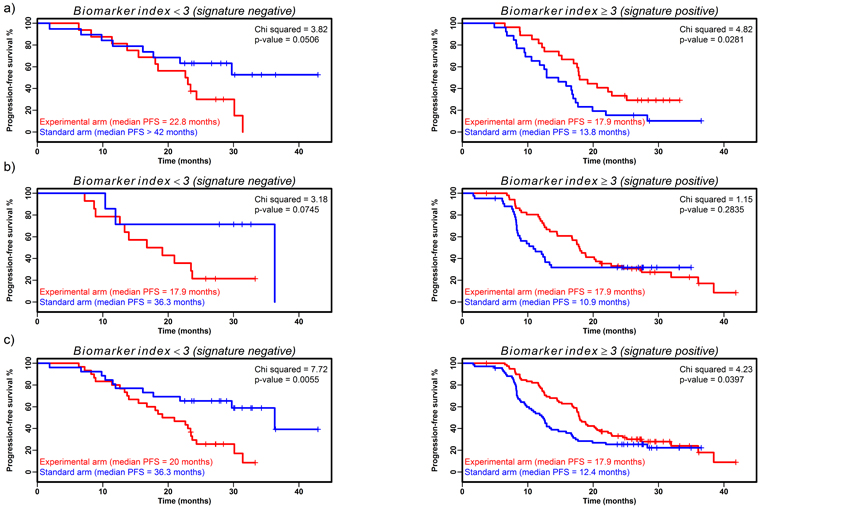
Figure 3. Predictive potential of biomarker index in signature-negative and signature-positive patient groups
Kaplan-Meier estimates of survival functions for biomarker index in signature-negative and positive groups separated by treatment arm in a) validation cohort I, b) validation cohort II and c) validation cohorts I and II combined. Index constructed by calculating cut-points for each marker (mesothelin = 0.96 nM; FLT4 = 45.45 ng/ml; AGP = 1.29 g/L; CA-125 = 295 kU/L; all p<0.05) converting to binary and summing for each patient before dichotomising around the optimal index cut-point to give signature-negative and signature-positive patient groups (index construction described fully in Supplementary Methods).

Comment in

  • Biomarkers and response to bevacizumab--letter.
    Cremolini C, Loupakis F, Bocci G, Falcone A. Cremolini C, et al. Clin Cancer Res. 2014 Feb 15;20(4):1056-7. doi: 10.1158/1078-0432.CCR-13-2763. Clin Cancer Res. 2014. PMID: 24536076 No abstract available.
  • Biomarkers and response to bevacizumab--response.
    Collinson F, Hutchinson M, Craven RA, Cairns DA, Alexandre Z, Wind TC, Gahir N, Messenger MP, Jackson S, Thompson D, Adusei C, Ledermann J, Hall G, Jayson GC, Selby PJ, Banks RE. Collinson F, et al. Clin Cancer Res. 2014 Feb 15;20(4):1058. doi: 10.1158/1078-0432.CCR-13-3269. Clin Cancer Res. 2014. PMID: 24536077 No abstract available.

References

    1. Jemal A, Siegel R, Xu J, Ward E. Cancer statistics, 2010. CA Cancer J Clin. 2010;60:277–300. - PubMed
    1. Stuart GC, Kitchener H, Bacon M, duBois A, Friedlander M, Ledermann J, et al. 2010 Gynecologic Cancer InterGroup (GCIG) consensus statement on clinical trials in ovarian cancer: report from the Fourth Ovarian Cancer Consensus Conference. Int J Gynecol Cancer. 2011;21:750–5. - PubMed
    1. Shen GH, Ghazizadeh M, Kawanami O, Shimizu H, Jin E, Araki T, et al. Prognostic significance of vascular endothelial growth factor expression in human ovarian carcinoma. Br J Cancer. 2000;83:196–203. - PMC - PubMed
    1. Han ES, Burger RA, Darcy KM, Sill MW, Randall LM, Chase D, et al. Predictive and prognostic angiogenic markers in a gynecologic oncology group phase II trial of bevacizumab in recurrent and persistent ovarian or peritoneal cancer. Gynecol Oncol. 2010;119:484–90. - PMC - PubMed
    1. Perren TJ, Swart AM, Pfisterer J, Ledermann JA, Pujade-Lauraine E, Kristensen G, et al. A phase 3 trial of bevacizumab in ovarian cancer. N Engl J Med. 2011;365:2484–96. - PubMed

Publication types

MeSH terms