


Neuropathologic basis of white matter hyperintensity accumulation with advanced age
- PMID: 23935177
- PMCID: PMC3888199
- DOI: 10.1212/WNL.0b013e3182a43e45
Neuropathologic basis of white matter hyperintensity accumulation with advanced age
Abstract
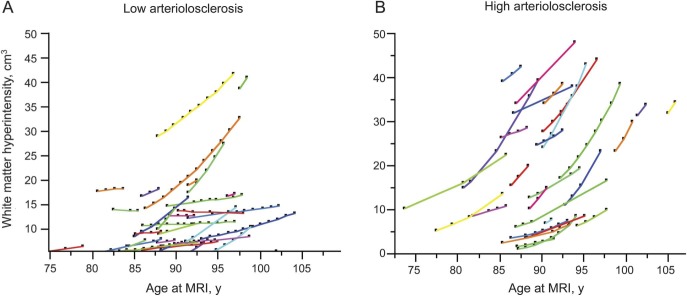
Objective: To determine which vascular pathology measure most strongly correlates with white matter hyperintensity (WMH) accumulation over time, and whether Alzheimer disease (AD) neuropathology correlates with WMH accumulation.
Methods: Sixty-six older persons longitudinally followed as part of an aging study were included for having an autopsy and >1 MRI scan, with last MRI scan within 36 months of death. Mixed-effects models were used to examine the associations between longitudinal WMH accumulation and the following neuropathologic measures: myelin pallor, arteriolosclerosis, microvascular disease, microinfarcts, lacunar infarcts, large-vessel infarcts, atherosclerosis, neurofibrillary tangle rating, and neuritic plaque score. Each measure was included one at a time in the model, adjusted for duration of follow-up and age at death. A final model included measures showing an association with p < 0.1.
Results: Mean age at death was 94.5 years (5.5 SD). In the final mixed-effects models, arteriolosclerosis, myelin pallor, and Braak score remained significantly associated with increased WMH accumulation over time. In post hoc analysis, we found that those with Braak score 5 or 6 were more likely to also have high atherosclerosis present compared with those with Braak score 1 or 2 (p = 0.003).
Conclusion: Accumulating white matter changes in advanced age are likely driven by small-vessel ischemic disease. Additionally, these results suggest a link between AD pathology and white matter integrity disruption. This may be due to wallerian degeneration secondary to neurodegenerative changes. Alternatively, a shared mechanism, for example ischemia, may lead to both vascular brain injury and neurodegenerative changes of AD. The observed correlation between atherosclerosis and AD pathology supports the latter.
Figures
References
-
- Poggesi A, Pantoni L, Inzitari D, et al. 2001-2011: a decade of the LADIS (Leukoaraiosis and DISability) Study: what have we learned about white matter changes and small-vessel disease? Cerebrovasc Dis 2011;32:577–588 - PubMed
Publication types
MeSH terms
Substances
Grants and funding
LinkOut - more resources
Full Text Sources
Other Literature Sources
Medical
