


Influenza A virus impairs control of Mycobacterium tuberculosis coinfection through a type I interferon receptor-dependent pathway
- PMID: 23935205
- PMCID: PMC3873785
- DOI: 10.1093/infdis/jit424
Influenza A virus impairs control of Mycobacterium tuberculosis coinfection through a type I interferon receptor-dependent pathway
Abstract
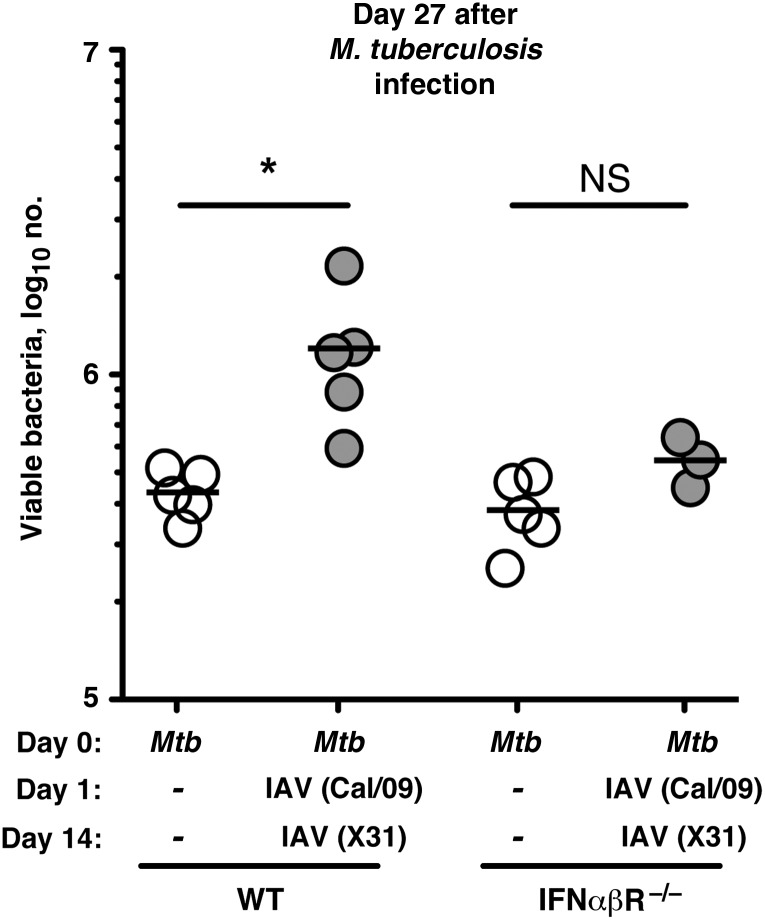
Influenza followed by severe acute bacterial pneumonia is a major cause of mortality worldwide. Several mechanisms account for this enhanced susceptibility, including increased production of type I interferon (IFN). In individuals infected with Mycobacterium tuberculosis, the influence of acute viral infections on tuberculosis progression is unclear. We show that prior exposure of mice to influenza A virus, followed by M. tuberculosis infection, leads to enhanced mycobacterial growth and decreased survival. Following M. tuberculosis/influenza virus coinfection, mycobacterial growth is enhanced by a type I IFN signaling pathway. Our findings highlight the detrimental influence influenza virus infection can have before or during M. tuberculosis infection.
Keywords: Interferon; Mycobacterium tuberculosis; co-infection; influenza; tuberculosis; type I IFN.
Figures

References
-
- Nunn P, Falzon D. World Health Organization (WHO) information on tuberculosis and pandemic influenza A (H1N1) Geneva, Switzerland: WHO Press; 2009.
-
- van der Sluijs KF, van Elden LJ, Nijhuis M, et al. IL-10 is an important mediator of the enhanced susceptibility to pneumococcal pneumonia after influenza infection. J Immunol. 2004;172:7603–9. - PubMed
Publication types
MeSH terms
Substances
Grants and funding
LinkOut - more resources
Full Text Sources
Other Literature Sources
Medical
