. 2013 Aug 5:6:19.
doi: 10.3389/fnmol.2013.00019. eCollection 2013.

Autism spectrum disorder causes, mechanisms, and treatments: focus on neuronal synapses

Affiliations

Autism spectrum disorder causes, mechanisms, and treatments: focus on neuronal synapses

Hyejung Won et al. Front Mol Neurosci. .

Abstract

Autism spectrum disorder (ASD) is a group of developmental disabilities characterized by impairments in social interaction and communication and restricted and repetitive interests/behaviors. Advances in human genomics have identified a large number of genetic variations associated with ASD. These associations are being rapidly verified by a growing number of studies using a variety of approaches, including mouse genetics. These studies have also identified key mechanisms underlying the pathogenesis of ASD, many of which involve synaptic dysfunctions, and have investigated novel, mechanism-based therapeutic strategies. This review will try to integrate these three key aspects of ASD research: human genetics, animal models, and potential treatments. Continued efforts in this direction should ultimately reveal core mechanisms that account for a larger fraction of ASD cases and identify neural mechanisms associated with specific ASD symptoms, providing important clues to efficient ASD treatment.

Keywords: animal model; autism spectrum disorder; genetics; synapse; synaptopathy; therapeutics.


Figures
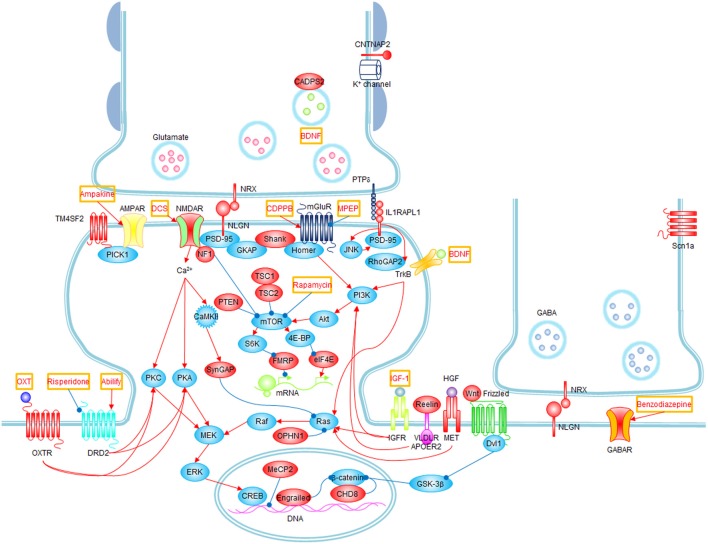
Figure 1
Figure 1
Signaling pathways and possible treatments associated with ASD. Molecules whose mutations or polymorphisms are associated with ASD are indicated in red. Stimulations and inhibitions are indicated by red and blue arrows, respectively. Possible treatments and their target molecules are indicated by red texts in orange boxes. SynGAP1, which directly interacts with PSD-95, could not be placed next to PSD-95 for simplicity.

References

    1. Abrahams B. S., Geschwind D. H. (2008). Advances in autism genetics: on the threshold of a new neurobiology. Nat. Rev. Genet. 9, 341–355 10.1038/nrg2346 - DOI - PMC - PubMed
    1. Alagarsamy S., Rouse S. T., Junge C., Hubert G. W., Gutman D., Smith Y., et al. (2002). NMDA-induced phosphorylation and regulation of mGluR5. Pharmacol. Biochem. Behav. 73, 299–306 10.1016/S0091-3057(02)00826-2 - DOI - PubMed
    1. Alarcon M., Abrahams B. S., Stone J. L., Duvall J. A., Perederiy J. V., Bomar J. M., et al. (2008). Linkage, association, and gene-expression analyses identify CNTNAP2 as an autism-susceptibility gene. Am. J. Hum. Genet. 82, 150–159 10.1016/j.ajhg.2007.09.005 - DOI - PMC - PubMed
    1. Allen G., Courchesne E. (2003). Differential effects of developmental cerebellar abnormality on cognitive and motor functions in the cerebellum: an fMRI study of autism. Am. J. Psychiatry 160, 262–273 10.1176/appi.ajp.160.2.262 - DOI - PubMed
    1. Allen G., Muller R. A., Courchesne E. (2004). Cerebellar function in autism: functional magnetic resonance image activation during a simple motor task. Biol. Psychiatry 56, 269–278 10.1016/j.biopsych.2004.06.005 - DOI - PubMed
