


Three ways in which midline regions contribute to self-evaluation
- PMID: 23935580
- PMCID: PMC3731671
- DOI: 10.3389/fnhum.2013.00450
Three ways in which midline regions contribute to self-evaluation
Abstract
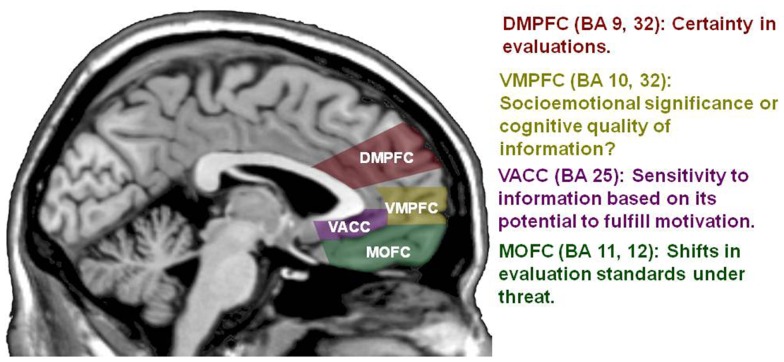
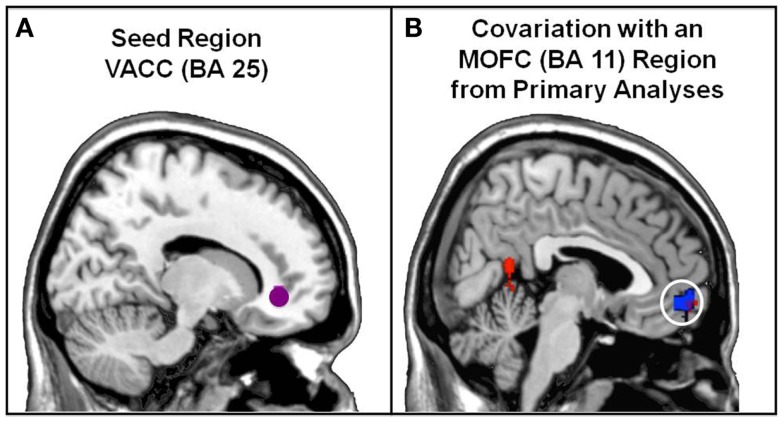
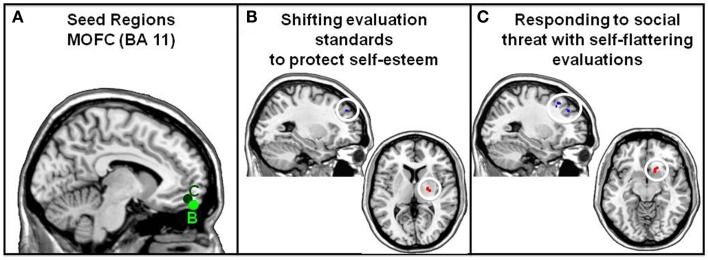
An integration of existing research and newly conducted psychophysiological interaction (PPI) connectivity analyses suggest a new framework for understanding the contribution of midline regions to social cognition. Recent meta-analyses suggest that there are no midline regions that are exclusively associated with self-processing. Whereas medial prefrontal cortex (MPFC) is broadly modulated by self-processing, subdivisions within MPFC are differentially modulated by the evaluation of close others (ventral MPFC: BA 10/32) and the evaluation of other social targets (dorsal MPFC: BA 9/32). The role of DMPFC in social cognition may also be less uniquely social than previously thought; it may be better characterized as a region that indexes certainty about evaluation rather than previously considered social mechanisms (i.e., correction of self-projection). VMPFC, a region often described as an important mediator of socioemotional significance, may instead perform a more cognitive role by reflecting the type of information brought to bear on evaluations of people we know well. Furthermore, the new framework moves beyond MPFC and hypothesizes that two other midline regions, ventral anterior cingulate cortex (VACC: BA 25) and medial orbitofrontal cortex (MOFC: BA 11), aid motivational influences on social cognition. Despite the central role of motivation in psychological models of self-perception, neural models have largely ignored the topic. Positive connectivity between VACC and MOFC may mediate bottom-up sensitivity to information based on its potential for helping us evaluate ourselves or others the way we want. As connectivity becomes more positive with striatum and less positive with middle frontal gyrus (BA 9/44), MOFC mediates top-down motivational influences by adjusting the standards we bring to bear on evaluations of ourselves and other people.
Keywords: frontal lobe; motivation; optimistic bias; person perception; self; self-projection; social cognition.
Figures
References
-
- Alicke M. D. (1985). Global self-evaluation as determined by the desirability and controllability of trait adjectives. J. Pers. Soc. Psychol. 49, 1621–1630 10.1037/0022-3514.49.6.1621 - DOI
-
- Aron A., Aron E., Smollan D. (1992). Inclusion of other in the self scale and the structure of interpersonal closeness. J. Pers. Soc. Psychol. 63, 596–612 10.1037/0022-3514.63.4.596 - DOI
-
- Beer J. S. (2012a). This time with motivation: the implications of social neuroscience for research on motivated self- and other-perception (and vice versa). Motiv. Emot. 36, 38–45 10.1007/s11031-011-9259-0 - DOI
LinkOut - more resources
Full Text Sources
Other Literature Sources
Research Materials
