. 2013 Aug 5:4:201.
doi: 10.3389/fmicb.2013.00201. eCollection 2013.

New insights into the evolutionary history of biological nitrogen fixation

Affiliations

New insights into the evolutionary history of biological nitrogen fixation

Eric S Boyd et al. Front Microbiol. .

Abstract

Nitrogenase, which catalyzes the ATP-dependent reduction of dinitrogen (N2) to ammonia (NH3), accounts for roughly half of the bioavailable nitrogen supporting extant life. The fundamental requirement for fixed forms of nitrogen for life on Earth, both at present and in the past, has led to broad and significant interest in the origin and evolution of biological N2 fixation. One key question is whether the limited availability of fixed nitrogen was a factor in life's origin or whether there were ample sources of fixed nitrogen produced by abiotic processes or delivered through the weathering of bolide impact materials to support this early life. If the latter, the key questions become what were the characteristics of the environment that precipitated the evolution of this oxygen sensitive process, when did this occur, and how was its subsequent evolutionary history impacted by the advent of oxygenic photosynthesis and the rise of oxygen in the Earth's biosphere. Since the availability of fixed sources of nitrogen capable of supporting early life is difficult to glean from the geologic record, there are limited means to get direct insights into these questions. Indirect insights, however, can be gained through phylogenetic studies of nitrogenase structural gene products and additional gene products involved in the biosynthesis of the complex metal-containing prosthetic groups associated with this enzyme complex. Insights gained from such studies, as reviewed herein, challenge traditional models for the evolution of biological nitrogen fixation and provide the basis for the development of new conceptual models that explain the stepwise evolution of this highly complex life sustaining process.

Keywords: NIf; great oxidation event; methanogens; nitrogen fixation.


Figures
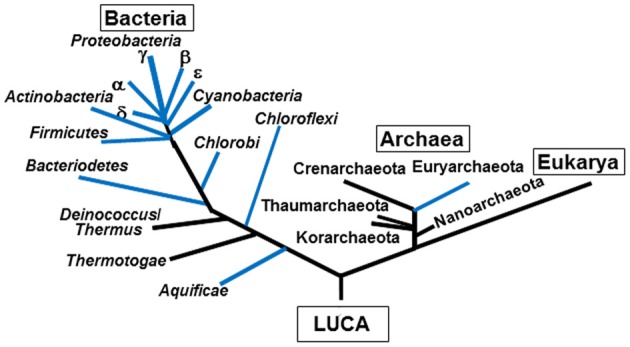
Figure 1
Figure 1
A schematic of a 3 domain taxonomic tree of life with lineages that include nitrogen fixing organisms, as identified through genome screening for nifHDKENB, overlaid in blue.
Figure 2
Figure 2
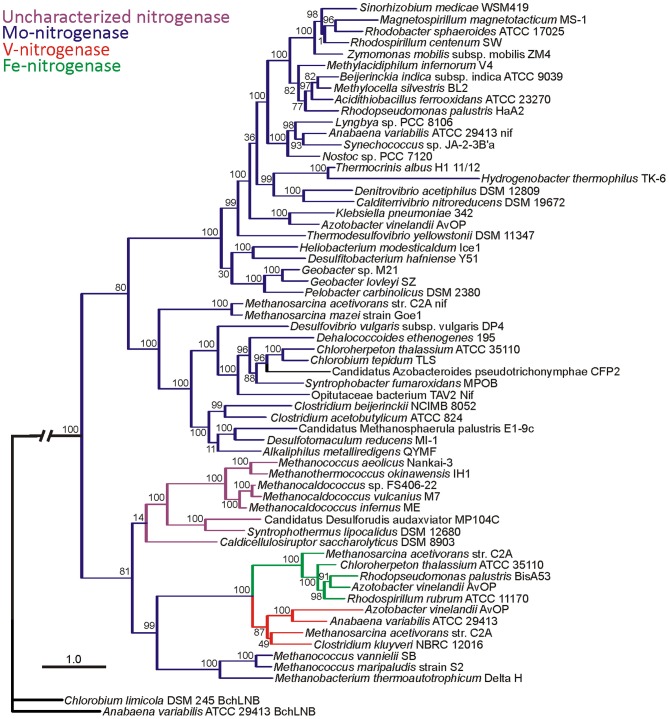
Maximum-likelihood phylogenetic reconstruction of a concatenation of Nif/Anf/Vnf and uncharacterized HDK protein sequences. Individual protein sequences were aligned, concatenated, and subjected to evolutionary reconstruction as described previously (Boyd et al., 2011b). The metal composition of the nitrogenase active site clusters are overlaid in blue (Nif), purple (“uncharacterized nitrogenase”), red (Vnf), and green (Anf). Bootstrap values are indicated at the nodes. Concatenations of paralogous proteins involved in the synthesis of chlorophyll/bacteriochlorophyll (Bch/ChlLNB) were used to root the phylogeny. The hash at the root was introduced to conserve space.
Figure 3
Figure 3
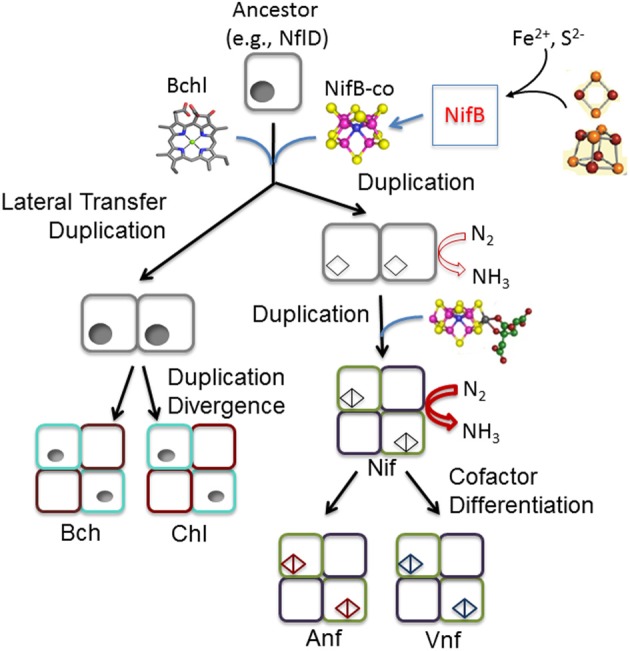
Hypothetical scheme depicting the evolution of nitrogenase from its protein ancestor. Parsimony suggests that the likely ancestor of these protein complexes was a NflD-like protein present in an ancestral methanogen. The movement of an ancestor of a NflD-like protein to anoxygenic phototrophs, and the diversification of this protein into BchN, would necessitate lateral gene transfer followed by a duplication event. In contrast, vertical inheritance of a duplicated NflD ancestor in a methanogen can account for proto NifD. The diversification of the duplicated NflD like ancestor into a proto homodimeric NifD (i.e., protonitrogenase) is presumed to have been precipitated by interaction with an ancestor of the radical SAM protein NifB, which in extant biology catalyzes the formation of the FeMo-co precursor, NifB-co, from simple FeS clusters. Here, NifB-co or the like could have serendipitously been inserted in the open active site cavity presumed to be present in the protonitrogenase ancestor (e.g., BchN- or NflD-like) conferring the ability to perhaps catalyze a low level of N2 reduction. A second duplication of nifD and the subsequent diverisification of this gene (loss of FeMo-co binding site) led to nifK. The later bicistronic duplication of nifDK and subsequent diversification of these genes to nifEN yielded the ability to further mature biosynthetic intermediates into FeMo-co. In this depiction, metal cofactor binding sites within proteins are indicated by lobes whereas those that likely bind organic cofactors (e.g., protochlorophyllide) are indicated by circles. Open lobes depict sites where a cluster similar to NifB-co may have been bound by a protonitrogenase.
Figure 4
Figure 4
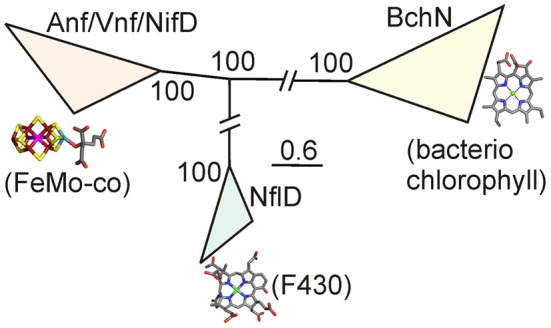
Phylogenetic relationships between Anf/Vnf/NifD, Bch/ChlN, and NflD proteins, as reproduced from Boyd et al. (2011b). Parsimony would suggest that the ancestor of this paralogous group of proteins likely harbored an open active site cavity similar to that which is present in modern NflD or Chl/BchN proteins. The ancestor of these protein complexes (at the trifurcation point of the tree) likely encoded a single structural protein approximating NflD. A series of ancient duplications followed by independent evolution yielded the precursor to the heterotetrameric BchNB and NifDK complex (See Figure 3 for a schematic outlining this evolutionary trajectory).

References

    1. Anbar A. D. (2008). Elements and evolution. Science 322, 1481–1483 10.1126/science.1163100 - DOI - PubMed
    1. Anbar A. D., Duan Y., Lyons T. W., Arnold G. L., Kendall B., Creaser R. A., et al. (2007). A whiff of oxygen before the great oxidation event. Science 317, 1903–1906 10.1126/science.1140325 - DOI - PubMed
    1. Anbar A. D., Knoll A. H. (2002). Proterozoic ocean chemistry and evolution: a bioinorganic bridge. Science 297, 1137–1142 10.1126/science.1069651 - DOI - PubMed
    1. Berman-Frank I., Lundgren P., Falkowski P. (2003). Nitrogen fixation and photosynthetic oxygen evolution in cyanobacteria. Res. Microbiol. 154, 157–164 10.1016/S0923-2508(03)00029-9 - DOI - PubMed
    1. Bolhuis H., Severin I., Confurius-Guns V., Wollenzien U. I. A., Stal L. J. (2009). Horizontal transfer of the nitrogen fixation gene cluster in the cyanobacterium Microcoleus chthonoplastes. ISME J. 4, 121–130 10.1038/ismej.2009.99 - DOI - PubMed

LinkOut - more resources