


Characterizing acupuncture de qi in mild cognitive impairment: relations with small-world efficiency of functional brain networks
- PMID: 23935659
- PMCID: PMC3725922
- DOI: 10.1155/2013/304804
Characterizing acupuncture de qi in mild cognitive impairment: relations with small-world efficiency of functional brain networks
Abstract
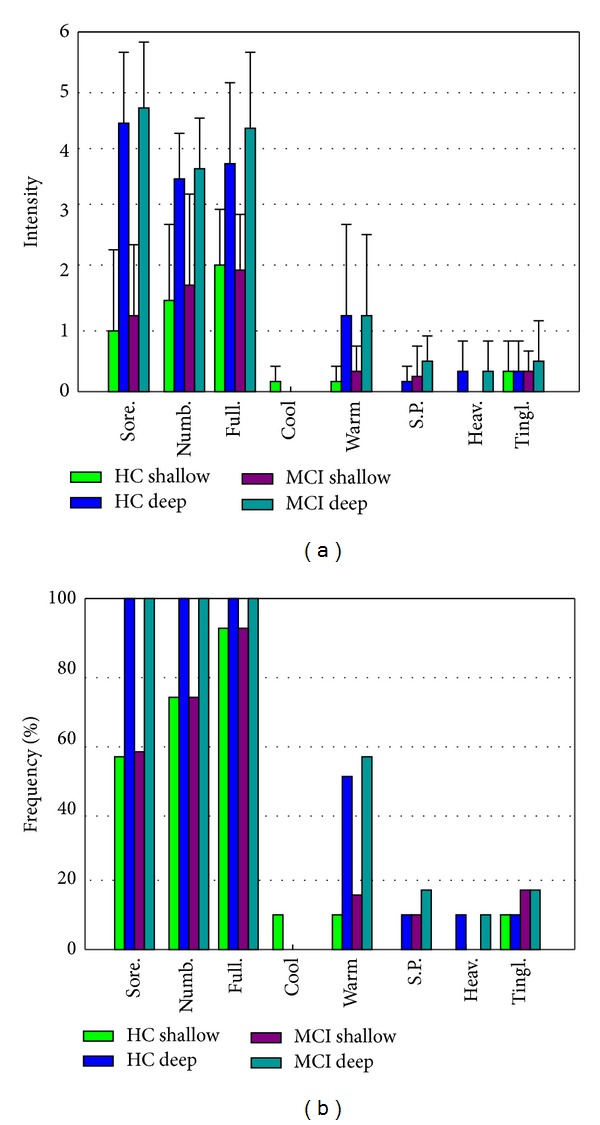
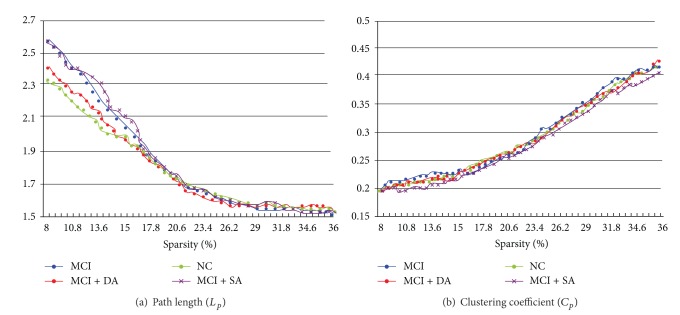
As an intermediate state between normal aging and dementia, mild cognitive impairment (MCI) became a hot topic and early treatments can improve disease prognosis. Acupuncture is shown to have possible effect in improving its cognitive defect. However, the underlying neural mechanism of acupuncture and relations between De Qi and different needling depths are still elusive. The present study aimed to explore how acupuncture can exert effect on the reorganization of MCI and to what extent needling depths, associating with De Qi sensations, can influence the acupuncture effects for MCI treatment. Our results presented that MCI patients exhibited losses of small-world attributes indicated by longer characteristic path lengths and larger clustering coefficients, compared with healthy controls. In addition, acupuncture with deep needling can induce much stronger and a wide range of De Qi sensations both in intensity and prevalence. Acupuncture with deep needling showed modulatory effect to compensate the losses of small-world attributes existed in MCI patients while acupuncture with superficial needling did not. Furthermore, acupuncture with deep needling enhanced the nodal centrality primarily in the abnormal regions of MCI including the hippocampus, postcentral cortex as well as anterior cingulate cortex. This study provides evidence to understand neural mechanism underlying acupuncture and the key role of De Qi for MCI treatment.
Figures
References
-
- Blennow K, de Leon MJ, Zetterberg H. Alzheimer’s disease. The Lancet. 2006;368(9533):387–403. - PubMed
-
- Petersen RC, Smith GE, Waring SC, Ivnik RJ, Tangalos EG, Kokmen E. Mild cognitive impairment: clinical characterization and outcome. Archives of Neurology. 1999;56(3):303–308. - PubMed
-
- Petersen RC, Doody R, Kurz A, et al. Current concepts in mild cognitive impairment. Archives of Neurology. 2001;58(12):1985–1992. - PubMed
-
- Kao HSR, Wang M, Yu S, et al. Acupuncture enhancement in clinical symptoms and cognitive-motor abilities of the Alzheimer's disease patients. Neurobiol Aging. 2000;21:p. 79.
-
- Pope SK, Horne MT, Morris MC, et al. Complementary and alternative therapies for Alzheimer’s disease: a conference summary. Alzheimer’s Care Quarterly. 2006;7(1):13–31.
LinkOut - more resources
Full Text Sources
Other Literature Sources
Research Materials
