


Targeting imperfect vaccines against drug-resistance determinants: a strategy for countering the rise of drug resistance
- PMID: 23935910
- PMCID: PMC3723804
- DOI: 10.1371/journal.pone.0068940
Targeting imperfect vaccines against drug-resistance determinants: a strategy for countering the rise of drug resistance
Abstract
The growing prevalence of antimicrobial resistance in major pathogens is outpacing discovery of new antimicrobial classes. Vaccines mitigate the effect of antimicrobial resistance by reducing the need for treatment, but vaccines for many drug-resistant pathogens remain undiscovered or have limited efficacy, in part because some vaccines selectively favor pathogen strains that escape vaccine-induced immunity. A strain with even a modest advantage in vaccinated hosts can have high fitness in a population with high vaccine coverage, which can offset a strong selection pressure such as antimicrobial use that occurs in a small fraction of hosts. We propose a strategy to target vaccines against drug-resistant pathogens, by using resistance-conferring proteins as antigens in multicomponent vaccines. Resistance determinants may be weakly immunogenic, offering only modest specific protection against resistant strains. Therefore, we assess here how varying the specific efficacy of the vaccine against resistant strains would affect the proportion of drug-resistant vs. -sensitive strains population-wide for three pathogens--Streptococcus pneumoniae, Staphylococcus aureus, and influenza virus--in which drug resistance is a problem. Notably, if such vaccines confer even slightly higher protection (additional efficacy between 1% and 8%) against resistant variants than sensitive ones, they may be an effective tool in controlling the rise of resistant strains, given current levels of use for many antimicrobial agents. We show that the population-wide impact of such vaccines depends on the additional effect on resistant strains and on the overall effect (against all strains). Resistance-conferring accessory gene products or resistant alleles of essential genes could be valuable as components of vaccines even if their specific protective effect is weak.
Conflict of interest statement
Figures
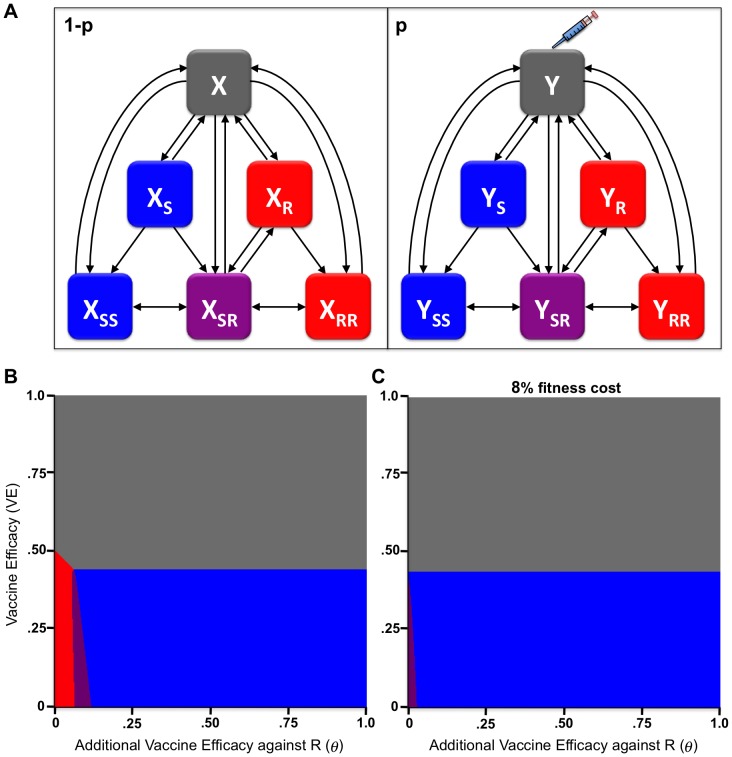
 of the population vaccinated and initially susceptible (
 ) and
) and  unvaccinated and initially susceptible (
 ), who can get infected with either the drug-sensitive strain (
 subscript), –resistant strain (
 subscript), or both (
 subscript) strains. Plots depict model state at equilibrium (all drug-resistant, all drug-sensitive, stable co-existence of both strains, or elimination of all strains) across a range of overall vaccine efficacy (
 ) and additional vaccine efficacy against resistant strain (
 ), where vaccine coverage is 80%. Plots show situation with no fitness cost (b) and with 8% fitness cost (c). Color scheme throughout the paper is as follows: uninfected (gray), sensitive (blue), resistant (red), co-infected with both strains/coexistence of both strains (purple). This model corresponds to Model E of Ref .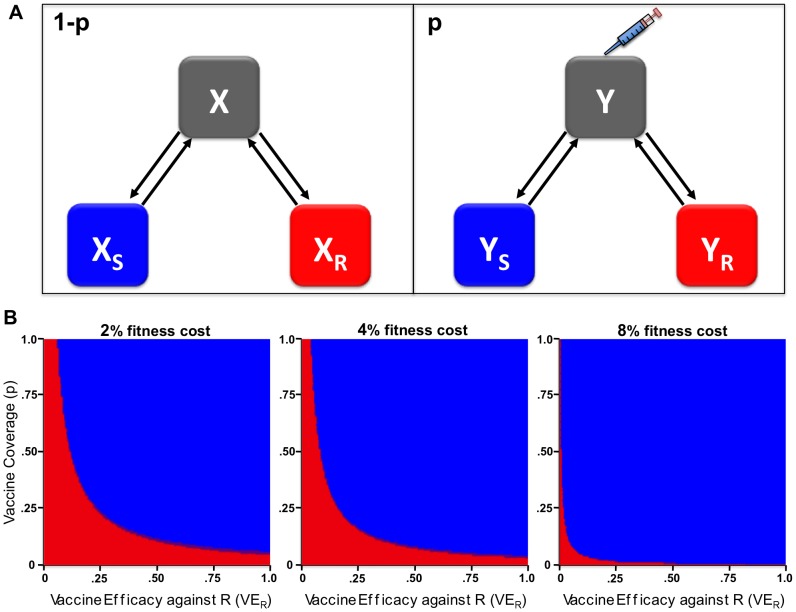
 of the population as vaccinated susceptibles (
 ) and
) and  as unvaccinated susceptibles (
 ), who can get colonized with either the drug-sensitive (
 subscript), or –resistant (
 subscript) strain. b, Contour plot of equilibrium stability conditions as a function of vaccine coverage (
 ) and specific vaccine efficacy against resistant strain (
 ), for 3 fitness costs. Stability conditions for the resistant-only and sensitive-only equilibrium were obtained analytically and were mutually exclusive. The stable equilibrium state is plotted by color as a function of fitness cost (different panels), vaccine efficacy against the resistant strain (x-axis) and vaccine coverage (y-axis).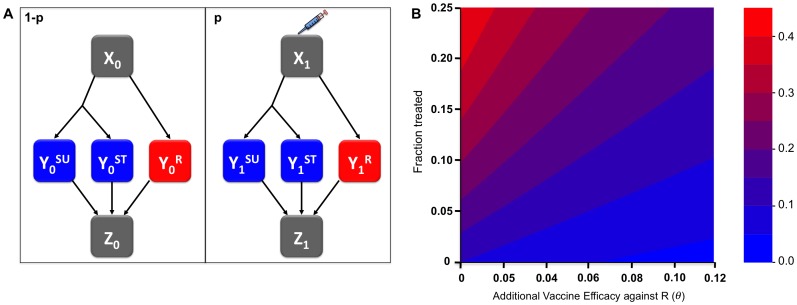
 of the population as vaccinated susceptibles (
 subscript) and
  as unvaccinated susceptibles (
 subscript), who can get infected with either the drug-sensitive (
 superscript) or –resistant (
 superscript) strains, get treated (
 superscript) or not (
 superscript) and are removed due to recovery or death (
 ). This is the model of Ref. , modified to include vaccination. b, Model evaluations for final cumulative proportion resistant among all infections over the course of one season, as a function of the additional vaccine efficacy
  against resistant, compared to sensitive strains (x-axis) and the fraction of influenza infections treated (y-axis). Here, vaccine coverage is 40% and
  = 59%.
References
-
- Andersson DI, Levin BR (1999) The biological cost of antibiotic resistance. Curr Opin Microbiol 2: 489–493. - PubMed
-
- Levin BR, Lipsitch M, Perrot V, Schrag S, Antia R, et al. (1997) The population genetics of antibiotic resistance. Clinical Infectious Diseases 24: S9–16. - PubMed
-
- Lipsitch M (2001) The rise and fall of antimicrobial resistance. Trends Microbiol 9: 438–444. - PubMed
Publication types
MeSH terms
Substances
Grants and funding
LinkOut - more resources
Full Text Sources
Other Literature Sources
Medical
