. 2013 Jul 23;8(7):e69782.
doi: 10.1371/journal.pone.0069782. Print 2013.

The C57BL/6J mouse exhibits sporadic congenital portosystemic shunts

Affiliations

The C57BL/6J mouse exhibits sporadic congenital portosystemic shunts

Cristina Cudalbu et al. PLoS One. .

Abstract

C57BL/6 mice are the most widely used strain of laboratory mice. Using in vivo proton Magnetic Resonance Spectroscopy ((1)H MRS), we have repeatedly observed an abnormal neurochemical profile in the brains of both wild-type and genetically modified mice derived from the C57BL/6J strain, consisting of a several fold increase in cerebral glutamine and two fold decrease in myo-inositol. This strikingly abnormal neurochemical "phenotype" resembles that observed in chronic liver disease or portosystemic shunting and appeared to be independent of transgene, origin or chow and was not associated with liver failure. As many as 25% of animals displayed the abnormal neurochemical profile, questioning the reliability of this model for neurobiology. We conducted an independent study to determine if this neurochemical profile was associated with portosystemic shunting. Our results showed that 100% of the mice with high brain glutamine displayed portosystemic shunting by concomitant portal angiography while all mice with normal brain glutamine did not. Since portosystemic shunting is known to cause alterations in gene expression in many organs including the brain, we conclude that portosystemic shunting may be the most significant problem associated with C57BL/6J inbreeding both for its effect on the central nervous system and for its systemic repercussions.


Conflict of interest statement

Competing Interests: The authors have declared that no competing interests exist.

Figures

Figure 1
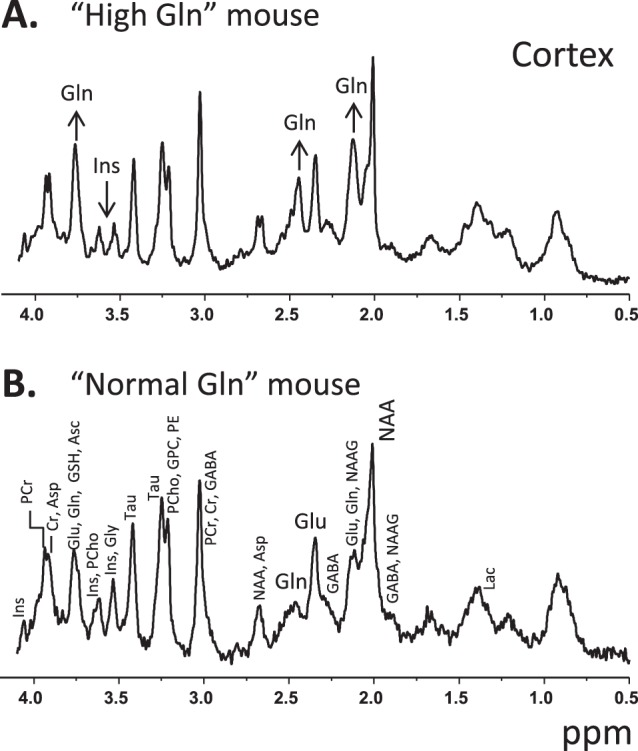
Figure 1. Representative in vivo spectra acquired at 14.1T in the cortex (VOI = 0.8×4×1.2 mm3) of “High Gln” (A) and “Normal Gln” (B) C57BL/6J mice.
The increase of Gln and decrease of Ins in the cortex of the “High Gln” mouse is visually apparent. Only those metabolites displaying a concentration change are labeled (i.e. Gln and Ins) for the “High Gln” spectrum.
Figure 2
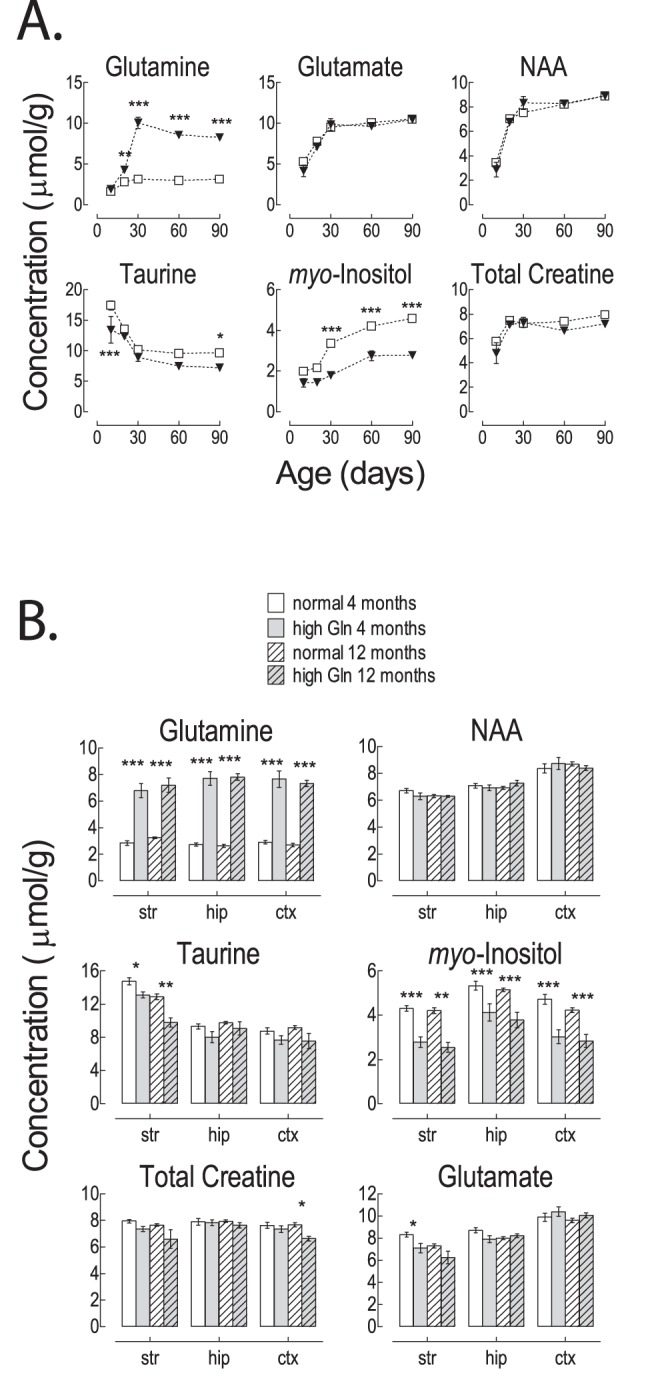
Figure 2. In vivo 1H MRS results obtained in the brain of “High Gln” and “Normal Gln” C57BL/6J mice.
A) Evolution of brain metabolite concentrations during mouse development at P 10, 20, 30, 60 and 90; open squares indicate “Normal Gln” mice and triangles indicate “High Gln” mice; and B) metabolite concentrations in the striatum (str), hippocampus (hip) and cortex (ctx) of “High Gln” and “Normal Gln” C57BL/6 mice at 4 and 12 months of age. Two-way ANOVA was performed at 5 developmental time-points (ages P10 to P90) comparing the “High Gln” mice to “Normal Gln” mice for each metabolite. Statistically significant differences for Gln, Tau and Ins between “High Gln” and “Normal Gln” mice (df = 1, F value between 23.6 and 625) are marked *(p<0.05), **(p<0.01) and ***(p<0.001). The age comparison showed statistical differences for all plotted metabolites (p<0.0001, df = 4, F value between 19.2 and 139) (not shown). We observed statistically significant age-dependent differences between groups for Ins and Gln (p = 0.002 and p<0.0001 respectively, df = 4, F value 4.47 and 66.7, respectively) (not shown). In adult mice two-way ANOVA was performed for each neurochemical at each age (4 and 12 months) in 2 groups (“High Gln” vs “Normal Gln” mice)×3 brain areas. Statistically significant differences for Gln, Glu, Tau, Ins and tCr between “High Gln” and “Normal Gln” mice (df = 1, F value between 14 and 519) are marked *(p<0.05), **(p<0.01) and ***(p<0.001). Additionally, the brain regions comparison showed statistical differences for some of the plotted metabolites (Glu, NAA, Tau, Ins p<0.001, df = 2, F value between 10 and 87) (not shown). Lac: lactate, GABA: γ-aminobutyrate, NAAG: N-acetylaspartylglutamate, NAA: N-acetylaspartate, Gln: glutamine, Glu: glutamate, Asp: aspartate, Cr: creatine, PCr: phosphocreatine, PE: phosphoethanolamine, PCho: phosphocholine, GPC: glycerophosphocholine, Tau: taurine, Ins: myo-inositol, Gly: glycine, GSH: glutathione, Asc: ascorbate.
Figure 3
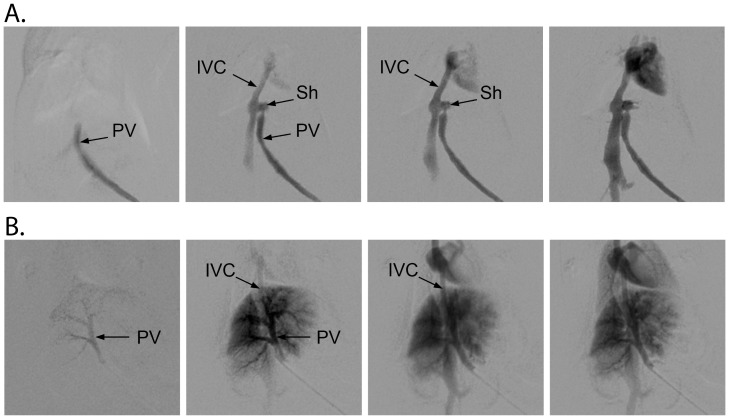
Figure 3. Representative angiographies obtained in a “High Gln” mouse (A) and in a “Normal Gln” (B) C57BL/6J mouse.
Normal filling of the portal tree is visible in B. In A, injection in the superior mesenteric vein leads to immediate filling of the inferior vena cava. Inferior vena cava (IVC), portal vein (PV), shunt (Sh).
Figure 4
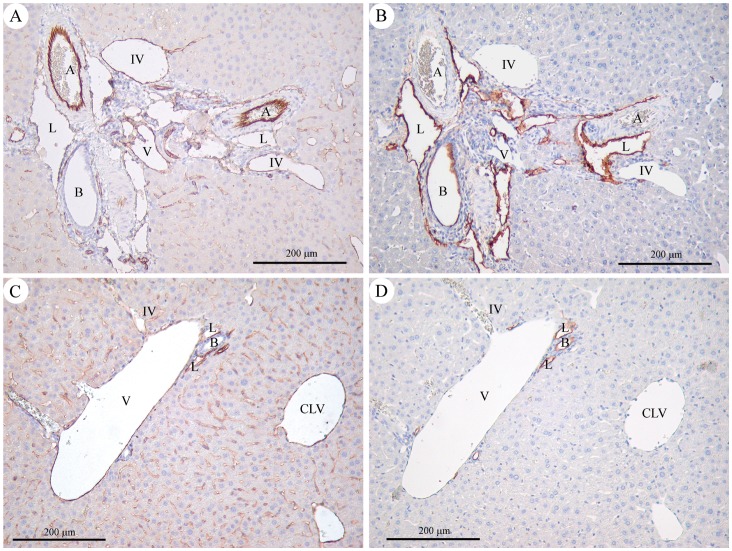
Figure 4. Representative immunohistochemistry findings in a “High Gln” mouse (A, B) and in a “Normal Gln” mouse (C, D).
Original magnification 100x. A and C: CD31 immunostaining highlights endothelial cells. In the “High Gln” mouse (A), the hepatic artery branch is of normal size, similar to that of the interlobular bile duct; the portal vein is small and hypoplastic, and the inlet venules are dilated. In the “Normal Gln” mouse (C), the portal vein is large, with a normal size ratio to the interlobular bile duct (the hepatic artery branch is not seen in this section). The inlet venule is thin. B and D: D2–40 expression confirms the lymphatic nature of the dilated channels at the periphery of the portal tracts in the “High Gln” mouse (B), being selectively reactive in lymphatic endothelial cells, contrary to arterial and venous endothelial cells. Of note, D2–40 (podoplanin) reactivity is also seen in bile duct epithelium. Abbreviations: A = hepatic artery; B = interlobular bile duct; CLV = centrilobular vein; IV = inlet venule; L = lymphatic vessel; V = portal vein.

References

    1. Zurita E, Chagoyen M, Cantero M, Alonso R, Gonzalez-Neira A, et al. (2011) Genetic polymorphisms among C57BL/6 mouse inbred strains. Transgenic Res 20: 481–489. - PubMed
    1. Matsuo N, Takao K, Nakanishi K, Yamasaki N, Tanda K, et al. (2010) Behavioral profiles of three C57BL/6 substrains. Front Behav Neurosci 4: 29. - PMC - PubMed
    1. Kiselycznyk C, Holmes A (2011) All (C57BL/6) Mice are not Created Equal. Front Neurosci 5: 10. - PMC - PubMed
    1. Bryant CD (2011) The blessings and curses of C57BL/6 substrains in mouse genetic studies. Ann N Y Acad Sci 1245: 31–33. - PMC - PubMed
    1. Bryant CD, Zhang NN, Sokoloff G, Fanselow MS, Ennes HS, et al. (2008) Behavioral differences among C57BL/6 substrains: implications for transgenic and knockout studies. J Neurogenet 22: 315–331. - PMC - PubMed

Publication types