. 2013 Jul 30;8(7):e70468.
doi: 10.1371/journal.pone.0070468. Print 2013.

Reduced heart rate variability in social anxiety disorder: associations with gender and symptom severity

Affiliations

Reduced heart rate variability in social anxiety disorder: associations with gender and symptom severity

Gail A Alvares et al. PLoS One. .

Abstract

Background: Polyvagal theory emphasizes that autonomic nervous system functioning plays a key role in social behavior and emotion. The theory predicts that psychiatric disorders of social dysfunction are associated with reduced heart rate variability, an index of autonomic control, as well as social inhibition and avoidance. The purpose of this study was to examine whether heart rate variability was reduced in treatment-seeking patients diagnosed with social anxiety disorder, a disorder characterized by social fear and avoidance.

Methods: Social anxiety patients (n = 53) were recruited prior to receiving psychological therapy. Healthy volunteers were recruited through the University of Sydney and the general community and were matched by gender and age (n = 53). Heart rate variability was assessed during a five-minute recording at rest, with participants completing a range of self-report clinical symptom measures.

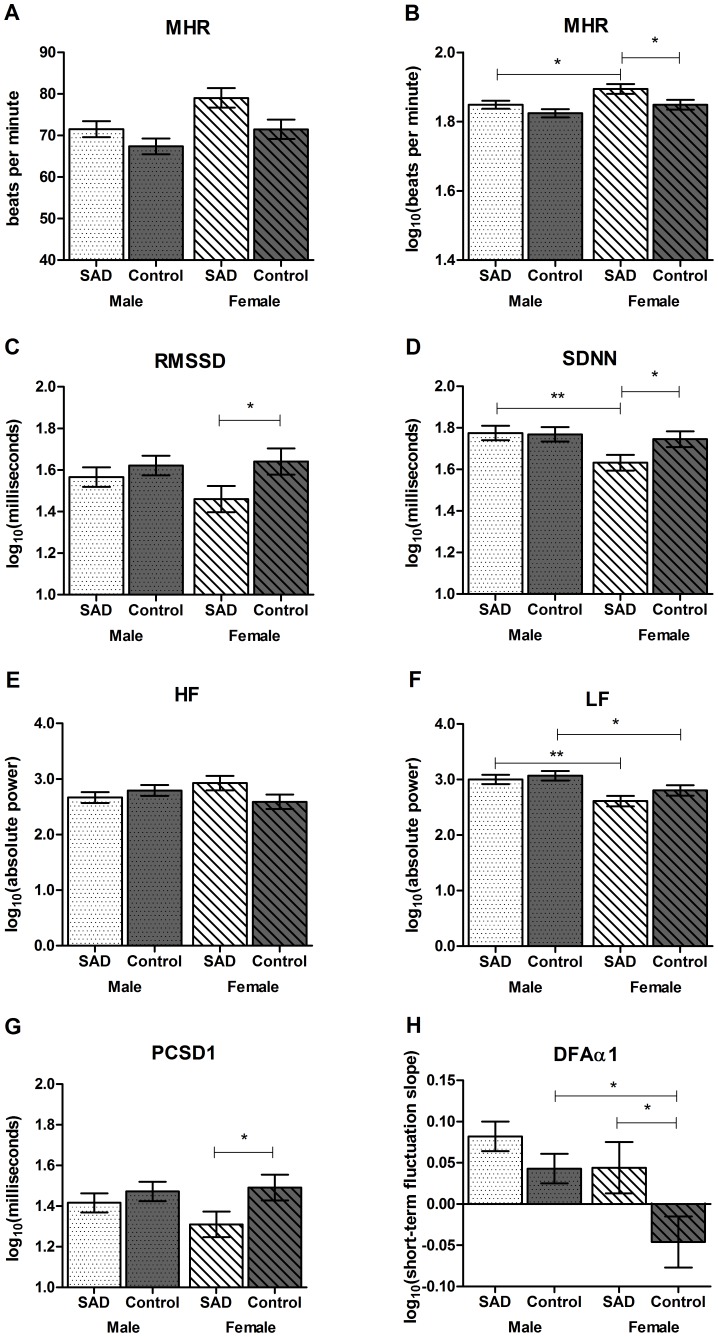
Results: Compared to controls, participants with social anxiety exhibited significant reductions across a number of heart rate variability measures. Reductions in heart rate variability were observed in females with social anxiety, compared to female controls, and in patients taking psychotropic medication compared to non-medicated patients. Finally, within the clinical group, we observed significant associations between reduced heart rate variability and increased social interaction anxiety, psychological distress, and harmful alcohol use.

Conclusions: The results of this study confirm that social anxiety disorder is associated with reduced heart rate variability. Resting state heart rate variability may therefore be considered a marker for social approach-related motivation and capacity for social engagement. Additionally, heart rate variability may provide a useful biomarker to explain underlying difficulties with social approach, impaired stress regulation, and behavioral inhibition, especially in disorders associated with significant impairments in these domains.


Conflict of interest statement

Competing Interests: Andrew H. Kemp is a PLOS ONE Editorial Board member. Ian B. Hickie is a member of the Medical Advisory Panel for BUPA Health Insurance (Australia) and also a Board Member of Psychosis Australia Trust. From 2012, he is a Commissioner in Australia’s new National Mental Health Commission. He was until January 2012 a director of headspace: the national youth mental health foundation. Professor Hickie was previously the chief executive officer (till 2003) and clinical adviser (till 2006) of beyondblue, an Australian National Depression Initiative. He is supported principally for clinical research in depression and health services and population health initiatives related to anxiety and depression by an NHMRC Australian Medical Research Fellowship (2007–2012). He has led projects for health professionals and the community supported by governmental, community agency and pharmaceutical industry partners (Wyeth, Eli Lily, Servier, Pfizer, AstraZeneca) for the identification and management of depression and anxiety. He has received honoraria for presentations of his own work at educational seminars supported by a number of nongovernment organisations and the pharmaceutical industry (including Pfizer, Servier and Astra Zeneca). He has served on advisory boards convened by the pharmaceutical industry in relation to specific antidepressants, including nefazodone, duloxetine and desvenlafaxine. He leads a new investigator-initiated study of the effects of agomelatine on circadian parameters (supported in part by Servier but also by other NHMRC funding) and has participated in a multicentre clinical trial of the effects of agomelatine on sleep architecture in depression and a Servier supported study of major depression and sleep disturbance in primary care settings. In addition to national and international government-based grant bodies, investigator-initiated mental health research at the BMRI, he has been supported by various pharmaceutical manufacturers (including Servier and Pfizer) and not-for-profit entities (including the Heart Foundation, beyondblue and the BUPA Foundation). None of these declared interests alter the authors’ adherence to all the PLOS ONE policies on sharing data and materials.

Figures

Figure 1
Figure 1. Comparison of resting heart rate variability between males and females with social anxiety, compared to controls, across mean heart rate (row 1), as well as time (row 2), frequency (row 3), and non-linear (row 4) domains.
Note. All variables are log-transformed (base 10), except for A (which depicts untransformed beats per minute). Error bars depict standard error of the mean. Significance taken from multivariate analysis of variance with group and gender entered as between subjects variables. Significance tests were not conducted on untransformed mean heart rate. MHR = mean heart rate, beats/min, SDNN = standard deviation of all R-R intervals, RMSSD = square root of mean squared differences of successive R-R intervals, LF = low frequency, HF = high frequency, PCSD1 =  standard deviation of the Poincaré plot perpendicular to the line of identity, DFAα1 =  detrended fluctuation analysis of the short-fluctuation slope. *p<.05, **p<.01.

References

    1. Kawachi I, Sparrow D, Vokonas P, Weiss S (1994) Symptoms of anxiety and risk of coronary heart disease. The Normative Aging Study. Circulation 90: 2225–2229. - PubMed
    1. Friedman B (2007) An autonomic flexibility–neurovisceral integration model of anxiety and cardiac vagal tone. Biological Psychology 74: 185–199. - PubMed
    1. Vogelzangs N, Seldenrijk A, Beekman ATF, van Hout HPJ, de Jonge P, et al. (2010) Cardiovascular disease in persons with depressive and anxiety disorders. Journal of Affective Disorders 125: 241–248. - PMC - PubMed
    1. Kessler RC, Berglund P, Demler O, Jin R, Merikangas K, et al. (2005) Lifetime prevalence and age-of-onset distributions of DSM-IV disorders in the National Comorbidity Survey Replication. Archives of General Psychiatry 62: 593–602. - PubMed
    1. Clark DM, Wells A (1995) A cognitive model of social phobia. In: Heimberg R, Liebowitz M, Hope DA, Schneier FR, editors. Social phobia: Diagnosis, assessment and treatment. New York: Guilford Press. 69–93.

Publication types

Substances