


Rapid and sensitive detection of novel avian-origin influenza A (H7N9) virus by reverse transcription loop-mediated isothermal amplification combined with a lateral-flow device
- PMID: 23936359
- PMCID: PMC3731295
- DOI: 10.1371/journal.pone.0069941
Rapid and sensitive detection of novel avian-origin influenza A (H7N9) virus by reverse transcription loop-mediated isothermal amplification combined with a lateral-flow device
Abstract
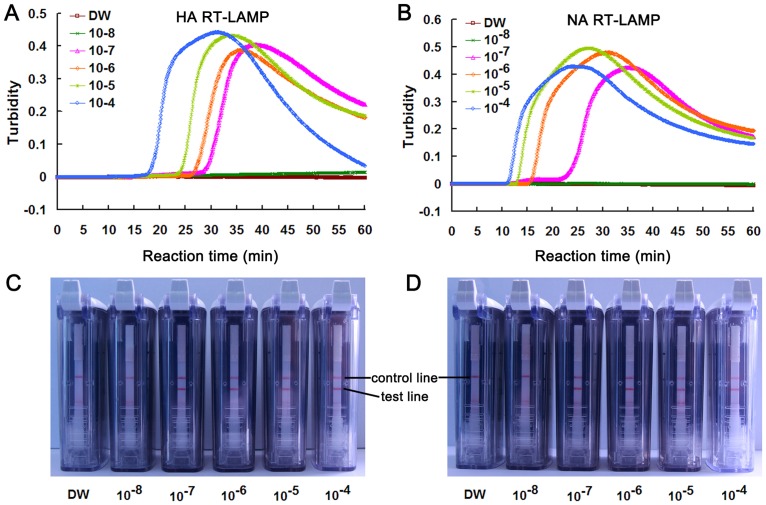
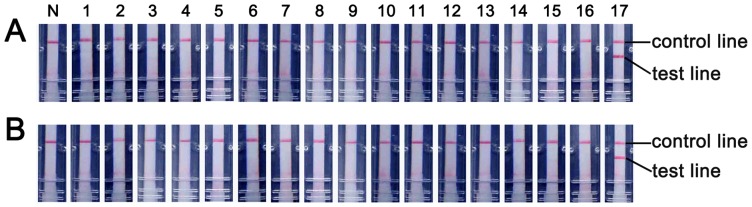
A severe disease in humans caused by a novel avian-origin influenza A (H7N9) virus emerged in China recently, which has caused at least 128 cases and 26 deaths. Rapid detection of the novel H7N9 virus is urgently needed to differentiate the disease from other infections, and to facilitate infection control as well as epidemiologic investigations. In this study, a reverse transcription loop-mediated isothermal amplification combined with a lateral flow device (RT-LAMP-LFD) assay to rapidly detect H7N9 virus was developed and evaluated. The RT-LAMP primers were designed to target the haemagglutinin (HA) and neuraminidase (NA) genes of H7N9 virus. Results of 10-fold dilution series assays showed that analysis of RT-LAMP products by the LFD method was as sensitive as real-time turbidity detection, and that the analytic sensitivities of the HA and NA RT-LAMP assays were both 10 copies of synthetic RNA. Furthermore, both the assays showed 100% clinical specificity for identification of H7N9 virus. The performance characteristics of the RT-LAMP-LFD assay were evaluated with 80 clinical specimens collected from suspected H7N9 patients. The NA RT-LAMP-LFD assay was more sensitive than real time RT-PCR assay. Compared with a combination of virus culture and real-time RT-PCR, the sensitivity, specificity, positive predictive value, and negative predictive value of the RT-LAMP-LFD assay were all 100%. Overall, The RT-LAMP-LFD assay established in this study can be used as a reliable method for early diagnosis of the avian-origin influenza A (H7N9) virus infection.
Conflict of interest statement
Figures
References
-
- Gao R, Cao B, Hu Y, Feng Z, Wang D, et al. (2013) Human infection with a novel avian-origin influenza A (H7N9) virus. N Engl J Med 368: 1888–1897. - PubMed
-
- WHO (2013) Human infection with influenza A (H7N9) virus in China – update. Available: http://www.who.int/csr/don/2013_05_02/en/index.html. Accessed 2013 May 2.
-
- WHO (2013) Real-time RT-PCR Protocol for the Detection of Avian Influenza A (H7N9) Virus. Available: http://www.who.int/influenza/gisrs_laboratory/cnic_realtime_rt_pcr_proto.... Accessed 2013 May 2.
Publication types
MeSH terms
LinkOut - more resources
Full Text Sources
Other Literature Sources
Medical
