


Does clinical management improve outcomes following self-harm? Results from the multicentre study of self-harm in England
- PMID: 23936430
- PMCID: PMC3731259
- DOI: 10.1371/journal.pone.0070434
Does clinical management improve outcomes following self-harm? Results from the multicentre study of self-harm in England
Abstract
Background: Evidence to guide clinical management of self-harm is sparse, trials have recruited selected samples, and psychological treatments that are suggested in guidelines may not be available in routine practice.
Aims: To examine how the management that patients receive in hospital relates to subsequent outcome.
Methods: We identified episodes of self-harm presenting to three UK centres (Derby, Manchester, Oxford) over a 10 year period (2000 to 2009). We used established data collection systems to investigate the relationship between four aspects of management (psychosocial assessment, medical admission, psychiatric admission, referral for specialist mental health follow up) and repetition of self-harm within 12 months, adjusted for differences in baseline demographic and clinical characteristics.
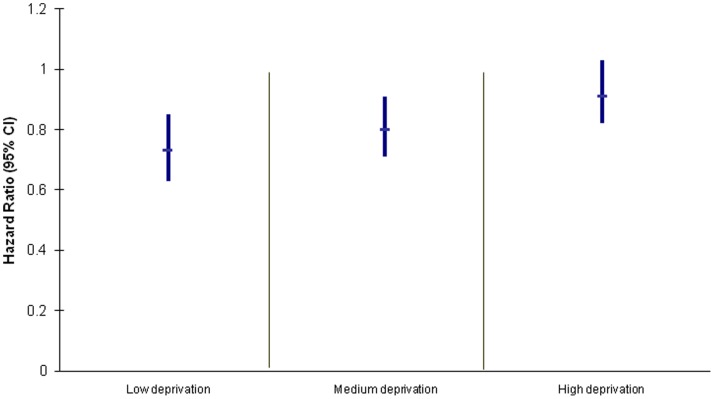
Results: 35,938 individuals presented with self-harm during the study period. In two of the three centres, receiving a psychosocial assessment was associated with a 40% lower risk of repetition, Hazard Ratios (95% CIs): Centre A 0.99 (0.90-1.09); Centre B 0.59 (0.48-0.74); Centre C 0.59 (0.52-0.68). There was little indication that the apparent protective effects were mediated through referral and follow up arrangements. The association between psychosocial assessment and a reduced risk of repetition appeared to be least evident in those from the most deprived areas.
Conclusion: These findings add to the growing body of evidence that thorough assessment is central to the management of self-harm, but further work is needed to elucidate the possible mechanisms and explore the effects in different clinical subgroups.
Conflict of interest statement
Figures
References
-
- Hawton K, Bergen H, Casey D, Simkin S, Palmer B, et al. (2007) Self-harm in England: a tale of three cities. Social Psychiatry and Psychiatric Epidemiology 42: 513–521. - PubMed
-
- NICE (2004) Self-harm: the short-term physical and psychological management and secondary prevention of self-harm in primary and secondary care. Clinical Guideline CG16. National Institute for Health and Clinical Excellence. - PubMed
-
- NICE (2011) Self-harm: longer-term management (full guideline). Clinical Guideline CG133. National Institute for Health and Clinical Excellence.
-
- Royal College of Psychiatrists (2010) Self-harm, suicide and risk: helping people who self-harm. College Report 158. London: Royal College of Psychiatrists.
-
- Kendall T, Taylor C, Bhatti H, Chan M, Kapur N (2011) Longer term management of self harm: summary of NICE guidance. British Medical Journal 343: 7073–7073. - PubMed
Publication types
MeSH terms
Grants and funding
LinkOut - more resources
Full Text Sources
Other Literature Sources
Medical
