Review
doi: 10.1146/annurev-pathol-020712-163936.
Epub 2013 Aug 7.
The influence of innate and adaptive immune responses on atherosclerosis
Affiliations
- PMID: 23937439
- PMCID: PMC3988528
- DOI: 10.1146/annurev-pathol-020712-163936
Item in Clipboard
Review
The influence of innate and adaptive immune responses on atherosclerosis
Annu Rev Pathol.
2014.
Abstract
Both the chronic development of atherosclerotic lesions and the acute changes in lesion phenotype that lead to clinical cardiovascular events are significantly influenced by the innate and adaptive immune responses to lipoprotein deposition and oxidation in the arterial wall. The rapid pace of discovery of mechanisms of immunologic recognition, effector functions, and regulation has significantly influenced the study of atherosclerosis, and our new knowledge is beginning to affect how we treat this ubiquitous disease. In this review, we discuss recent advances in our understanding of how innate and adaptive immunity contribute to atherosclerosis, as well as therapeutic opportunities that arise from this knowledge.
Figures
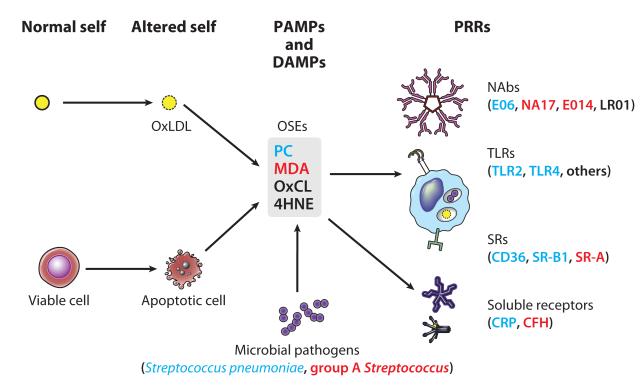
Summary of oxidation-specific epitopes (OSEs) as major antigens of innate immunity. Oxidation-induced changes in normal self-molecules generate OSEs that are recognized as damage-associated molecular patterns (DAMPs) by the innate immune system. OSEs are also found on apoptotic cells and on microbes (or molecular mimics), where they serve as pathogen-associated molecular patterns (PAMPs). Oxidation of low-density lipoprotein (LDL), which occurs in atherosclerotic lesions, generates several OSEs, such as exposed phosphocholine (PC), malondialdehyde (MDA), oxidized cardiolipin (OxCL), and 4-hydroxynonenal (4HNE). These DAMPs are recognized by various pattern recognition receptors (PRRs) of the innate immune system. For example, PC on OxLDL, apoptotic cells, and Streptococcus pneumoniae is recognized by the innate immunoglobulin M (IgM) natural antibody (NAb) E06, the scavenger receptors (SRs) CD36 and SR-B1, and the pentraxin C-reactive protein (CRP). MDA is recognized by the NAbs E014 and NA17, SR-A, and complement factor H (CFH). An MDA mimic recognized by E014 is found on group A Streptococcus. These OSEs and others are present in atherosclerotic lesions and act as major antigens stimulating innate and adaptive responses that affect the progression of vascular disease.
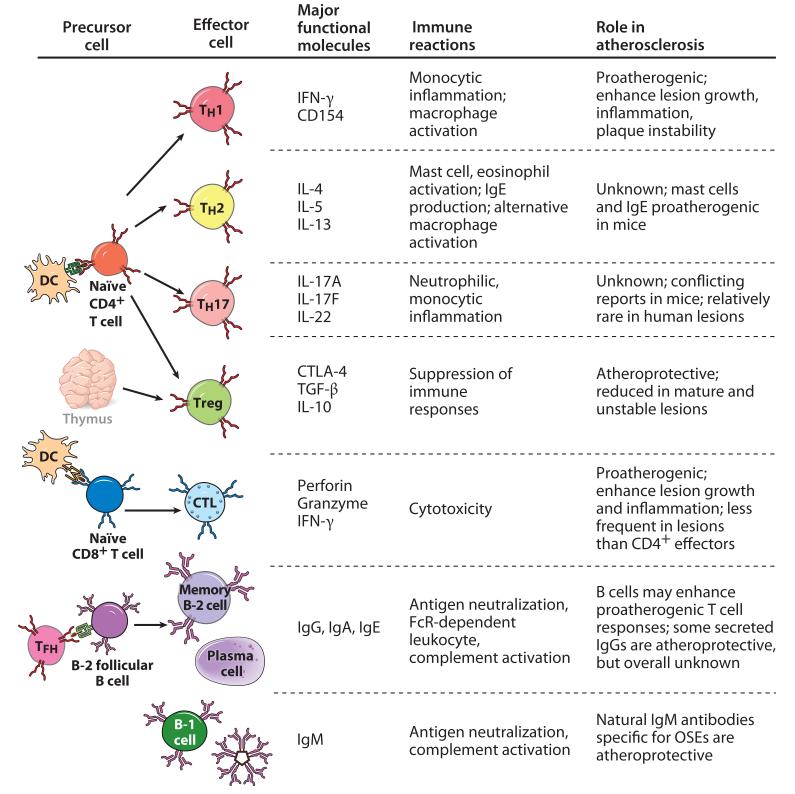
Lymphocyte effector cells and their role in atherosclerosis. CD4+ helper T (TH) cells differentiate from näive CD4+ T cells in response to antigen presentation by dendritic cells (DCs) and include TH1, TH2, and TH17 subsets defined by the cytokines they produce. Likewise, cytotoxic T lymphocytes (CTLs) are derived from antigen-stimulated näive CD8+ T cell precursors. The evidence from mouse models has clearly established that TH1 cells exert proatherogenic effects, but the impact of TH17 or TH2 cells is not clear. CTLs, which kill antigen-bearing target cells and secrete interferon (IFN)-γ, contribute to lesion growth and inflammation. CD4+ regulatory T cells (Tregs), which may be derived from näive T cells in peripheral lymphoid tissues or develop in thymus, have a profound protective effect against lesion growth and inflammation. B-2 cells that recognize proteins or protein-linked antigens receive help from follicular helper T cells (TFH) and differentiate into memory B cells or long-lived plasma cells that secreting high-affinity, isotype-switched antibodies. B-2 cells, but not the antibodies they produce, may promote proatherogenic T cell responses. The overall impact of immunoglobulin G (IgG) secreted by B-2 cells is unknown, although some IgG antibodies to oxidation-specific epitopes (OSEs) provide atheroprotection. In contrast, innate B-1 cells secrete IgM natural antibodies, which overall appear to be atheroprotective. Abbreviations: CTLA, cytotoxic T lymphocyte antigen; IL, interleukin; TGF, transforming growth factor.
References
-
- Hansson GK, Robertson AK, Söderberg-Nauclér C. Inflammation and atherosclerosis. Annu. Rev. Pathol. Mech. Dis. 2006;1:297–329. - PubMed
-
- Tufano A, Di Capua M, Coppola A, Conca P, Cimino E, et al. The infectious burden in atherothrombosis. Semin. Thromb. Hemost. 2012;38:515–23. - PubMed
-
- Wick G, Knoflach M, Xu Q. Autoimmune and inflammatory mechanisms in atherosclerosis. Annu. Rev. Immunol. 2004;22:361–403. - PubMed
Publication types
MeSH terms
Substances
Grants and funding
LinkOut - more resources
Full Text Sources
Other Literature Sources
Medical