. 2013 Nov;18(11):1178-84.
doi: 10.1038/mp.2013.98. Epub 2013 Aug 13.

Detecting large copy number variants using exome genotyping arrays in a large Swedish schizophrenia sample

Affiliations

Detecting large copy number variants using exome genotyping arrays in a large Swedish schizophrenia sample

J P Szatkiewicz et al. Mol Psychiatry. 2013 Nov.

Abstract

Although copy number variants (CNVs) are important in genomic medicine, CNVs have not been systematically assessed for many complex traits. Several large rare CNVs increase risk for schizophrenia (SCZ) and autism and often demonstrate pleiotropic effects; however, their frequencies in the general population and other complex traits are unknown. Genotyping large numbers of samples is essential for progress. Large cohorts from many different diseases are being genotyped using exome-focused arrays designed to detect uncommon or rare protein-altering sequence variation. Although these arrays were not designed for CNV detection, the hybridization intensity data generated in each experiment could, in principle, be used for gene-focused CNV analysis. Our goal was to evaluate the extent to which CNVs can be detected using data from one particular exome array (the Illumina Human Exome Bead Chip). We genotyped 9100 Swedish subjects (3962 cases with SCZ and 5138 controls) using both standard genome-wide association study (GWAS) and exome arrays. In comparison with CNVs detected using GWAS arrays, we observed high sensitivity and specificity for detecting genic CNVs 400 kb including known pathogenic CNVs along with replicating the literature finding that cases with SCZ had greater enrichment for genic CNVs. Our data confirm the association of SCZ with 16p11.2 duplications and 22q11.2 deletions, and suggest a novel association with deletions at 11q12.2. Our results suggest the utility of exome-focused arrays in surveying large genic CNVs in very large samples; and thereby open the door for new opportunities such as conducting well-powered CNV assessment and comparisons between different diseases. The use of a single platform also minimizes potential confounding factors that could impact accurate detection.


Conflict of interest statement

Conflict of Interest

Dr Sullivan was on the SAB of Expression Analysis (Durham, NC, USA). The other authors report no financial conflicts of interest.

Figures
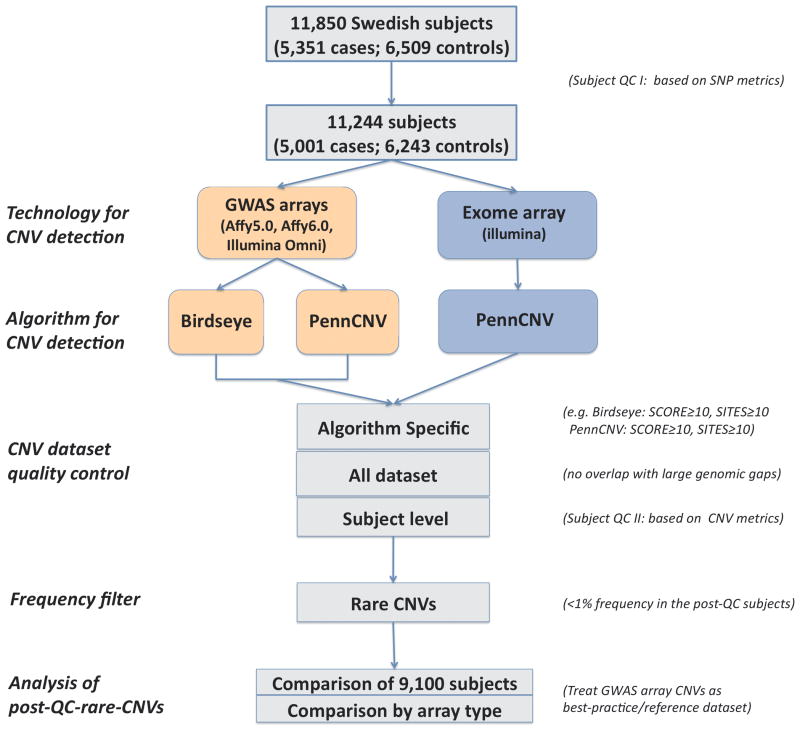
Figure 1
Figure 1
Experimental workflow and CNV datasets.
Figure 2
Figure 2. Probe content comparison genome-wide and in genes
Figure (2a) shows a barplot comparing the number of probes (blue, Y-axis on the left) and the proportion of probes in genes (cyan, Y-axis on the right) between exome and GWAS arrays. Figure (2b) shows a barplot comparing probe density genome-wide (green) and within genes (gold). Within genes, the exome array has a higher mean probe density (3.85 probes/20 kb) than Affymetrix 5.0 (2.93 probes/20kb) but lower than high-density GWAS chips (12.47 probes/20kb for Affymetrix 6.0 and 5.23 probes/20kb for Omin Express).
Figure 3
Figure 3. Example CNVs detected by the exome array in 16p11.2 and 22q11.2
In each sub-figure (3a:16p11.2; 3b:22q11.2), the X-axis indicates genomic position of exome array probes and the Y-axis indicates the values of LRR (top panel) or BAF (bottom panel). Red vertical lines: CNV boundaries predicted from GWAS chips. Blue dots: exome array probes involved in 16p11.2 duplication (3a). Red dots: exome array probes involved in 22q11.2 deletion (3b). Black dots: probes of normal copy. Additional examples are provided in Figure S3.
Figure 4
Figure 4
Summary results for comparing CNV calls between Exome and GWAS arrays. GWAS array CNVs were used as the reference for all comparisons. Comparisons were stratified by CNV type (all CNVs in black, deletions in red, and duplications in blue) and by size (x-axis). Sensitivity and specificity.(4a) Sensitivity to detect any GWAS CNVs. (4b) Specificity of the exome array CNV dataset to detect any GWAS CNV, estimated by computing the proportion of exome array CNVs overlapping any GWAS CNVs for each size bin of the exome array CNVs. (4c) Sensitivity to detect GWAS CNVs limited to genic CNVs and accounting for probe coverage (intersect ≥1 gene and ≥1 exome array probe/20kb of its length). (4d) Specificity of the exome array CNV dataset compared to genic CNVs from GWAS arrays. Burden tests. The y-axis shows fold changes for CNV burden of cases versus controls, and the x-axes indicate CNV size bins (total numbers of CNVs per bin in parentheses).(4e) Burden test using genic CNVs from the GWAS dataset. (4f) Burden test using genic CNVs from the exome array dataset. Note that the X-axes stop at the particular bin when the total numbers of CNVs per bin (in parentheses) are comparable between (4e) and (4f) and hence the total number of bins displayed in (4e) and (4f) are different.

References

    1. Stankiewicz P, Lupski JR. Structural variation in the human genome and its role in disease. Annu Rev Med. 2010;61:437–455. - PubMed
    1. Levinson DF, Duan J, Oh S, Wang K, Sanders AR, Shi J, et al. Copy number variants in schizophrenia: Confirmation of five previous findings and new evidence for 3q29 microdeletions and VIPR2 duplications. Am J Psychiatry. 2011 Feb 1;168:302–316. - PMC - PubMed
    1. Sanders SJ, Ercan-Sencicek AG, Hus V, Luo R, Murtha MT, Moreno-De-Luca D, et al. Multiple Recurrent De Novo CNVs, Including Duplications of the 7q11.23 Williams Syndrome Region, Are Strongly Associated with Autism. Neuron. 2011 Jun 9;70(5):863–885. - PMC - PubMed
    1. Cooper GM, Coe BP, Girirajan S, Rosenfeld JA, Vu TH, Baker C, et al. A copy number variation morbidity map of developmental delay. Nature genetics. 2011 Sep;43(9):838–846. - PMC - PubMed
    1. Sullivan PF, Daly MJ, O'Donovan M. Genetic architectures of psychiatric disorders: the emerging picture and its implications. Nature Reviews Genetics. 2012;13:537–551. - PMC - PubMed

Publication types
