. 2013:4:2292.
doi: 10.1038/ncomms3292.

Identification and design principles of low hole effective mass p-type transparent conducting oxides

Affiliations
Free PMC article

Identification and design principles of low hole effective mass p-type transparent conducting oxides

Geoffroy Hautier et al. Nat Commun. 2013.
Free PMC article

Abstract

The development of high-performance transparent conducting oxides is critical to many technologies from transparent electronics to solar cells. Whereas n-type transparent conducting oxides are present in many devices, their p-type counterparts are not largely commercialized, as they exhibit much lower carrier mobilities due to the large hole effective masses of most oxides. Here we conduct a high-throughput computational search on thousands of binary and ternary oxides and identify several highly promising compounds displaying exceptionally low hole effective masses (up to an order of magnitude lower than state-of-the-art p-type transparent conducting oxides), as well as wide band gaps. In addition to the discovery of specific compounds, the chemical rationalization of our findings opens new directions, beyond current Cu-based chemistries, for the design and development of future p-type transparent conducting oxides.


Figures
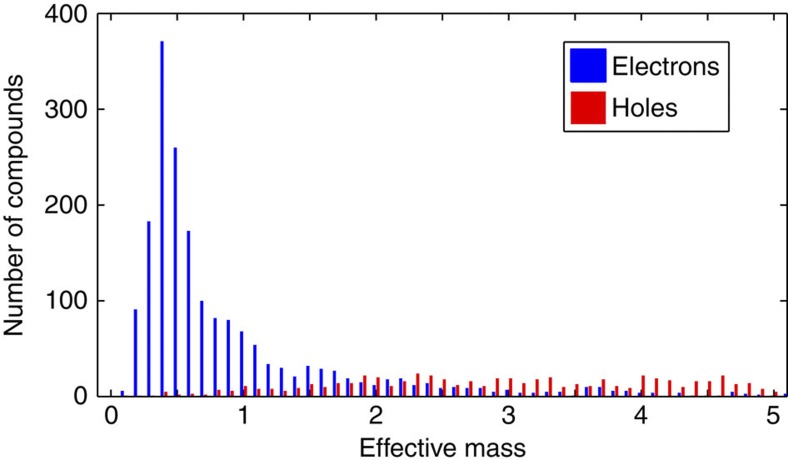
Figure 1
Figure 1. Effective mass distribution for electrons and holes in oxides.
The histogram shows the maximum line effective mass for holes (valence band) in red and electrons (conduction band) in blue in our set of binary and ternary oxides. The effective mass bin size is 0.2 and the figure focuses on the region of low effective mass (lower than 5).
Figure 2
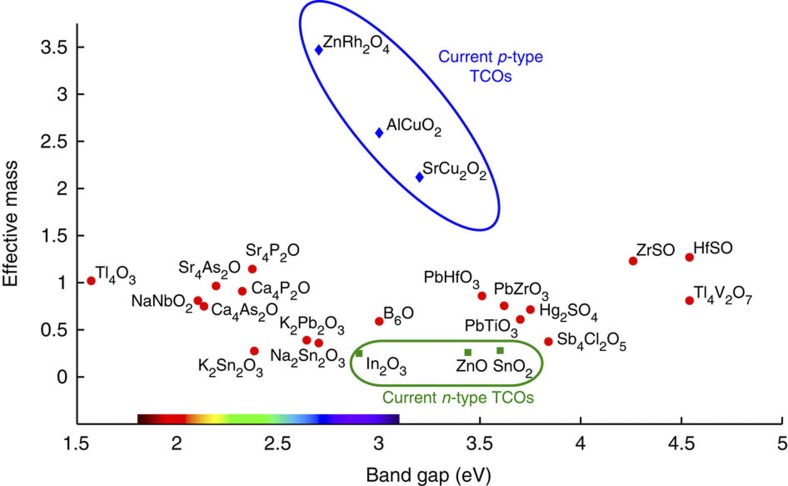
Figure 2. Effective mass versus band gap for the p-type TCO candidates.
We superposed on the band gap axis a colour spectrum corresponding to the wavelength associated with a photon energy. The TCO candidates are marked with red dots. A few known p-type (blue diamonds) and n-type (green square) TCOs can be compared to the new candidates. The best TCOs should lie in the lower right corner. For clarity, we kept only one representative when polymorphs existed for a given stoechiometry (for example, PbTiO3 and K2Sn2O3) and did not plot Rb2Sn2O3, which is superposed on K2Sn2O3.
Figure 3
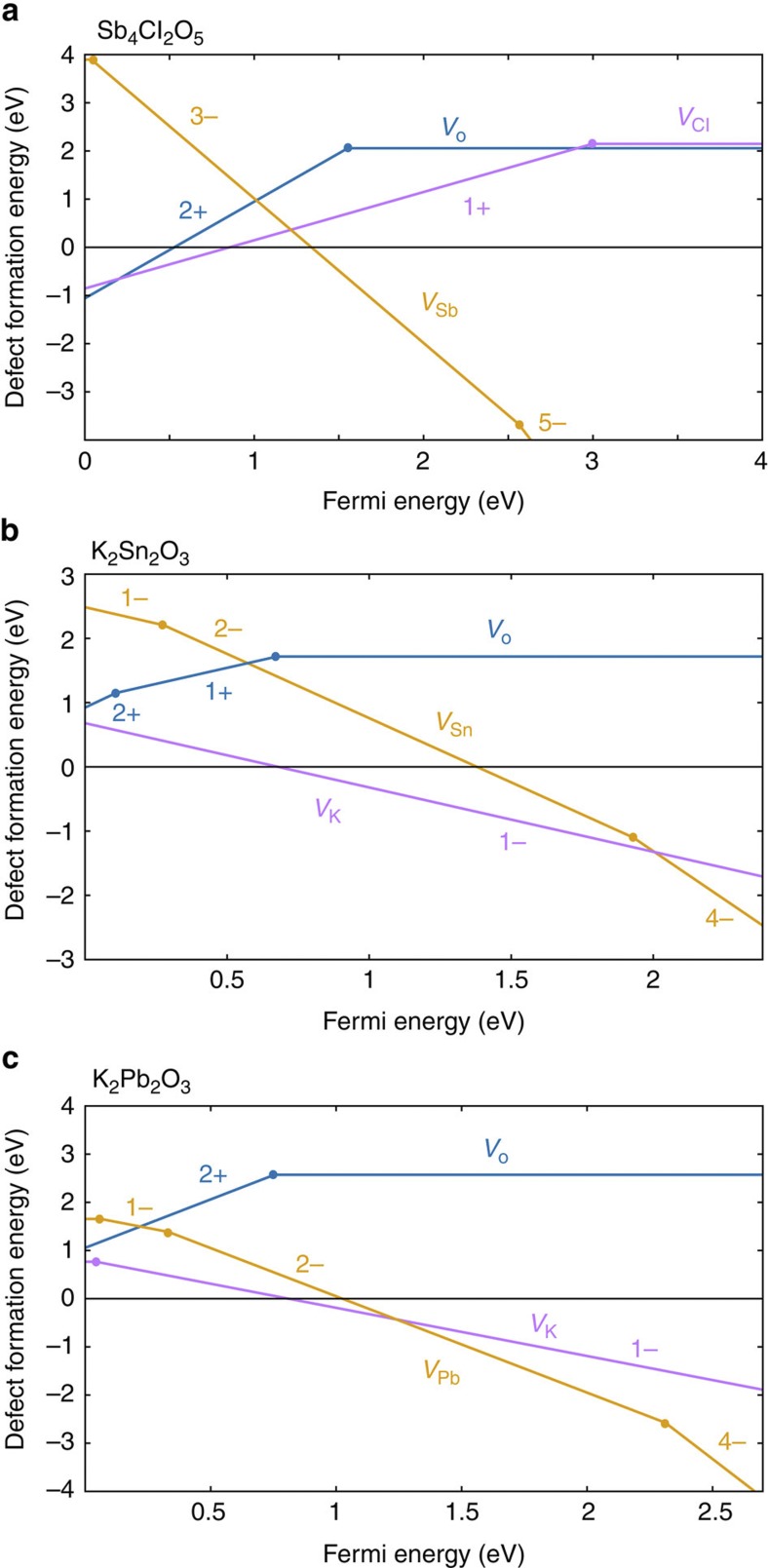
Figure 3. Vacancy formation energy versus Fermi energy.
The panels indicate results for Sb4Cl2O5 (a) K2Sn2O3 (b) and K2Pb2O3 (c). The oxygen vacancy formation energy is indicated by a blue line. The cation vacancies are indicated by orange and purple lines. All defects are calculated in oxidizing conditions. The zero of Fermi energy is the valence band maximum.
Figure 4
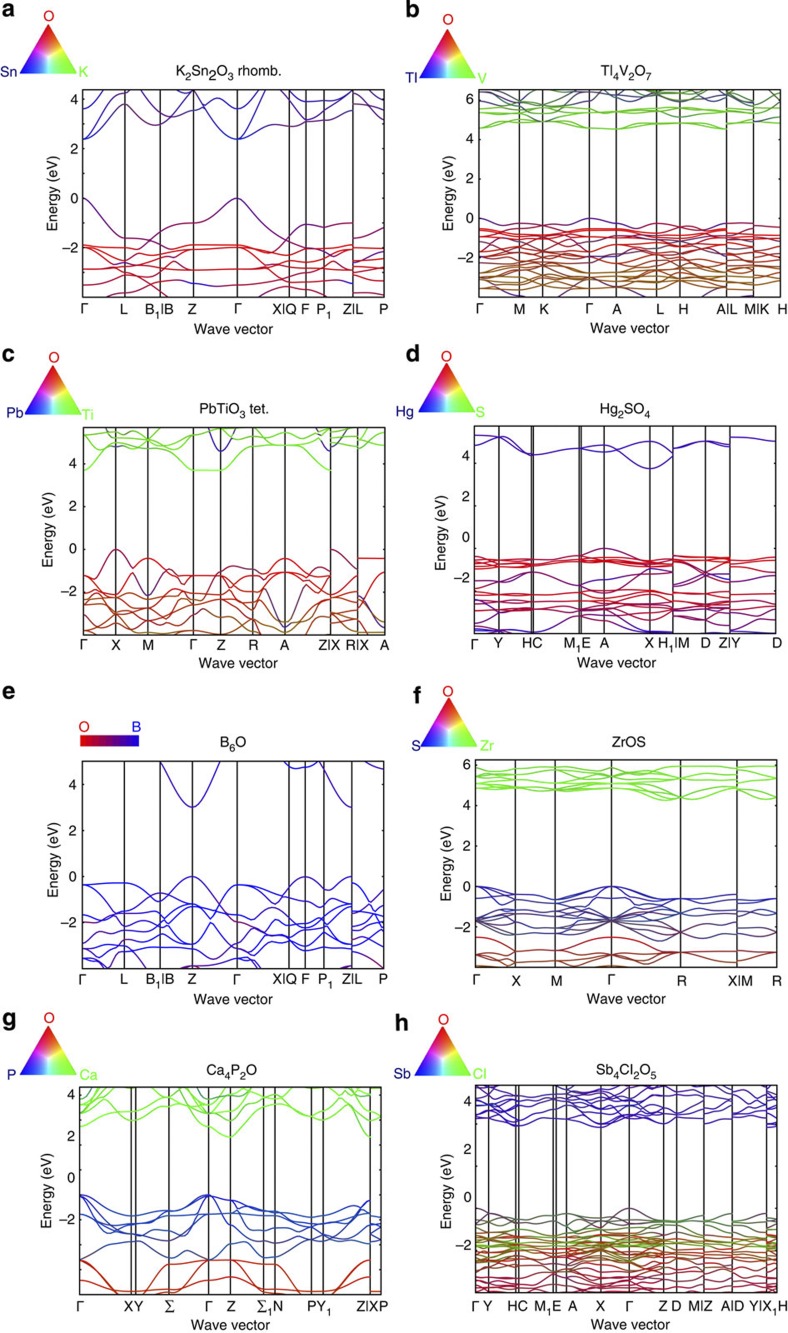
Figure 4. Projected band structures for low hole effective mass oxides.
The panels refer to K2Sn2O3 rhombohedral (a), Tl4V2O7 (b), PbTiO3 tetragonal (c), Hg2SO4 (d), B6O (e), ZrOS (f), Ca4P2O (g), Sb4Cl2O5 (h). The band structures are computed by GGA with a rigid shift of the conduction band (scissor operator) to fit the band gap to the GW value. The colour indicates the character of the bands by projections of the wave function on the different sites. Each element in the ternary compound has one of the red, green or blue colour associated with it and the resulting colour is obtained by mixing them in proportion equivalent to the projections. The red colour is always associated with oxygen. Equivalent Figures without colour scheme but with markers are available in Supplementary Figs S24–S31.

References

    1. Ginley D. S. & Bright C. Transparent conducting oxides. MRS Bull. 25, 15–18 (2000).
    1. Fortunato E., Barquinha P. & Martins R. Oxide semiconductor thin-film transistors: a review of recent advances. Adv. Mater. 24, 2945–2986 (2012). - PubMed
    1. Granqvist C. G. Transparent conductors as solar energy materials: A panoramic review. Sol. Energy Mater. Sol. Cells 91, 1529–1598 (2007).
    1. Ellmer K. Past achievements and future challenges in the development of optically transparent electrodes. Nat. Photonics 6, 809–817 (2012).
    1. Ginley D. S., Hosono H. & Paine D. C. Handbook of Transparent Conductors Springer (2011).

Publication types