. 2013 Nov;41(20):9584-92.
doi: 10.1093/nar/gkt714. Epub 2013 Aug 11.

CRISPR/Cas9 systems targeting β-globin and CCR5 genes have substantial off-target activity

Affiliations

CRISPR/Cas9 systems targeting β-globin and CCR5 genes have substantial off-target activity

Thomas J Cradick et al. Nucleic Acids Res. 2013 Nov.

Abstract

The ability to precisely modify endogenous genes can significantly facilitate biological studies and disease treatment, and the clustered regularly interspaced short palindromic repeats (CRISPR) systems have the potential to be powerful tools for genome engineering. However, the target specificity of CRISPR systems is largely unknown. Here we demonstrate that CRISPR/Cas9 systems targeting the human hemoglobin β and C-C chemokine receptor type 5 genes have substantial off-target cleavage, especially within the hemoglobin δ and C-C chemokine receptor type 2 genes, respectively, causing gross chromosomal deletions. The guide strands of the CRISPR/Cas9 systems were designed to have a range of mismatches with the sequences of potential off-target sites. Off-target analysis was performed using the T7 endonuclease I mutation detection assay and Sanger sequencing. We found that the repair of the on-and off-target cleavage resulted in a wide variety of insertions, deletions and point mutations. Therefore, CRISPR/Cas9 systems need to be carefully designed to avoid potential off-target cleavage sites, including those with mismatches to the 12-bases proximal to the guide strand protospacer-adjacent motif.


Figures
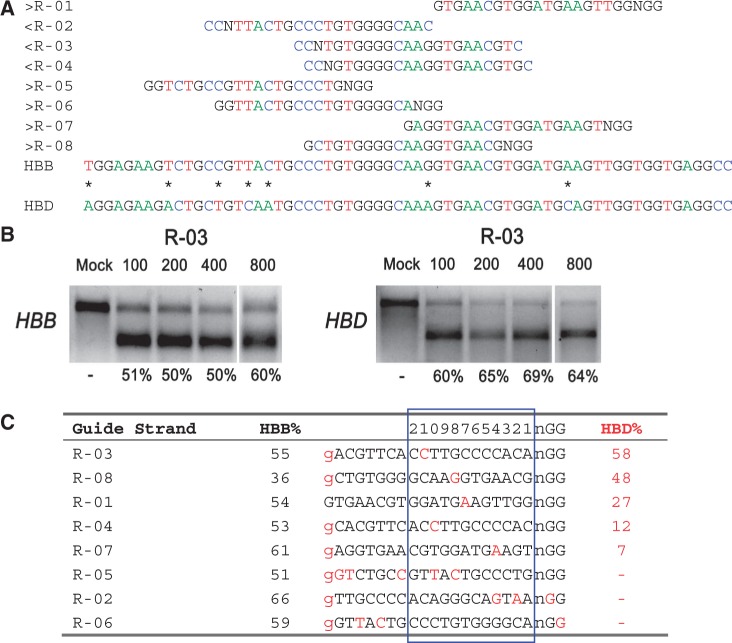
Figure 1.
Figure 1.
On- and off-target cleavage by CRISPR/Cas9 systems targeting the HBB gene. (a) Guide strands are aligned to their target sites and corresponding region in HBB and HBD. Forward direction guide strands (marked ‘greater than’) are shown adjacent to NGG, representing the PAM sequence. Guide strands complementary to the reverse strand (marked ‘less than’) are listed to the right of CCN. Asterisks between HBB and HBD indicate nucleotides that differentiate the two genes. The first base shown in HBB is the sickle cell anemia mutation site. For clarity, the A, C, T and G nucleotides are shown in green, blue, red and black, respectively. (b) R-03-induced cleavage at HBB (on-target) and HBD (off-target) measured by the T7E1 assay. Cells were transfected with 100, 200, 400 or 800 ng of the R-03 CRISPR plasmid. (c) Guide strands ranked in order of the off-target mutation rates at HBD. Differences between the guide sequence and HBD are in red. A lowercase g indicates that the first base in HBB does not match the guide strands’ initial G (for all but R-01). The 12 bases closest to the PAM are boxed in blue and numbered on top.
Figure 2.
Figure 2.
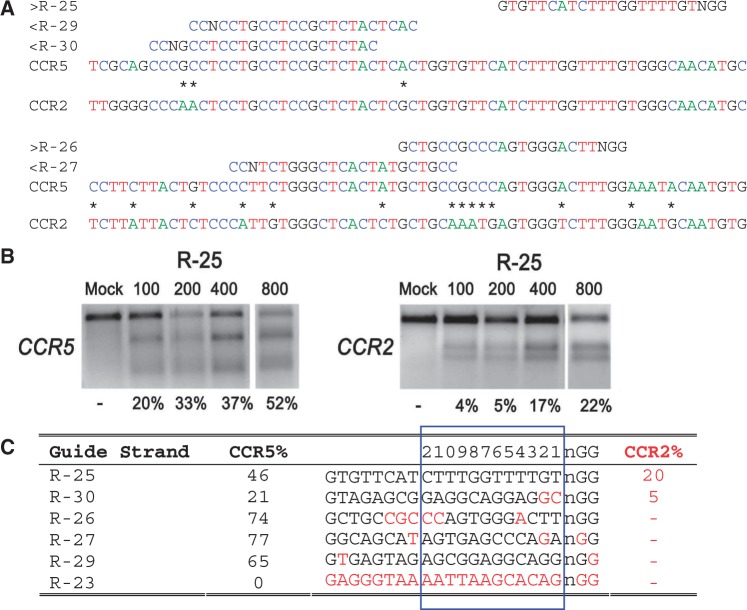
On- and off-target cleavage by CRISPR/Cas9 systems targeting the CCR5 gene. (a) Guide strands are aligned to their target sites in CCR5 and corresponding region in CCR2. Forward direction guide strands (marked ‘greater than’) are shown adjacent to NGG, representing the PAM sequence. Guide strands complementary to the reverse strand (marked ‘less than’) are listed to the right of CCN. Asterisks between CCR5 and CCR2 indicate nucleotides that differentiate the two genes. For clarity, the A, C, T and G nucleotides are shown in green, blue, red and black, respectively. (b) Cells were transfected with 100, 200, 400 or 800 ng of the R-25 CRISPR plasmid. Results of the T7E1 mutation detection assay with the on- and off-target mutation rates at CCR5 and CCR2, respectively. R-23 targeting CFTR was used as a negative control. (c) Guide strands ranked in order of the off-target mutation rates at CCR2. Differences between the guide strand sequence and complementary sequence in CCR2 are in red. The 12 bases closest to the PAM are boxed in blue and numbered on top.
Figure 3.
Figure 3.
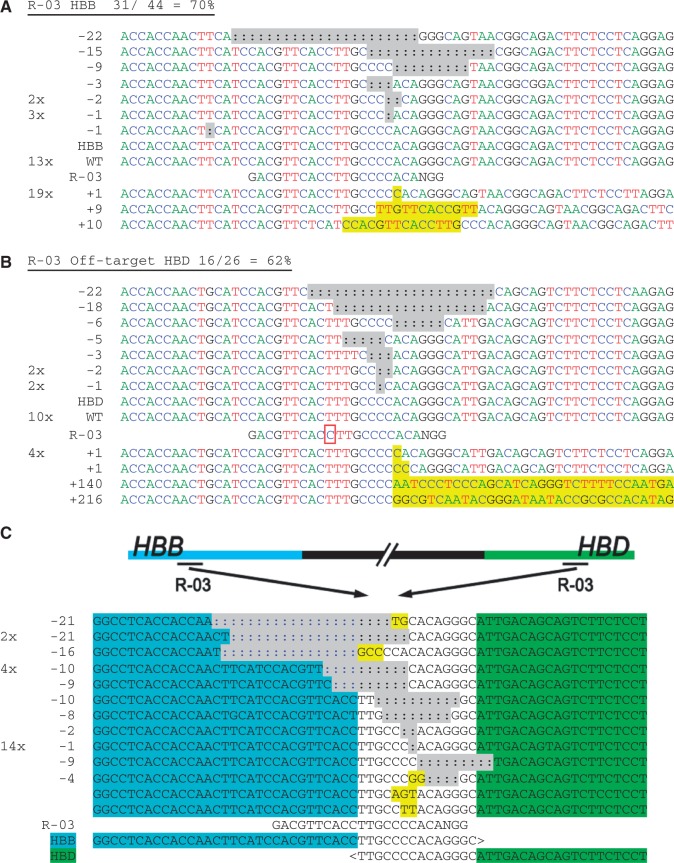
Chromosomal deletions in HBB and HBD induced by CRISPR/Cas9 systems. HEK-293T cells were transfected with each CRISPR construct, and their genomic DNA harvested after 3 days in culture. The (a) on- and (b) off-target loci for guide strands R-03 were amplified with flanking PCR primers, cloned and Sanger sequenced. Sequencing reads are given for each guide strand and aligned to the wild-type sequence. The number of times each read occurred is indicated to the left of the alignment. Unmodified reads are indicated by ‘WT’. In (b) the guide strand mismatch is boxed. In (a) and (b), the A, C, T and G nucleotides are shown in green, blue, red and black, respectively, for clarity. (c) Genomic DNA from cells treated with R-03 was amplified using an HBD forward primer and reverse primer downstream of the HBB site. The PCR products were sequenced and aligned to ‘HBB-HBD’ with the bases unique to HBB or HBD indicated in blue or green, respectively, surrounding an identical area found in both genes. Sequencing detected that each product contained indels and mutations consistent with NHEJ, near the target sites for R-03. Insertions and point mutations are marked in yellow and deletions (:) are highlighted in gray.
Figure 4.
Figure 4.
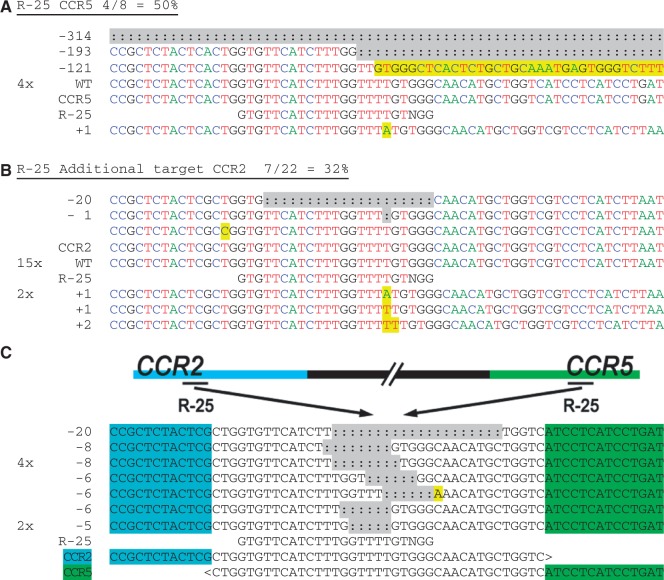
Chromosomal deletions in CCR5 and CCR2 induced by CRISPR/Cas9 systems. HEK-293T cells were transfected with each CRISPR construct, and their genomic DNA harvested after 3 days in culture. The (a) on- and (b) off-target loci for guide strands R-25 were amplified with flanking PCR primers, cloned and Sanger sequenced. Sequencing reads are given for each guide strand and aligned to the wild-type sequence. The number of times each read occurred is indicated to the left of the alignment. Unmodified reads are indicated by ‘WT’. In (b) the guide strand mismatch is boxed. In (a) and (b), the A, C, T and G nucleotides are shown in green, blue, red and black, respectively, for clarity. (c) Genomic DNA from cells treated with R-25 was amplified using a CCR2 forward primer and reverse primer downstream of the CCR5 site. The PCR products were sequenced and aligned to ‘CCR2-CCR5’ with the bases unique to CCR2 or CCR5 indicated in blue or green, respectively, surrounding an identical area found in both genes. Sequencing detected that each product contained indels and mutations consistent with NHEJ, near the target sites for R-25. Insertions and point mutations are marked in yellow and deletions (:) are highlighted in gray.
Figure 5.
Figure 5.
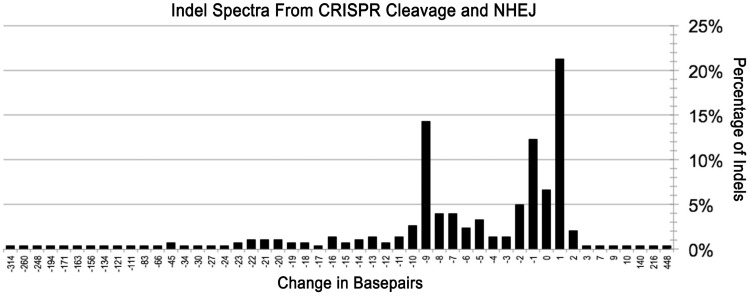
Indel spectra from CRISPR/Cas9 cleavage and NHEJ repair. The change in number of base pairs resulting from each indel was calculated and compiled. The y-axis represents the percentage of each number of insertion or deletion. The most common indels for the CRISPR/Cas9 systems studied: 1 bp additions, 9 bp deletions and 1 bp deletions occurred in 64, 43 and 37 of 302 clones, respectively.

References

    1. Perez EE, Wang J, Miller JC, Jouvenot Y, Kim KA, Liu O, Wang N, Lee G, Bartsevich VV, Lee YL, et al. Establishment of HIV-1 resistance in CD4+ T cells by genome editing using zinc-finger nucleases. Nat. Biotechnol. 2008;26:808–816. - PMC - PubMed
    1. Geurts AM, Cost GJ, Freyvert Y, Zeitler B, Miller JC, Choi VM, Jenkins SS, Wood A, Cui X, Meng X, et al. Knockout rats via embryo microinjection of zinc-finger nucleases. Science. 2009;325:433. - PMC - PubMed
    1. Bolotin A, Quinquis B, Sorokin A, Ehrlich SD. Clustered regularly interspaced short palindrome repeats (CRISPRs) have spacers of extrachromosomal origin. Microbiology. 2005;151:2551–2561. - PubMed
    1. Horvath P, Barrangou R. CRISPR/Cas, the immune system of bacteria and archaea. Science. 2010;327:167–170. - PubMed
    1. Marraffini LA, Sontheimer EJ. CRISPR interference: RNA-directed adaptive immunity in bacteria and archaea. Nat. Rev. Genet. 2010;11:181–190. - PMC - PubMed

Publication types