Spread of carbapenem-resistant Acinetobacter baumannii global clone 2 in Asia and AbaR-type resistance islands
- PMID: 23939892
- PMCID: PMC3811275
- DOI: 10.1128/AAC.00633-13
Spread of carbapenem-resistant Acinetobacter baumannii global clone 2 in Asia and AbaR-type resistance islands
Abstract
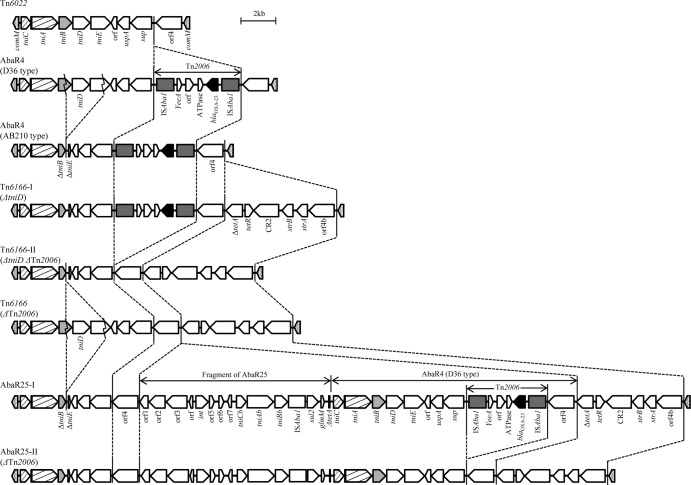
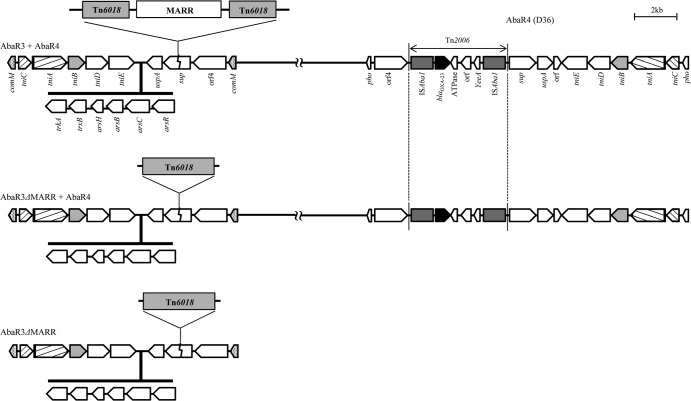
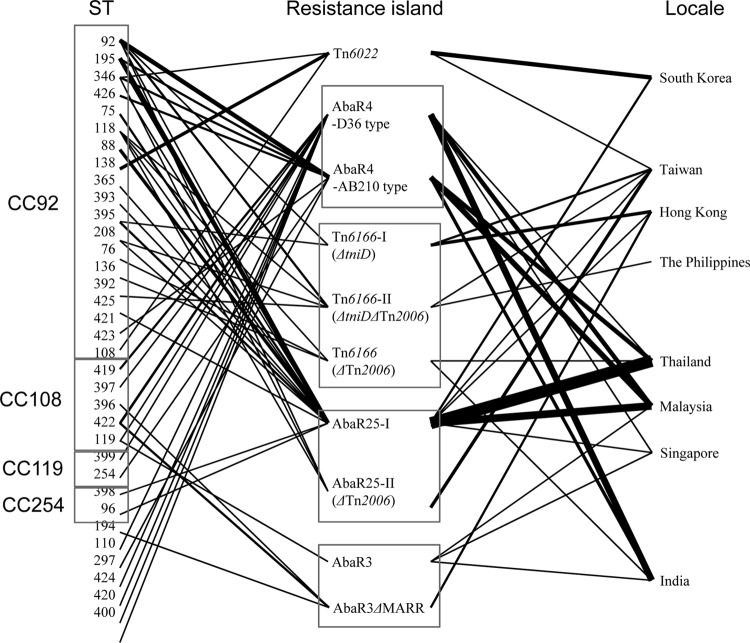
In this surveillance study, we identified the genotypes, carbapenem resistance determinants, and structural variations of AbaR-type resistance islands among carbapenem-resistant Acinetobacter baumannii (CRAB) isolates from nine Asian locales. Clonal complex 92 (CC92), corresponding to global clone 2 (GC2), was the most prevalent in most Asian locales (83/108 isolates; 76.9%). CC108, or GC1, was a predominant clone in India. OXA-23 oxacillinase was detected in CRAB isolates from most Asian locales except Taiwan. blaOXA-24 was found in CRAB isolates from Taiwan. AbaR4-type resistance islands, which were divided into six subtypes, were identified in most CRAB isolates investigated. Five isolates from India, Malaysia, Singapore, and Hong Kong contained AbaR3-type resistance islands. Of these, three isolates harbored both AbaR3- and AbaR4-type resistance islands simultaneously. In this study, GC2 was revealed as a prevalent clone in most Asian locales, with the AbaR4-type resistance island predominant, with diverse variants. The significance of this study lies in identifying the spread of global clones of carbapenem-resistant A. baumannii in Asia.
Figures
References
-
- Munoz-Price LS, Weinstein RA. 2008. Acinetobacter infection. N. Engl. J. Med. 358:1271–1281 - PubMed
-
- Gaynes R, Edwards JR. 2005. Overview of nosocomial infections caused by gram-negative bacilli. Clin. Infect. Dis. 41:848–854 - PubMed
-
- Chung DR, Song JH, Kim SH, Huang SG, Wang H, So TM, Yasin RM, Hsueh PR, Carlos CC, Hsu LY, Buntaran L, Lalitha MK, Kim MJ, Choi JY, Kim SI, Ko KS, Kang CI, Peck KR, ANSORP Study Group 2011. High prevalence of multidrug-resistant non-fermenters in hospital-acquired pneumonia in Asia. Am. J. Respir. Crit. Care Med. 184:1409–1417 - PubMed
-
- Gilad J, Carmeli Y. 2008. Treatment options for multidrug-resistant Acinetobacter species. Drugs 68:165–189 - PubMed
Publication types
MeSH terms
Substances
LinkOut - more resources
Full Text Sources
Other Literature Sources
Medical