


Functional abdominal pain in childhood and long-term vulnerability to anxiety disorders
- PMID: 23940244
- PMCID: PMC3876748
- DOI: 10.1542/peds.2012-2191
Functional abdominal pain in childhood and long-term vulnerability to anxiety disorders
Abstract
Background: Cross-sectional studies link functional abdominal pain (FAP) to anxiety and depression in childhood, but no prospective study has evaluated psychiatric status in adulthood or its relation to pain persistence.
Methods: Pediatric patients with FAP (n = 332) and control subjects (n = 147) were tracked prospectively and evaluated for psychiatric disorders and functional gastrointestinal disorders (FGIDs) at follow-up in adolescence and young adulthood (mean age = 20.01 years). Participants were classified according to presence (FGID-POS) or absence (FGID-NEG) of FGIDs at follow-up.
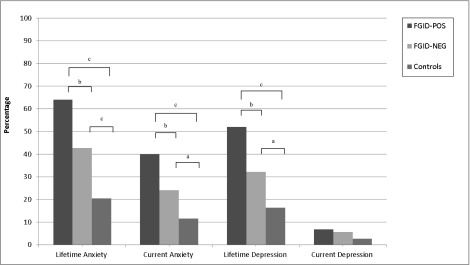
Results: Lifetime and current risk of anxiety disorders was higher in FAP than controls (lifetime: 51% vs 20%; current: 30% vs 12%). Controlling for gender and age, the odds ratio was 4.9 (confidence interval = 2.83-7.43) for lifetime anxiety disorder and 3.57 (confidence interval = 2.00-6.36) for current anxiety disorder at follow-up for FAP versus controls. Lifetime risk of depressive disorder was significantly higher in FAP versus controls (40% vs. 16%); current risk did not differ. In most cases, initial onset of anxiety disorders was before pediatric FAP evaluation; onset of depressive disorders was subsequent to FAP evaluation. Within the FAP group, risk of current anxiety disorders at follow-up was significantly higher for FGID-POS versus FGID-NEG (40% vs 24%), and both were higher than controls (12%); current depressive disorders did not differ across FGID-POS, FGID-NEG, and controls.
Conclusions: Patients with FAP carry long-term vulnerability to anxiety that begins in childhood and persists into late adolescence and early adulthood, even if abdominal pain resolves.
Keywords: anxiety; depression; functional gastrointestinal disorder; pediatric; prospective; psychiatric disorders.
Figures
References
-
- Chitkara DK, Rawat DJ, Talley NJ. The epidemiology of childhood recurrent abdominal pain in Western countries: a systematic review. Am J Gastroenterol. 2005;100(8):1868–1875 - PubMed
-
- Saps M, Seshadri R, Sztainberg M, Schaffer G, Marshall BM, Di Lorenzo C. A prospective school-based study of abdominal pain and other common somatic complaints in children. J Pediatr. 2009;154(3):322–326 - PubMed
-
- Hyams JS, Burke G, Davis PM, Rzepski B, Andrulonis PA. Abdominal pain and irritable bowel syndrome in adolescents: a community-based study. J Pediatr. 1996;129(2):220–226 - PubMed
-
- Robinson JO, Alverez JH, Dodge JA. Life events and family history in children with recurrent abdominal pain. J Psychosom Res. 1990;34(2):171–181 - PubMed
MeSH terms
Grants and funding
LinkOut - more resources
Full Text Sources
Other Literature Sources
Medical
Miscellaneous
