. 2013 Sep 15;191(6):3186-3191.
doi: 10.4049/jimmunol.1301285. Epub 2013 Aug 12.

Immune tolerance negatively regulates B cells in knock-in mice expressing broadly neutralizing HIV antibody 4E10

Affiliations

Immune tolerance negatively regulates B cells in knock-in mice expressing broadly neutralizing HIV antibody 4E10

Colleen Doyle-Cooper et al. J Immunol. .

Abstract

A major goal of HIV research is to develop vaccines reproducibly eliciting broadly neutralizing Abs (bNAbs); however, this has proved to be challenging. One suggested explanation for this difficulty is that epitopes seen by bNAbs mimic self, leading to immune tolerance. We generated knock-in mice expressing bNAb 4E10, which recognizes the membrane proximal external region of gp41. Unlike b12 knock-in mice, described in the companion article (Ota et al. 2013. J. Immunol. 191: 3179-3185), 4E10HL mice were found to undergo profound negative selection of B cells, indicating that 4E10 is, to a physiologically significant extent, autoreactive. Negative selection occurred by various mechanisms, including receptor editing, clonal deletion, and receptor downregulation. Despite significant deletion, small amounts of IgM and IgG anti-gp41 were found in the sera of 4E10HL mice. On a Rag1⁻/⁻ background, 4E10HL mice had virtually no serum Ig of any kind. These results are consistent with a model in which B cells with 4E10 specificity are counterselected, raising the question of how 4E10 was generated in the patient from whom it was isolated. This represents the second example of a membrane proximal external region-directed bNAb that is apparently autoreactive in a physiological setting. The relative conservation in HIV of the 4E10 epitope might reflect the fact that it is under less intense immunological selection as a result of B cell self-tolerance. The safety and desirability of targeting this epitope by a vaccine is discussed in light of the newly described bNAb 10E8.


Figures
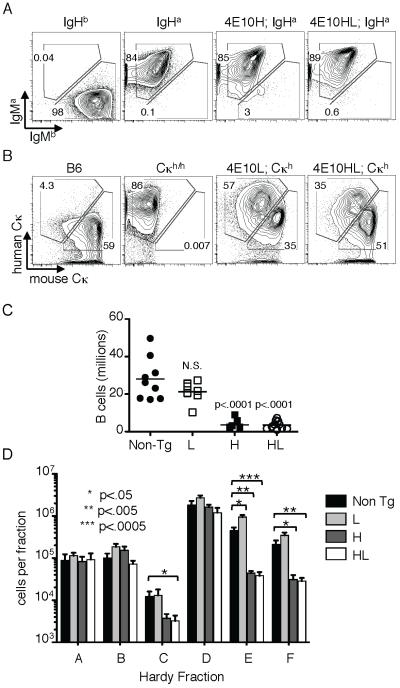
Figure 1
Figure 1
B cell development and allelic inclusion in 4E10 mice. A,B, Knock-in mice carrying serologically distinguishable endogenous H and L chain constant regions were generated by breeding homozygous knock-in mice with IgHa/a; Cκh/h mice. Spleen B cells of the indicated genotypes were assessed by flow cytometry using antibodies against IgMb and mouse Cκ, to detect the transgene H and L alleles, respectively, and antibodies against IgMa and human Cκ to identify chains derived from endogenous genes. Data is representative of results obtained with 4-10 mice/group. C, Reduced splenic B cell numbers in 4E10 knock-in mice. B220+CD19+ splenic B cells were enumerated from mice of the indicated genotypes. Each data point represents the value obtained in one mouse. Data were from at least three independent experiments. D, Analysis of BM B cell developmental fractions according to the staining scheme of Hardy (27). Fractions represent developmental stages as follows: A-C, proB; D, small preB; E, immature B; F, recirculating B. Number of mice analyzed was 6 for 4E10HL and 4 for the other genotypes, carried out in one experiment.
Figure 2
Figure 2
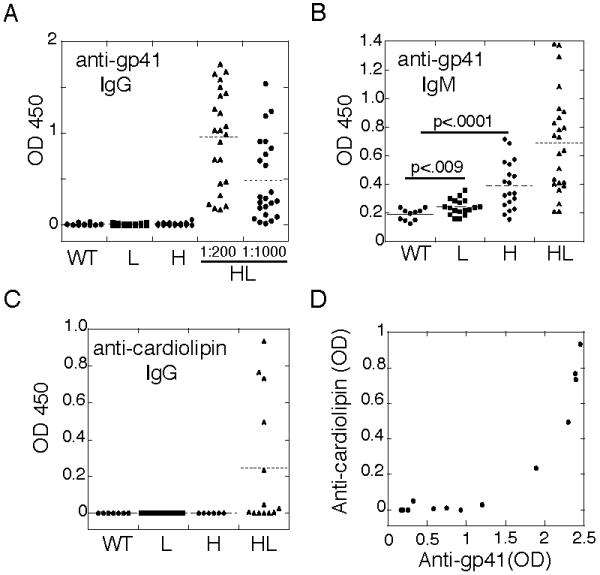
Analysis of spontaneous anti-gp41 activity in the sera of 4E10 HL mice. Sera from mice of the indicated genotypes were tested for reactivity to gp41 and were from mice 6-10 weeks old. A,B, Total IgG and IgM anti-gp41 activity of normal sera from individual adult mice of the indicated genotypes. Readings were from ELISA using serum at 1:200 dilution unless otherwise indicated. C, IgG anti-cardiolipin assay. D, Correlation between anti-gp41 and anti-cardiolipin IgG activity.
Figure 3
Figure 3
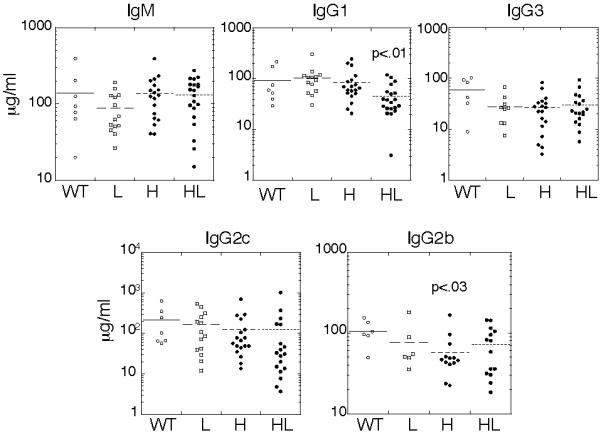
Normal serum Ig levels of mice of the indicated genotypes carrying one or no copies of the knock-in H and L alleles. Each point represents the levels measured in an individual mouse.
Figure 4
Figure 4
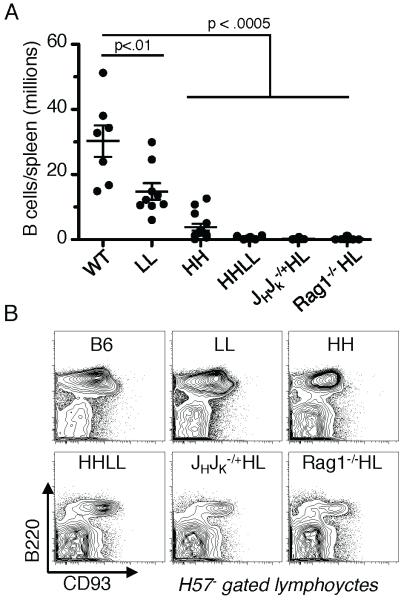
Effect of enforcing 4E10 expression on B cell numbers and maturation. Spleen cells of mice homozygous for 4E10 H or L targeted loci, or double homozygotes (respectively LL, HH and HHLL), were compared to 4E10HL hemizygous mice deficient in the second allele (JHJk−/+HL) or lacking Rag1 (Rag1−/−HL). A, Total B cell numbers (CD19+B220+) in spleens. B, Analysis of CD93 and B220 coexpression in splenic lymphocytes gated to exclude TCRβ+ cells using MAb H57.
Figure 5
Figure 5
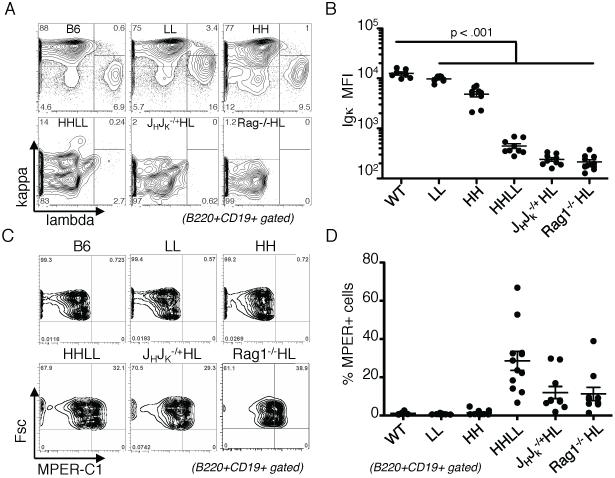
Analysis of BCR surface density and MPER binding among splenic B cells from mice with enforced 4E10 expression. A,B, Analysis of sIgL density on splenic B cells of mice of the indicated genotypes. C,D, Analysis of the frequency of MPER binding splenic B cells using the biotinylated C1 peptide. Values from individual mice obtained over at least 2 experiments are indicated by dots.
Figure 6
Figure 6
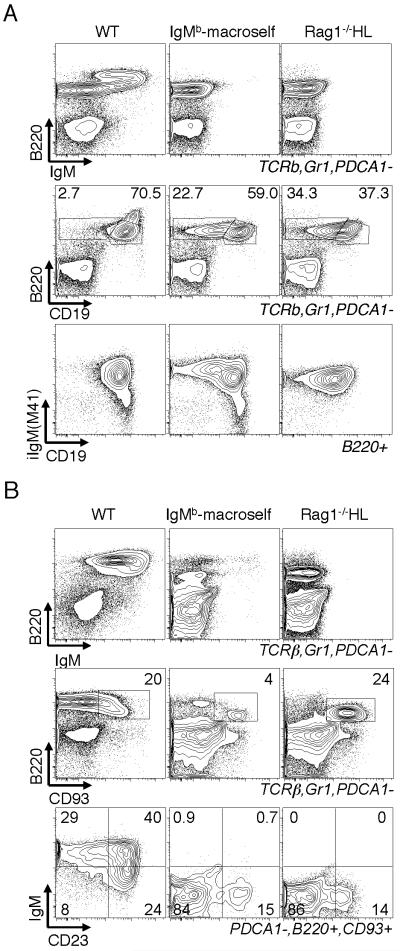
BCR internalization and developmental block of B cells in Rag1−/−HL mice. A, Analysis of BM B cells for surface markers B220, IgM, CD19 and intracellular IgM (iIgM). In the top two rows of panels BM cells were gated to exclude most myeloid and T cells. For iIgM analysis (lower row) cells were B220+ gated. IgMb-macroself Tg mice express a superantigen reactive to IgMb (28). B, Analysis of spleen B cells from mice of the indicated genotype. Second row of panels shows the gating used for the analysis on the lower row.
Figure 7
Figure 7
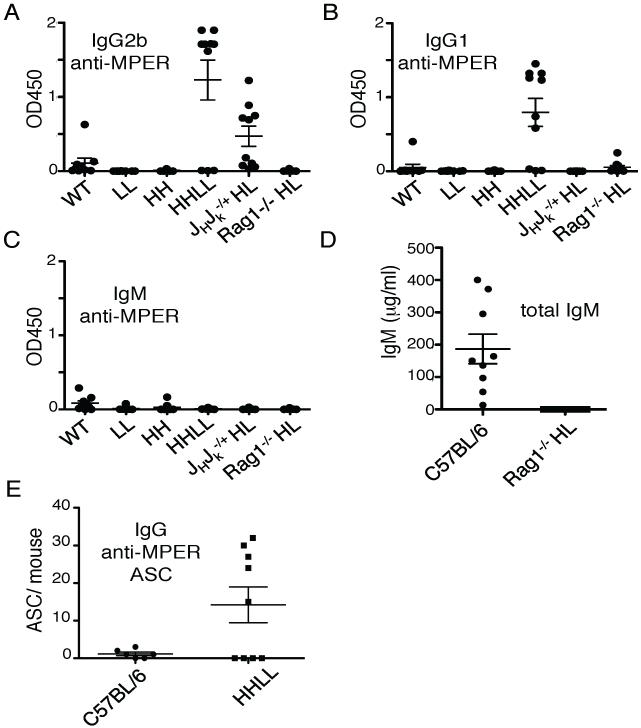
Analysis of spontaneous anti-MPER activity in the sera of in mice with limited ability to edit because of 4E10 gene homozygosity or gene knockout. A,B, Analysis of IgG2b and IgG1 anti-MPER titers in mice of the indicated genotypes. C, IgM anti-MPER levels in the same samples shown in A,B. D, Total IgM levels in Rag1−/−;HL mice compared to WT controls. E, Assessment of IgG anti-MPER antibody forming cell (AFC) numbers in HHLL mice. BM, SP and selected LN were assessed for anti-gp41 activity using an ELISpot assay. Serological assays shown were carried out in a single experiment for optimal comparison, but were similar to results in assays done with the same sera at different dilutions or on different days. Each point represents the mean value from an independent mouse.

References

    1. Baba TW, Liska V, Hofmann-Lehmann R, Vlasak J, Xu W, Ayehunie S, Cavacini LA, Posner MR, Katinger H, Stiegler G, Bernacky BJ, Rizvi TA, Schmidt R, Hill LR, Keeling ME, Lu Y, Wright JE, Chou TC, Ruprecht RM. Human neutralizing monoclonal antibodies of the IgG1 subtype protect against mucosal simian-human immunodeficiency virus infection. Nat. Med. 2000;6:200–206. - PubMed
    1. Conley AJ, Kessler JA, 2nd, Boots LJ, McKenna PM, Schleif WA, Emini EA, Mark GE, 3rd, Katinger H, Cobb EK, Lunceford SM, Rouse SR, Murthy KK. The consequence of passive administration of an anti-human immunodeficiency virus type 1 neutralizing monoclonal antibody before challenge of chimpanzees with a primary virus isolate. J. Virol. 1996;70:6751–6758. - PMC - PubMed
    1. Gauduin MC, Parren PW, Weir R, Barbas CF, Burton DR, Koup RA. Passive immunization with a human monoclonal antibody protects hu-PBL-SCID mice against challenge by primary isolates of HIV-1. Nat. Med. 1997;3:1389–1393. - PubMed
    1. Mascola JR, Stiegler G, VanCott TC, Katinger H, Carpenter CB, Hanson CE, Beary H, Hayes D, Frankel SS, Birx DL, Lewis MG. Protection of macaques against vaginal transmission of a pathogenic HIV-1/SIV chimeric virus by passive infusion of neutralizing antibodies. Nat. Med. 2000;6:207–210. - PubMed
    1. Mascola JR, Lewis MG, Stiegler G, Harris D, VanCott TC, Hayes D, Louder MK, Brown CR, Sapan CV, Frankel SS, Lu Y, Robb ML, Katinger H, Birx DL. Protection of Macaques against pathogenic simian/human immunodeficiency virus 89.6PD by passive transfer of neutralizing antibodies. J. Virol. 1999;73:4009–4018. - PMC - PubMed

Publication types

MeSH terms

LinkOut - more resources