


Soil food web properties explain ecosystem services across European land use systems
- PMID: 23940339
- PMCID: PMC3761618
- DOI: 10.1073/pnas.1305198110
Soil food web properties explain ecosystem services across European land use systems
Abstract
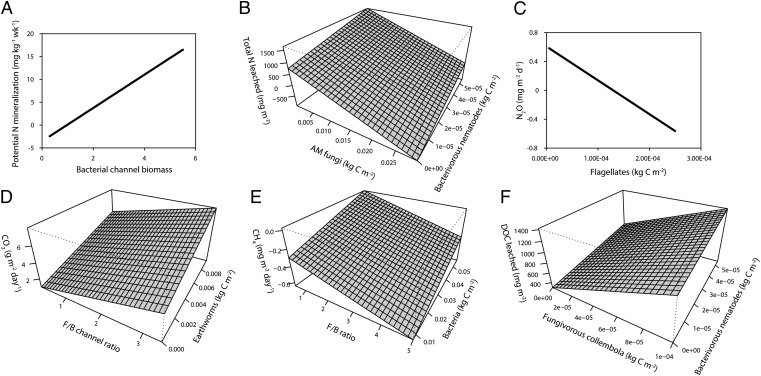
Intensive land use reduces the diversity and abundance of many soil biota, with consequences for the processes that they govern and the ecosystem services that these processes underpin. Relationships between soil biota and ecosystem processes have mostly been found in laboratory experiments and rarely are found in the field. Here, we quantified, across four countries of contrasting climatic and soil conditions in Europe, how differences in soil food web composition resulting from land use systems (intensive wheat rotation, extensive rotation, and permanent grassland) influence the functioning of soils and the ecosystem services that they deliver. Intensive wheat rotation consistently reduced the biomass of all components of the soil food web across all countries. Soil food web properties strongly and consistently predicted processes of C and N cycling across land use systems and geographic locations, and they were a better predictor of these processes than land use. Processes of carbon loss increased with soil food web properties that correlated with soil C content, such as earthworm biomass and fungal/bacterial energy channel ratio, and were greatest in permanent grassland. In contrast, processes of N cycling were explained by soil food web properties independent of land use, such as arbuscular mycorrhizal fungi and bacterial channel biomass. Our quantification of the contribution of soil organisms to processes of C and N cycling across land use systems and geographic locations shows that soil biota need to be included in C and N cycling models and highlights the need to map and conserve soil biodiversity across the world.
Keywords: modeling; nitrogen; soil fauna; soil microbes.
Conflict of interest statement
The authors declare no conflict of interest.
Figures
References
-
- Stoate C, et al. Ecological impacts of arable intensification in Europe. J Environ Manage. 2001;63(4):337–365. - PubMed
-
- Postma-Blaauw MB, de Goede RGM, Bloem J, Faber JH, Brussaard L. Soil biota community structure and abundance under agricultural intensification and extensification. Ecology. 2010;91(2):460–473. - PubMed
-
- de Vries FT, Van Groenigen JW, Hoffland E, Bloem J. Nitrogen losses from two grassland soils with different fungal biomass. Soil Biol Biochem. 2011;43(5):997–1005.
-
- Hunt HW, et al. The detrital food web in a shortgrass prairie. Biol Fertil Soils. 1987;3(1):57–68.
Publication types
MeSH terms
Substances
LinkOut - more resources
Full Text Sources
Other Literature Sources
