. 2013 Aug 27;110(35):14408-13.
doi: 10.1073/pnas.1306376110. Epub 2013 Aug 12.

Human NAIP and mouse NAIP1 recognize bacterial type III secretion needle protein for inflammasome activation

Affiliations

Human NAIP and mouse NAIP1 recognize bacterial type III secretion needle protein for inflammasome activation

Jieling Yang et al. Proc Natl Acad Sci U S A. .

Abstract

Inflammasome mediated by central nucleotide-binding and oligomerization domain (NOD)-like receptor (NLR) protein is critical for defense against bacterial infection. Here we show that type III secretion system (T3SS) needle proteins from several bacterial pathogens, including Salmonella typhimurium, enterohemorrhagic Escherichia coli, Shigella flexneri, and Burkholderia spp., can induce robust inflammasome activation in both human monocyte-derived and mouse bone marrow macrophages. Needle protein activation of human NRL family CARD domain containing 4 (NLRC4) inflammasome requires the sole human neuronal apoptosis inhibitory protein (hNAIP). Among the seven mouse NAIPs, NAIP1 functions as the mouse counterpart of hNAIP. We found that NAIP1 recognition of T3SS needle proteins was more robust in mouse dendritic cells than in bone marrow macrophages. Needle proteins, as well as flagellin and rod proteins from five different bacteria, exhibited differential and cell type-dependent inflammasome-stimulating activity. Comprehensive profiling of the three types of NAIP ligands revealed that NAIP1 sensing of the needle protein dominated S. flexneri-induced inflammasome activation, particularly in dendritic cells. hNAIP/NAIP1 and NAIP2/5 formed a large oligomeric complex with NLRC4 in the presence of corresponding bacterial ligands, and could support reconstitution of the NLRC4 inflammasome in a ligand-specific manner.

Keywords: NOD-like protein; caspase-1; innate immunity; pathogen-associated molecular pattern; pyroptosis.


Conflict of interest statement

The authors declare no conflict of interest.

Figures
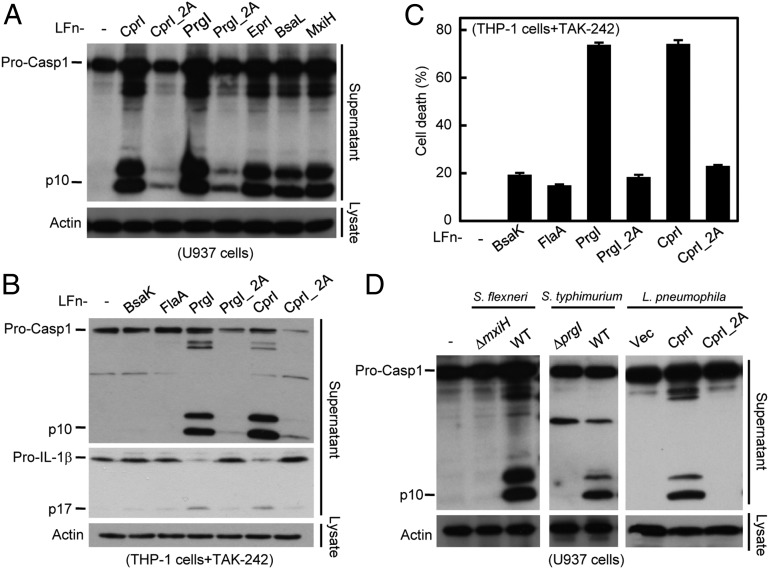
Fig. 1.
Fig. 1.
Various T3SS needle proteins activate the inflammasome in human monocytes-derived macrophages. (A–C) Effects of cytoplasmic delivery of bacterial T3SS needle proteins on inflammasome activation in PMA-differentiated U937 (A) and THP-1 (B and C) cells. CprI, PrgI, EprI, BsaL, and MxiH are T3SS needle proteins from C. violaceum, S. typhimurium, EHEC, B. thailandensis, and S. flexneri, respectively. CprI_2A, CprI V69A/I79A; PrgI_2A, PrgI V65A/I75A; FlaA, L. pneumophila flagellin; BsaK, B. thailandensis T3SS rod protein. Shown in A and B are anti–caspase-1/IL-1β and anti-actin immunoblots of culture supernatants (Upper) and total cell lysates (Lower); p10 and p17 denote the mature forms of caspase-1 and IL-1β, respectively. Percentages of pyroptosis in C were determined by lactate dehydrogenase release as mean ± SD values (error bar) from three independent determinations. In B and C, 20 mM TAK-242 was used to block potential TLR ligand-induced NF-κB activation. (D) T3SS needle proteins activate the inflammasome in U937 cells during bacterial infections. WT or indicated needle protein-deficient strains of S. flexneri and S. typhimurium, as well as L. pneumophila ΔflaA expressing CprI, CprI_2A, or an empty vector (Vec) were used to infect PMA-differentiated U937 cells.
Fig. 2.
Fig. 2.
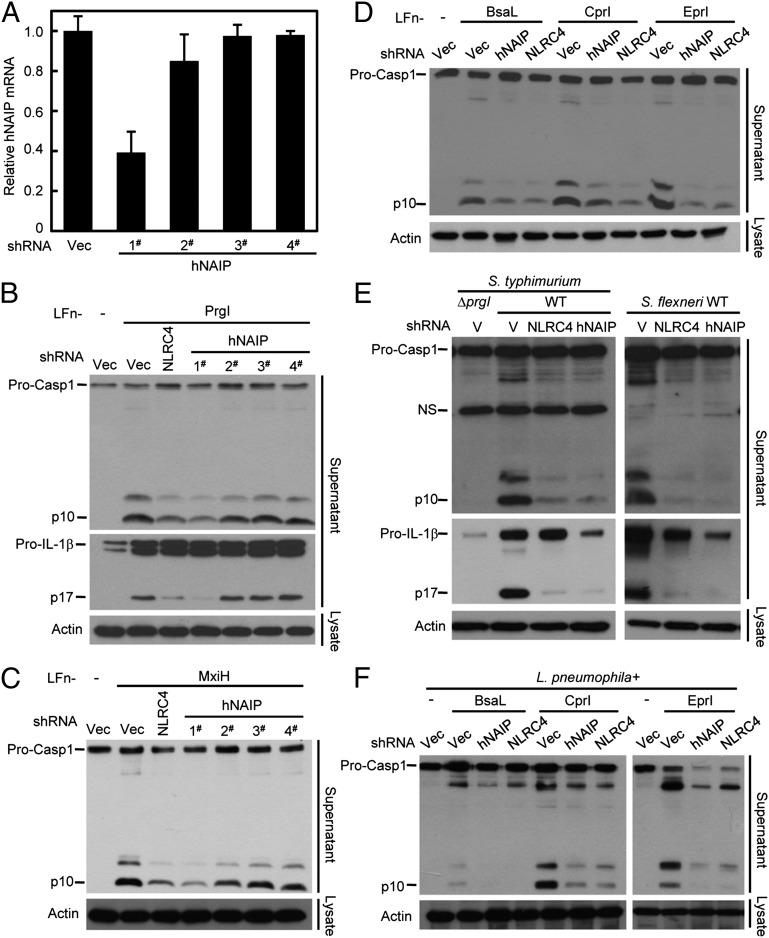
hNAIP and NLRC4 are required for T3SS needle protein activation of the inflammasome. (A) Quantitative real-time PCR (qRT-PCR) analysis of hNAIP transcripts in hNAIP stable knockdown U937 cells. Vec, a nontargeting shRNA. The transcript level of actin was used for normalization. Values are mean ± SD (error bar) from three independent determinations. (B–D) Effects of hNAIP and NLRC4 knockdown on T3SS needle protein-induced inflammasome activation in PMA-differentiated U937 cells. Purified PrgI, MxiH, BsaL, CprI, and EprI proteins were delivered into NLRC4 and hNAIP knockdown U937 cells using the LFn-PA system. Shown are anti–caspase-1/IL-1β and anti-actin immunoblots of culture supernatants (Upper) and total cell lysates (Lower). p10 and p17 denote the mature form of caspase-1 and IL-1β, respectively. (E and F) Effects of hNAIP and NLRC4 knockdown on bacterial infection-induced inflammasome activation in PMA-differentiated U937 cells. In E, S. typhimurium and S. flexneri were used for infection; in F, U937 cells were infected with L. pneumophila ΔflaA strain expressing indicated needle protein.
Fig. 3.
Fig. 3.
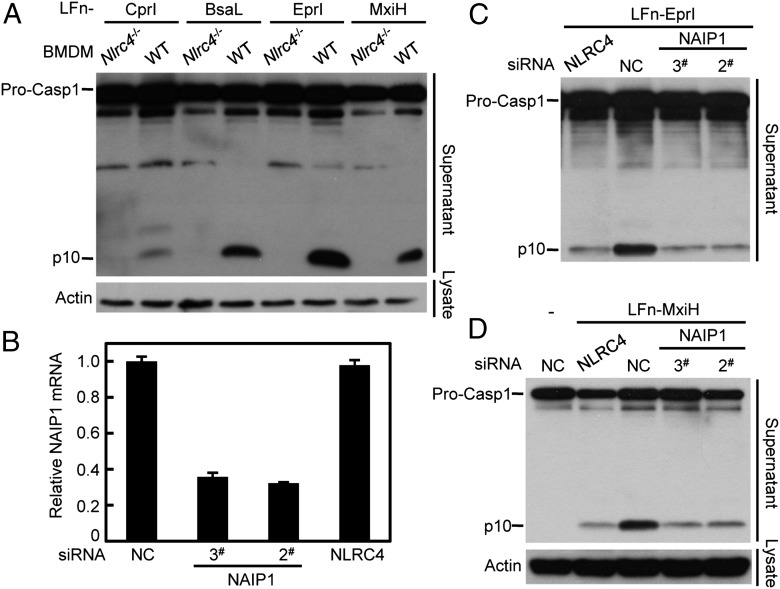
Mouse NAIP1 mediates needle protein activation of the NLRC4 inflammasome in murine BMDM cells. (A) Purified CprI, BsaL, EprI, and MxiH proteins were delivered into BMDMs derived from WT (C57BL/6) or Nlrc4−/− mice. Shown are anti–caspase-1 and anti-actin immunoblots of culture supernatants (Upper) and total cell lysates (Lower). (B) qRT-PCR analysis of NAIP1 knockdown efficiency in mouse BMDMs. siRNA oligos targeting mouse NAIP1 (2# and 3#) or NLRC4 or a nontargeting siRNA (NC) were transfected into primary WT BMDM cells. The transcript level of actin was used for normalization. Values are mean ± SD (error bar) from three independent determinations. (C and D) Effects of NAIP1 and NLRC4 knockdown on needle protein-induced inflammasome activation in mouse BMDM cells. Purified EprI (C) or MxiH (D) proteins were transduced into mouse BMDM cells transfected with indicated siRNAs.
Fig. 4.
Fig. 4.
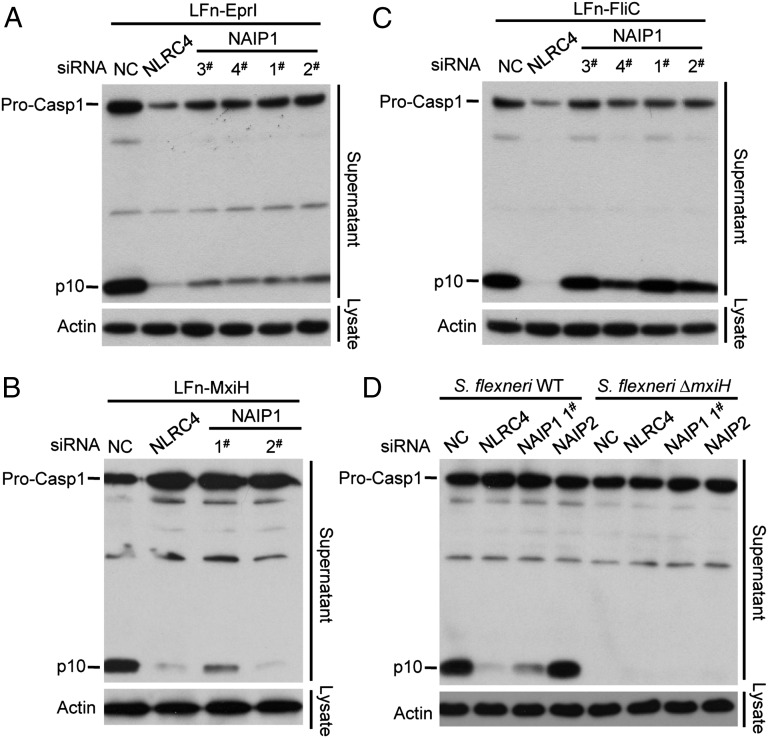
The NAIP1/NLRC4 inflammasome in mouse dentritic cells mediates a robust response to cytoplasmic T3SS needle protein and S. flexneri infection. (A–C) Effects of NAIP1 and NLRC4 knockdown on T3SS needle protein-induced inflammasome activation in DC2.4 cells. Purified EprI, MxiH, and P. aeruginosa flagellin (FliC) were delivered into DC2.4 cells transfected with indicated siRNAs. Knockdown efficiency of the four independent NAIP1-targeting siRNAs (1#–4#) is shown in SI Appendix, Fig. S7A. Shown are anti–caspase-1 and anti-actin immunoblots of culture supernatants (Upper) and total cell lysates (Lower). (D) Effects of NAIP1, NAIP2, and NLRC4 knockdown on S. flexneri-induced caspase-1 activation. DC2.4 cells transfected with indicated siRNAs were infected with WT or the ΔmxiH strain of S. flexneri.
Fig. 5.
Fig. 5.
Reconstitution of the NAIP1/hNAIP-NLRC4 inflammasome complex and its response to cytoplasmic needle proteins and bacterial infections. (A and B) NAIP1 recognition of T3SS needle proteins stimulates the oligomeric needle protein-NAIP1-NLRC4 inflammasome complex formation. The 293T cells were cotransfected with indicated combinations of Flag-NLRC4, HA-NAIPs (1, 2, or 5) and Myc-FliC, PrgJ, or MxiH. Anti-Flag and anti-HA immunoblotting of BN-PAGE gels were performed to examine the NAIP-NLRC4 inflammasome complex. Total cell lysates were also separated on the SDS/PAGE gels, followed by anti-Flag, HA, and Myc immunoblotting. (C) Ligand-specific reconstitution of the NAIP-NLRC4 inflammasome in 293T cells. The 293T cells transfected with NLRC4, procaspase-1, and pro-IL-1β together with an indicated NAIP expression plasmid were stimulated with indicated LFn-tagged NAIP ligands. Shown are immunoblotting analyses of IL-1β maturation; anti-actin blots serve as the loading control. (D) Responses of reconstituted NAIP1/hNAIP-NLRC4 inflammasome to bacterial infections. The 293T cells expressing indicated inflammasome components were infected with S. flexneri or S. typhimurium strains as indicated.

References

    1. Takeuchi O, Akira S. Pattern recognition receptors and inflammation. Cell. 2010;140(6):805–820. - PubMed
    1. Chen G, Shaw MH, Kim YG, Nuñez G. NOD-like receptors: Role in innate immunity and inflammatory disease. Annu Rev Pathol. 2009;4:365–398. - PubMed
    1. Ting JP, Kastner DL, Hoffman HM. CATERPILLERs, pyrin and hereditary immunological disorders. Nat Rev Immunol. 2006;6(3):183–195. - PubMed
    1. Schroder K, Tschopp J. The inflammasomes. Cell. 2010;140(6):821–832. - PubMed
    1. Bergsbaken T, Fink SL, Cookson BT. Pyroptosis: Host cell death and inflammation. Nat Rev Microbiol. 2009;7(2):99–109. - PMC - PubMed

Publication types

LinkOut - more resources