


Exome sequencing of index patients with retinal dystrophies as a tool for molecular diagnosis
- PMID: 23940504
- PMCID: PMC3683009
- DOI: 10.1371/journal.pone.0065574
Exome sequencing of index patients with retinal dystrophies as a tool for molecular diagnosis
Erratum in
-
Correction: Exome Sequencing of Index Patients with Retinal Dystrophies as a Tool for Molecular Diagnosis.PLoS One. 2016 Mar 31;11(3):e0153121. doi: 10.1371/journal.pone.0153121. eCollection 2016. PLoS One. 2016. PMID: 27031522 Free PMC article. No abstract available.
Abstract
Background: Retinal dystrophies (RD) are a group of hereditary diseases that lead to debilitating visual impairment and are usually transmitted as a Mendelian trait. Pathogenic mutations can occur in any of the 100 or more disease genes identified so far, making molecular diagnosis a rather laborious process. In this work we explored the use of whole exome sequencing (WES) as a tool for identification of RD mutations, with the aim of assessing its applicability in a diagnostic context.
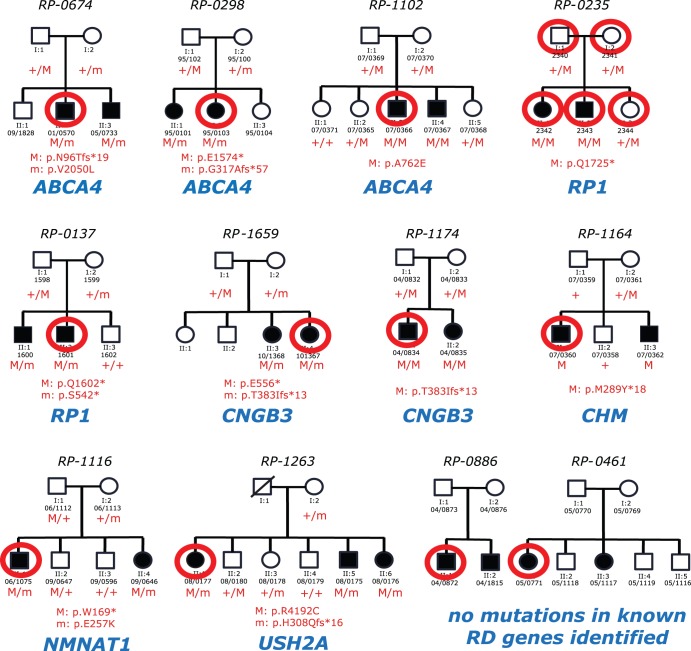
Methodology/principal findings: We ascertained 12 Spanish families with seemingly recessive RD. All of the index patients underwent mutational pre-screening by chip-based sequence hybridization and resulted to be negative for known RD mutations. With the exception of one pedigree, to simulate a standard diagnostic scenario we processed by WES only the DNA from the index patient of each family, followed by in silico data analysis. We successfully identified causative mutations in patients from 10 different families, which were later verified by Sanger sequencing and co-segregation analyses. Specifically, we detected pathogenic DNA variants (∼50% novel mutations) in the genes RP1, USH2A, CNGB3, NMNAT1, CHM, and ABCA4, responsible for retinitis pigmentosa, Usher syndrome, achromatopsia, Leber congenital amaurosis, choroideremia, or recessive Stargardt/cone-rod dystrophy cases.
Conclusions/significance: Despite the absence of genetic information from other family members that could help excluding nonpathogenic DNA variants, we could detect causative mutations in a variety of genes known to represent a wide spectrum of clinical phenotypes in 83% of the patients analyzed. Considering the constant drop in costs for human exome sequencing and the relative simplicity of the analyses made, this technique could represent a valuable tool for molecular diagnostics or genetic research, even in cases for which no genotypes from family members are available.
Conflict of interest statement
Figures
References
-
- Berson EL (1993) Retinitis pigmentosa. The Friedenwald Lecture. Invest Ophthalmol Vis Sci 34: 1659–1676. - PubMed
-
- Clark GR, Crowe P, Muszynska D, O’Prey D, O’Neill J, et al.. (2010) Development of a diagnostic genetic test for simplex and autosomal recessive retinitis pigmentosa. Ophthalmology 117: 2169–2177 e2163. - PubMed
-
- Zernant J, Kulm M, Dharmaraj S, den Hollander AI, Perrault I, et al. (2005) Genotyping microarray (disease chip) for Leber congenital amaurosis: detection of modifier alleles. Invest Ophthalmol Vis Sci 46: 3052–3059. - PubMed
Publication types
MeSH terms
Substances
LinkOut - more resources
Full Text Sources
Other Literature Sources
Miscellaneous
