


Smoking, radiotherapy, diabetes and osteoporosis as risk factors for dental implant failure: a meta-analysis
- PMID: 23940794
- PMCID: PMC3733795
- DOI: 10.1371/journal.pone.0071955
Smoking, radiotherapy, diabetes and osteoporosis as risk factors for dental implant failure: a meta-analysis
Abstract
Background: There are conflicting reports as to the association between smoking, radiotherapy, diabetes and osteoporosis and the risk of dental implant failure. We undertook a meta-analysis to evaluate the association between smoking, radiotherapy, diabetes and osteoporosis and the risk of dental implant failure.
Methods: A comprehensive research on MEDLINE and EMBASE, up to January 2013, was conducted to identify potential studies. References of relevant studies were also searched. Screening, data extraction and quality assessment were conducted independently and in duplicate. A random-effects meta-analysis was used to pool estimates of relative risks (RRs) with 95% confidence intervals (CIs).
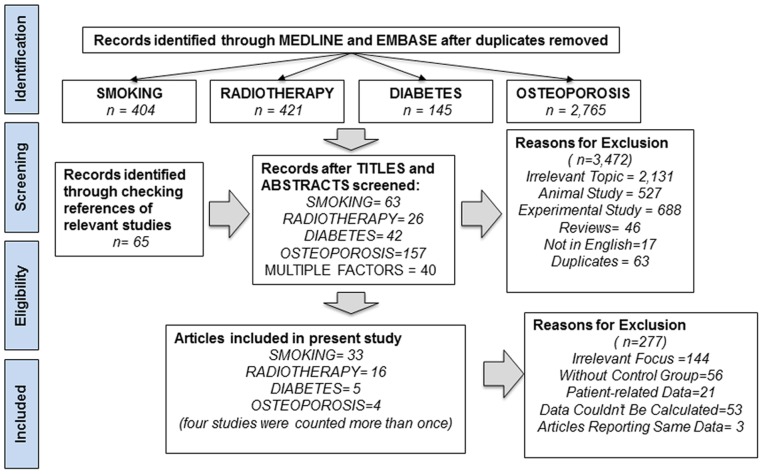
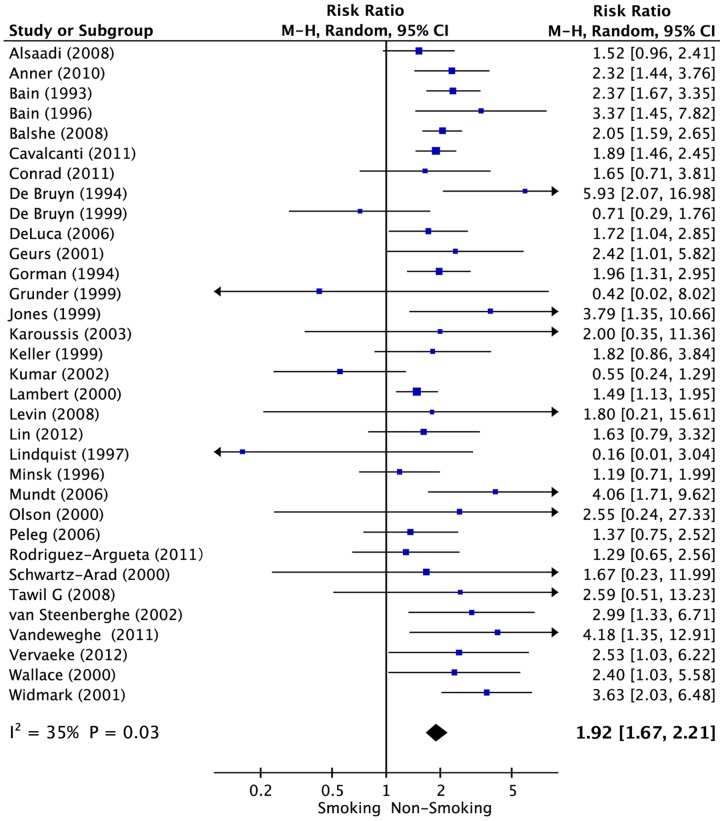
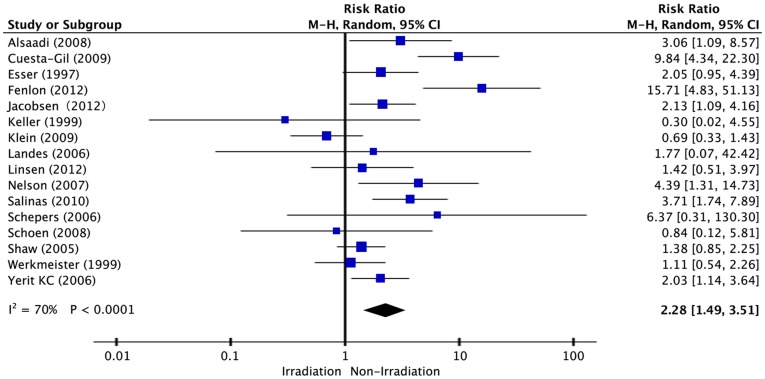
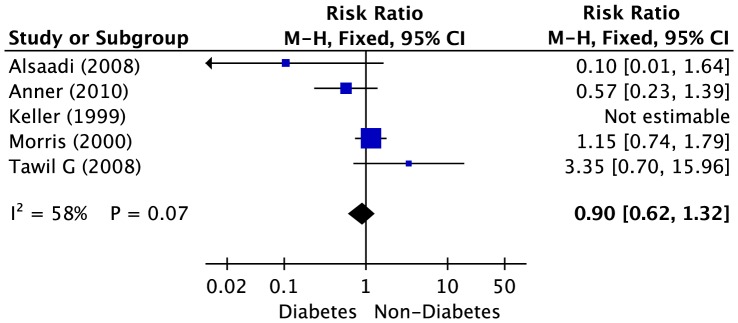
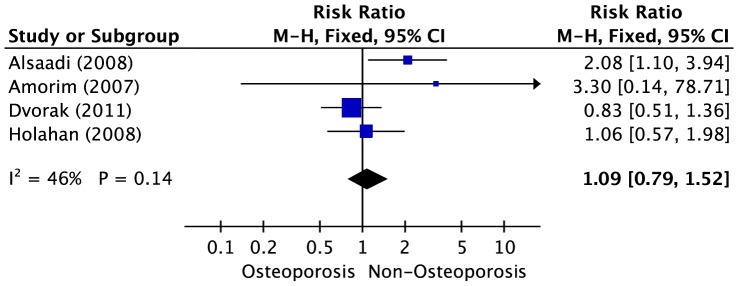
Results: A total of 51 studies were identified in this meta-analysis, with more than 40,000 dental implants placed under risk-threatening conditions. The pooled RRs showed a direct association between smoking (n = 33; RR = 1.92; 95% CI, 1.67-2.21) and radiotherapy (n = 16; RR = 2.28; 95% CI, 1.49-3.51) and the risk of dental implant failure, whereas no inverse impact of diabetes (n = 5; RR = 0.90; 95% CI, 0.62-1.32) on the risk of dental implant failure was found. The influence of osteoporosis on the risk of dental implant failure was direct but not significant (n = 4; RR = 1.09; 95% CI, 0.79-1.52). The subgroup analysis indicated no influence of study design, geographical location, length of follow-up, sample size, or mean age of recruited patients.
Conclusions: Smoking and radiotherapy were associated with an increased risk of dental implant failure. The relationship between diabetes and osteoporosis and the risk of implant failure warrant further study.
Conflict of interest statement
Figures
References
-
- Klokkevold PR, Han TJ (2007) How do smoking, diabetes, and periodontitis affect outcomes of implant treatment? Int J Oral Maxillofac Implants 22 Suppl.: 173–202. - PubMed
-
- Naert I, Koutsikakis G, Quirynen M, Duyck J, van Steenberghe D, et al. (2002) Biologic outcome of implant-supported restorations in the treatment of partial edentulism. Part 2: a longitudinal radiographic study. Clin Oral Implants Res 13: 390–395. - PubMed
-
- Lekholm U, Gunne J, Henry P, Higuchi K, Lindén U, et al. (1999) Survival of the Brånemark implant in partially edentulous jaws: a 10-year prospective multicenter study. Int J Oral Maxillofac Implants 14: 639–645. - PubMed
-
- Ferrigno N, Laureti M, Fanali S, Grippaudo G (2002) A long-term follow-up study of non-submerged ITI implants in the treatment of totally edentulous jaws. Part I: Ten-year life table analysis of a prospective multicenter study with 1286 implants. Clin Oral Implants Res 13: 260–273. - PubMed
-
- Cosyn J, Vandenbulcke E, Browaeys H, Van Maele G, De Bruyn H (2012) Factors associated with failure of surface-modified implants up to four years of function. Clin Implant Dent Relat Res 14: 347–358. - PubMed
Publication types
MeSH terms
Substances
LinkOut - more resources
Full Text Sources
Other Literature Sources
Medical
