Eating disorder pathology in adolescents participating in a lifestyle intervention for obesity: associations with weight change, general psychopathology and health-related quality of life
- PMID: 23941969
- PMCID: PMC5644671
- DOI: 10.1159/000354534
Eating disorder pathology in adolescents participating in a lifestyle intervention for obesity: associations with weight change, general psychopathology and health-related quality of life
Abstract
Objective: The aim of this study was to identify the prevalence of eating disorder symptoms in obese adolescents participating in a lifestyle intervention for weight loss and to investigate possible relationships with weight change, general psychopathology, and health-related quality of life (HRQOL).
Method: At the beginning and after completion of a 6-month lifestyle intervention, 41 participants (20 females; age: 13.7 ± 1.4 years) reported on core symptoms of eating disorders (SCOFF), self-esteem (Rosenberg Self-Esteem Scale, RSES), and HRQOL (Questionnaire for Measuring Health-Related Quality of Life in Children and Adolescents, KINDL), while parents filled in a questionnaire assessing their children's internalizing and externalizing behavioral problems (Child Behavior Checklist, CBCL).
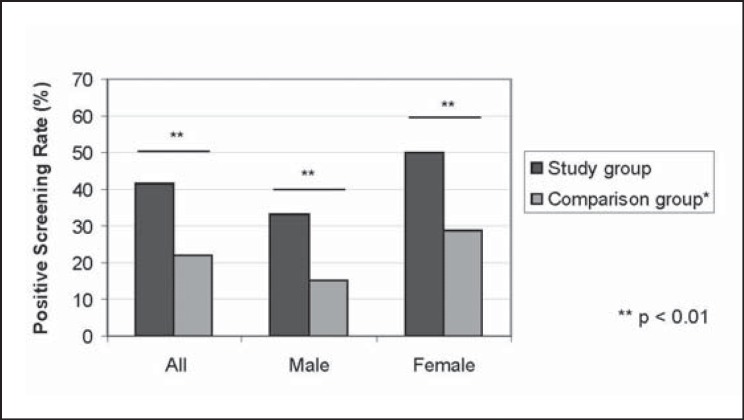
Results: Compared to age-matched normative samples, patients showed increased behavior problems and an impaired HRQOL. 43% of the patients were screened positive for an eating disorder pathology, and this subgroup showed an increased psychopathological burden compared to patients that were screened negative. The lifestyle intervention resulted in a significant weight loss which was unaffected by the presence of an eating disorder pathology. The screening rate for eating disorders remained stable after the intervention.
Conclusion: The large overlap, mutual interaction, and high burden of eating and weight problems in children and adolescents underpin the need for an integrated view in both prevention and treatment approaches in pediatric obesity.
Figures
References
-
- Oude Luttikhuis H, Baur L, Jansen H, Shrewsbury VA, O'Malley C, Stolk RP, Summerbell CD. Interventions for treating obesity in children. Cochrane Database Syst Rev. 2009;(1) CD001872. - PubMed
-
- Tsiros MD, Olds T, Buckley JD, Grimshaw P, Brennan L, Walkley J, Hills AP, Howe PRC, Coates AM. Health-related quality of life in obese children and adolescents. Int J Obes (Lond) 2009;33:387–400. - PubMed
-
- Griffiths LJ, Parsons TJ, Hill AJ. Self-esteem and quality of life in obese children and adolescents: a systematic review. Int J Pediatr Obes. 2010;5:282–304. - PubMed
-
- Fontaine KR, Barofsky I. Obesity and health-related quality of life. Obes Rev. 2001;2:173–182. - PubMed
-
- Lowry K, Sallinen B, Janicke D. The effects of weight management programs on self-esteem in pediatric overweight populations. J Pediatr Psychol. 2007;32:1179–1195. - PubMed
Publication types
MeSH terms
LinkOut - more resources
Full Text Sources
Other Literature Sources
Medical