. 2014 Jan-Feb;7(1):85-91.
doi: 10.1016/j.brs.2013.07.002. Epub 2013 Jul 30.

Left cathodal trans-cranial direct current stimulation of the parietal cortex leads to an asymmetrical modulation of the vestibular-ocular reflex

Affiliations

Left cathodal trans-cranial direct current stimulation of the parietal cortex leads to an asymmetrical modulation of the vestibular-ocular reflex

Qadeer Arshad et al. Brain Stimul. 2014 Jan-Feb.

Abstract

Multi-sensory visuo-vestibular cortical areas within the parietal lobe are important for spatial orientation and possibly for descending modulation of the vestibular-ocular reflex (VOR). Functional imaging and lesion studies suggest that vestibular cortical processing is localized primarily in the non-dominant parietal lobe. However, the role of inter-hemispheric parietal balance in vestibular processing is poorly understood. Therefore, we tested whether experimentally induced asymmetries in right versus left parietal excitability would modulate vestibular function. VOR function was assessed in right-handed normal subjects during caloric ear irrigation (30 °C), before and after trans-cranial direct current stimulation (tDCS) was applied bilaterally over the parietal cortex. Bilateral tDCS with the anode over the right and the cathode over the left parietal region resulted in significant asymmetrical modulation of the VOR, with highly suppressed responses during the right caloric irrigation (i.e. rightward slow phase nystagmus). In contrast, we observed no VOR modulation during either cathodal stimulation of the right parietal cortex or SHAM tDCS conditions. Application of unilateral tDCS revealed that the left cathodal stimulation was critical in inducing the observed modulation of the VOR. We show that disruption of parietal inter-hemispheric balance can induce asymmetries in vestibular function. This is the first report using neuromodulation to show right hemisphere dominance for vestibular cortical processing.

Keywords: Parietal balance; Vestibular cortical processing; Vestibular-ocular reflex; tDCS.


Figures

Figure 1
Figure 1
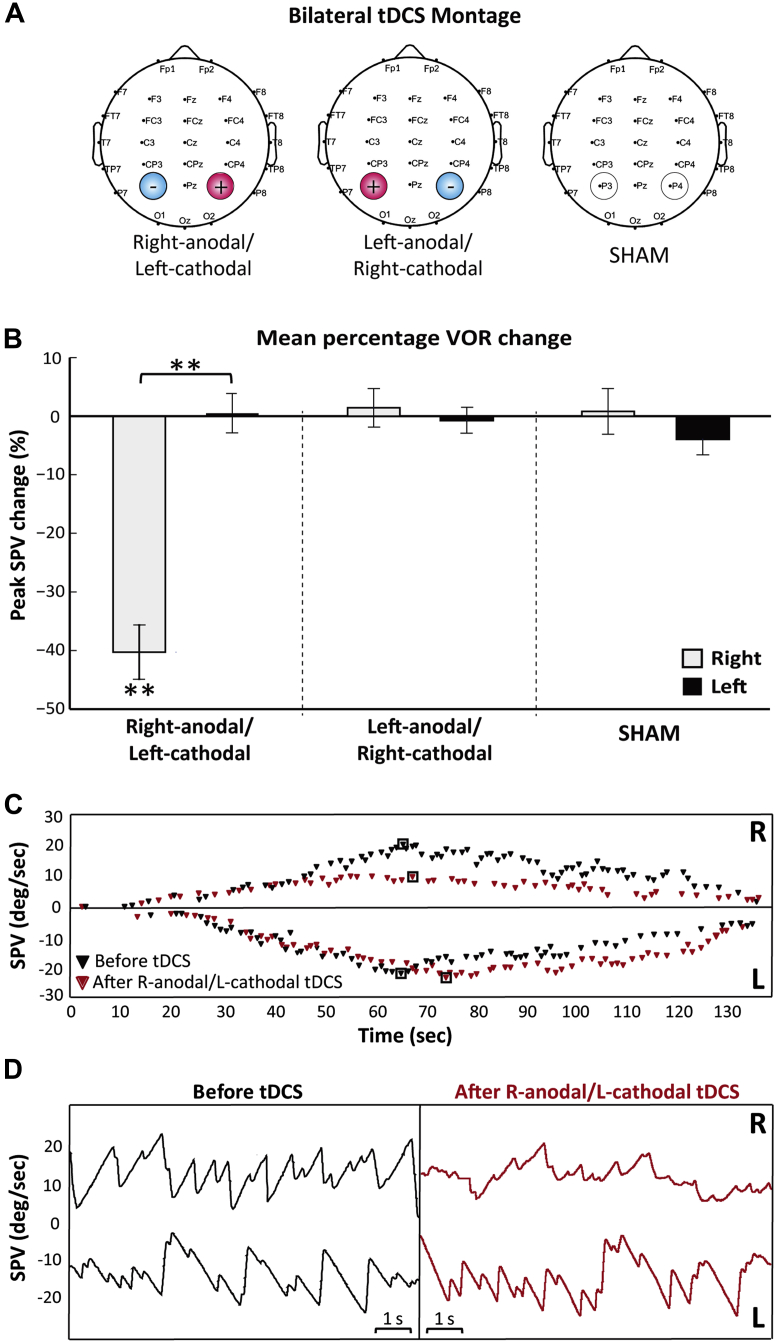
Bilateral tDCS montage and the effect of bilateral tDCS stimulation on the VOR. A. The electrodes delivering tDCS were placed on the left and right parietal cortex, over P3 and P4 respectively (10–20 EEG international positioning system). Three types of bilateral parietal tDCS stimulation were applied: anodal over right hemisphere and cathodal over left hemisphere (referred to as Right-anodal/Left-cathodal), cathodal over right hemisphere and anodal over left hemisphere (referred to as Left-anodal/Right-cathodal) and SHAM. B. Right-anodal/left-cathodal resulted in asymmetrical modulation of the VOR with significant decrease in peak slow phase velocity (SPV) during the right caloric with no significant change seen during the left caloric. Left-anodal/right-cathodal and SHAM stimulations resulted in symmetrical VOR responses with no modulation of the peak SPV during right or left calorics. Data marked ** are significant at P < 0.01. C. VOR responses from a single subject are shown over time for the right (R; positive SPV) and left (L; negative SPV) calorics before (black diamonds) and after (red diamonds) Right-anodal/Left-cathodal stimulation over the parietal cortex. The black boxes indicate the peak SPV. D. Oculomotor responses are shown over 10 s around the peak SPV (from C) for right (R) and left (L) calorics before (black) and after (red) tDCS right-anodal/left-cathodal stimulation. Significant reduction in oculomotor SPV is seen during the right caloric after right-anodal/left-cathodal parietal stimulation. (For interpretation of the references to color in this figure legend, the reader is referred to the web version of this article.)
Figure 2
Figure 2
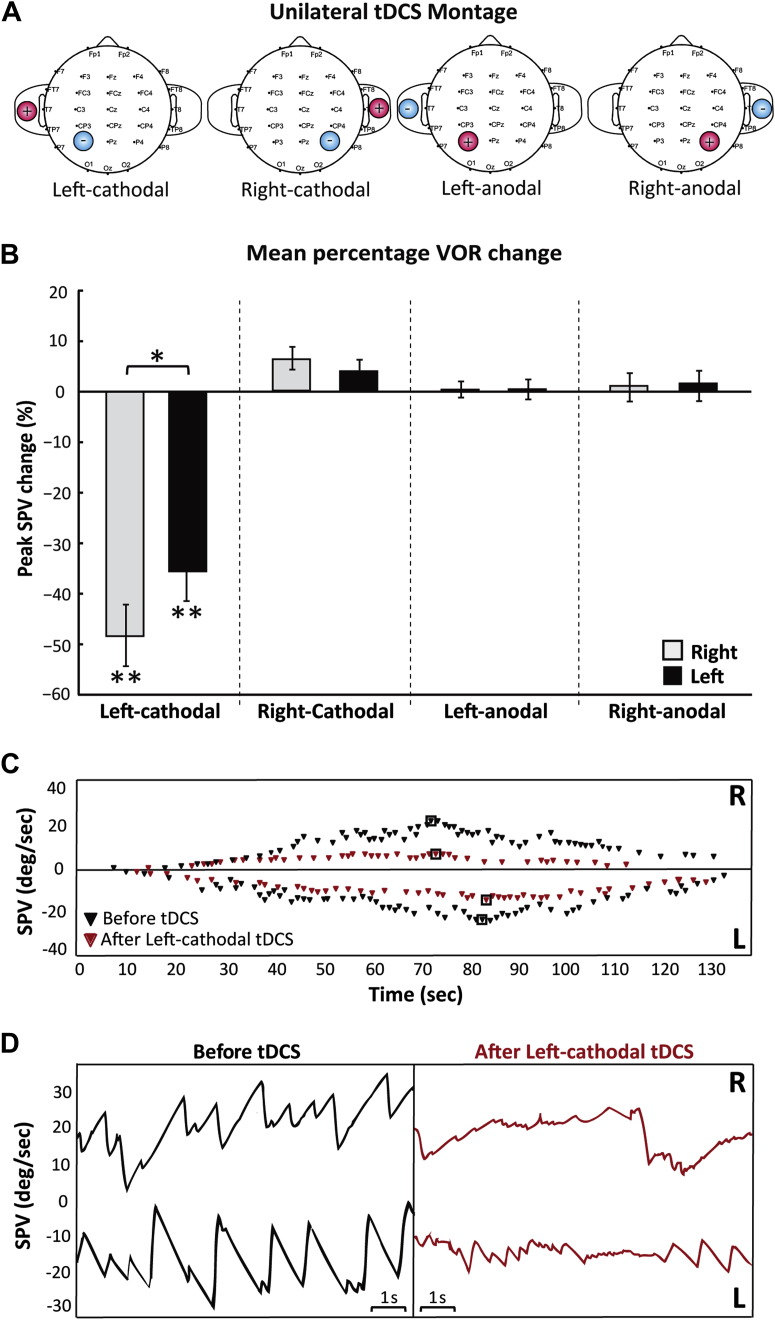
Unilateral tDCS montage and the effect of unilateral tDCS stimulation on the VOR. A. Electrode montage for the 4 different conditions (Left-cathodal, Right-cathodal, Left-anodal, Right-anodal). The reference electrode was placed on the ipsilateral shoulder. B. Left-cathodal stimulation shows a bilateral reduction albeit a significantly greater reduction for right caloric stimulation. Data marked * are significant at P < 0.05, ** are significant at P < 0.01. C. VOR responses from a single subject are shown over time for the right (R; positive SPV) and left (L; negative SPV) calorics before (black diamonds) and after (red diamonds) Left-cathodal stimulation. The black boxes indicate the peak SPV. Oculomotor responses are shown over 10 s around the chosen peak SPV for right (R) and left (L) calorics before (black) and after (red) unilateral Left-cathodal stimulation. Significant reduction in oculomotor SPV is seen during the right and left caloric after left parietal cathodal stimulation. (For interpretation of the references to color in this figure legend, the reader is referred to the web version of this article.)
Figure 3
Figure 3
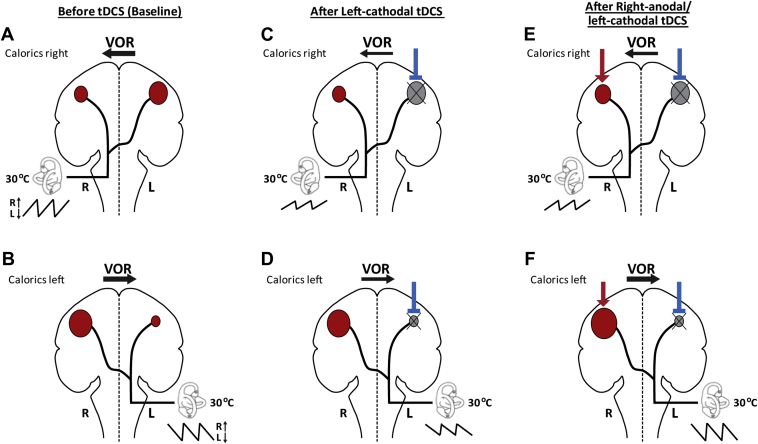
Schematic model of vestibular processing during baseline cold caloric irrigation (A, B) and hypothesized modulation of VOR response after left-cathodal (C, D) and right-anodal/left-cathodal (E, F) tDCS stimulation. The intensity of the cortical activation is represented by the size of the red areas. The direction of slow phase eye movement generated by caloric irrigation is shown by black arrows with the thickness of the arrows indicating eye velocity magnitude. The VOR response following a caloric is exemplified by a short nystagmic trace (inserted below the semi-circular canals), the relative amplitude of which reflects the changes in mean SPV observed. A and B. In the baseline condition, activation of semi-circular canals by caloric irrigation results in stronger projections to contralateral parietal cortex with right hemisphere dominance , , , , . C, D, E, and F. Left-cathodal stimulation results in inhibition of the underlying cortex as represented by blue blunt arrow and gray areas; Right-anodal stimulation causes facilitation of the underlying cortex as represented by red arrow and expansion of red areas. C and D. After unilateral left-cathodal inhibitory stimulation, the left parietal lobe may have insufficient resources to process right and left caloric responses, resulting in the bilateral but asymmetric reduction of the slow phase eye velocity. E and F. After bilateral left-cathodal/right-anodal tDCS stimulation, right caloric is insufficiently processed due to inhibition of the left parietal lobe. Left caloric is sufficiently processed with normal VOR response since application of the right-anodal stimulation may compensate for the lack of processing resources in the left parietal lobe. (For interpretation of the references to color in this figure legend, the reader is referred to the web version of this article.)

References

    1. Dieterich M., Bense S., Lutz S., Drzezga A., Stephan T., Bartenstein P. Dominance for vestibular cortical function in the non-dominant hemisphere. Cereb Cortex. 2003;13(9):994–1007. - PubMed
    1. Ventre-Dominey J., Nighoghossian N., Denise P. Evidence for interacting cortical control of vestibular function and spatial representation in man. Neuropsychologia. 2003;41(14):1884–1898. - PubMed
    1. Sparing R., Thimm M., Hesse M.D., Küst J., Karbe H., Fink G.R. Bidirectional alterations of interhemispheric parietal balance by non-invasive cortical stimulation. Brain. 2009;132(11):3011–3020. - PubMed
    1. Cohen Kadosh R., Soskic S., Iuculano T., Kanai R., Walsh V. Modulating neuronal activity produces specific and long-lasting changes in numerical competence. Curr Biol. 2010;20(22):2016–2020. - PMC - PubMed
    1. Bardi L., Kanai R., Mapelli D., Walsh V. Direct Current Stimulation (tDCS) reveals parietal asymmetry in local/global and salience-based selection. Cortex. 2013;49(3):850–860. - PubMed

Publication types

LinkOut - more resources