


Postnatal phenobarbital for the prevention of intraventricular haemorrhage in preterm infants
- PMID: 23943189
- PMCID: PMC7061244
- DOI: 10.1002/14651858.CD001691.pub3
Postnatal phenobarbital for the prevention of intraventricular haemorrhage in preterm infants
Update in
-
Postnatal phenobarbital for the prevention of intraventricular haemorrhage in preterm infants.Cochrane Database Syst Rev. 2023 Mar 16;3(3):CD001691. doi: 10.1002/14651858.CD001691.pub4. Cochrane Database Syst Rev. 2023. PMID: 36924438 Free PMC article.
Abstract
Background: Intraventricular haemorrhage (IVH) is a major complication of preterm birth. Large haemorrhages are associated with a high risk of disability and hydrocephalus. Instability of blood pressure and cerebral blood flow are postulated as causative factors. Another mechanism may involve reperfusion damage from oxygen free radicals. Phenobarbital has been suggested as a safe treatment that stabilises blood pressure and may protect against free radicals.
Objectives: To determine the effect of postnatal administration of phenobarbital on the risk of IVH, neurodevelopmental impairment or death in preterm infants.
Search methods: We used the search strategy of the Neonatal Collaborative Review Group. The original review author (A Whitelaw) was an active trialist in this area and had personal contact with many groups in this field. He handsearched journals from 1976 (when cranial computed tomography (CT) scanning started) to October 2000; these included: Pediatrics, Journal of Pediatrics, Archives of Disease in Childhood, Pediatric Research, Developmental Medicine and Child Neurology, Acta Paediatrica, European Journal of Pediatrics, Neuropediatrics, New England Journal of Medicine, Lancet and British Medical Journal. We searched the National Library of Medicine (USA) database (via PubMed) and the Cochrane Central Register of Controlled Trials (CENTRAL, 2012, Issue 10) through to 31 October 2012. We did not limit the searches to the English language, as long as the article included an English abstract. We read identified articles in the original language or translated.
Selection criteria: We included randomised or quasi-randomised controlled trials in which phenobarbital was given to preterm infants identified as being at risk of IVH because of gestational age below 34 weeks, birthweight below 1500 g or respiratory failure. Adequate determination of IVH by ultrasound or CT was also required.
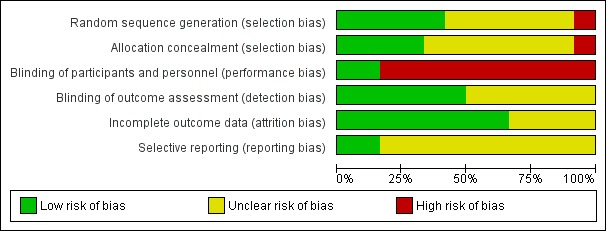
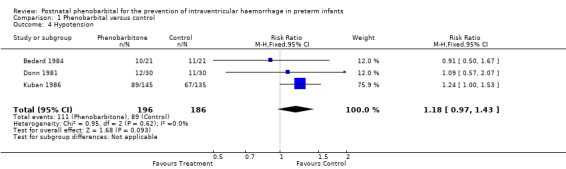
Data collection and analysis: In addition to details of patient selection and control of bias, we extracted the details of the administration of phenobarbital. We searched for the following endpoints: IVH (with grading), posthaemorrhagic ventricular dilation or hydrocephalus, neurodevelopmental impairment and death. In addition, we searched for possible adverse effects of phenobarbitone, for example hypotension, mechanical ventilation, pneumothorax, hypercapnia and acidosis.
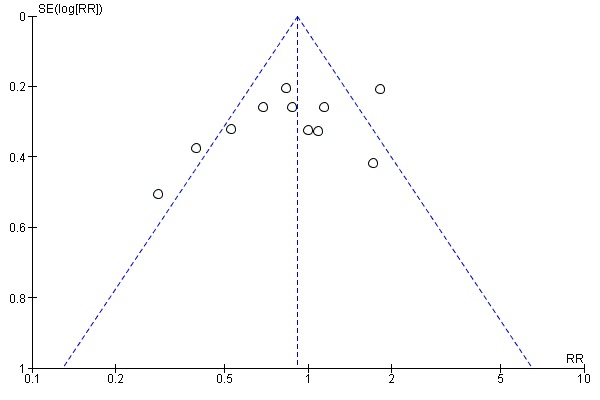
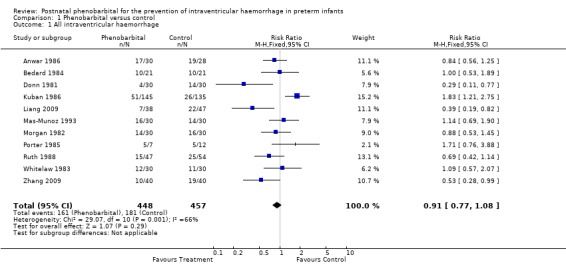
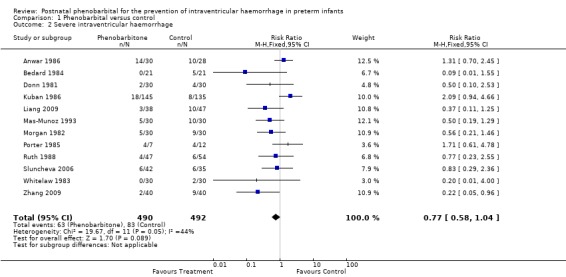
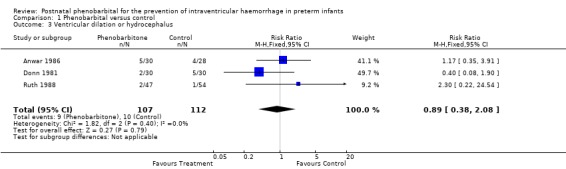
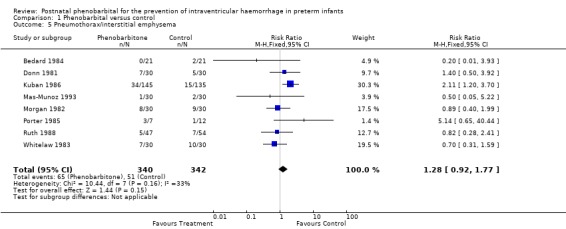
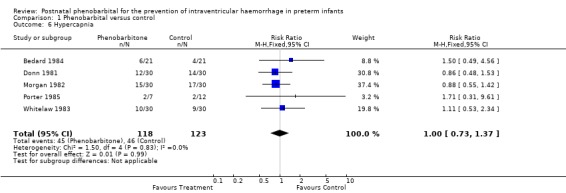
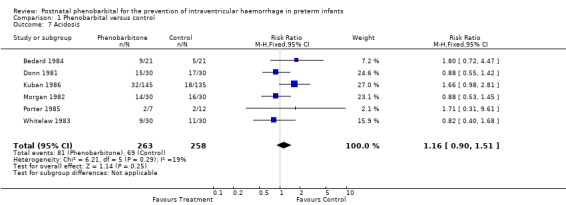
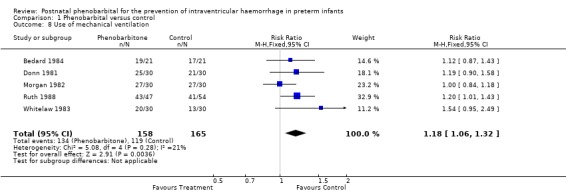
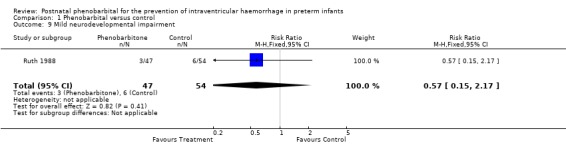
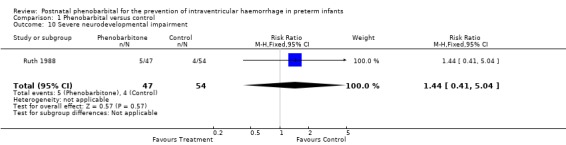
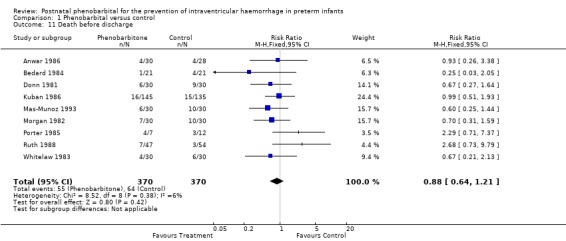
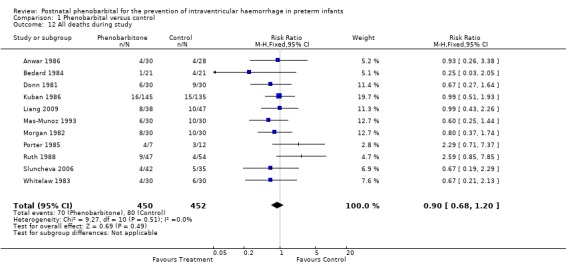
Main results: We included 12 controlled trials that recruited 982 infants. There was heterogeneity between trials for the outcome IVH, with three trials finding a significant decrease in IVH and one trial finding an increase in IVH in the group receiving phenobarbital. Meta-analysis showed no difference between the phenobarbital-treated group and the control group in either all IVH (typical risk ratio (RR) 0.91; 95% CI 0.77 to 1.08), severe IVH (typical RR 0.77; 95% CI 0.58 to 1.04), posthaemorrhagic ventricular dilation (typical RR 0.89; 95% CI 0.38 to 2.08), severe neurodevelopmental impairment (typical RR 1.44; 95% CI 0.41 to 5.04) or death before hospital discharge (typical RR 0.88; 95% CI 0.64 to 1.21). There was a consistent trend in the trials towards increased use of mechanical ventilation in the phenobarbital-treated group, which was supported by the meta-analysis (typical RR 1.18; 95% CI 1.06 to 1.32; typical risk difference 0.129; 95% CI 0.04 to 0.21), but there was no significant difference in pneumothorax, acidosis or hypercapnia.
Authors' conclusions: Postnatal administration of phenobarbital cannot be recommended as prophylaxis to prevent IVH in preterm infants and is associated with an increased need for mechanical ventilation.
Conflict of interest statement
None.
Figures

Update of
-
Postnatal phenobarbital for the prevention of intraventricular hemorrhage in preterm infants.Cochrane Database Syst Rev. 2007 Oct 17;(4):CD001691. doi: 10.1002/14651858.CD001691.pub2. Cochrane Database Syst Rev. 2007. Update in: Cochrane Database Syst Rev. 2013 Aug 13;(8):CD001691. doi: 10.1002/14651858.CD001691.pub3. PMID: 17943755 Updated.
References
References to studies included in this review
Anwar 1986 {published data only}
Bedard 1984 {published data only}
-
- Bedard MP, Shankaran S, Slovis TL, Pantoja A, Dayal B, Poland RL. Effect of prophylactic phenobarbital on intraventricular hemorrhage in high‐risk infants. Pediatrics 1984;73(4):435‐9. - PubMed
Donn 1981 {published data only}
-
- Donn SM, Roloff DW, Goldstein GW. Prevention of intraventricular haemorrhage in preterm infants by phenobarbitone. Lancet 1981;2(8240):215‐7. - PubMed
Kuban 1986 {published and unpublished data}
-
- Kuban K, Leviton A, Brown ER, Krishnamoorthy K, Baglivo J, Sullivan KF, et al. Respiratory complications in low‐birth‐weight infants who received phenobarbital. American Journal of Diseases in Children 1987;141(9):996‐9. - PubMed
-
- Kuban KC, Leviton A, Krishnamoorthy KS, Brown ER, Teele RL, Baglivo JA, et al. Neonatal intracranial hemorrhage and phenobarbital. Pediatrics 1986;77(4):443‐50. - PubMed
Liang 2009 {published data only}
-
- Liang GL, He YZ, Luo L. Phenobarbitone to prevent intraventricular hemorrhage in preterm infants ‐ an observational study (38 cases). Journal of Medical Theory and Practice 2009;22(4):449‐50. [1001‐7585(2009)04‐0449‐02]
Mas‐Munoz 1993 {published data only}
-
- Mas‐Munoz RL, Udaeta‐Mora E, Barrera‐Reyes RH, Rivera‐Rueda MA, Morales‐Suarez M. The effect of phenobarbital on the severity of intraventricular hemorrhage [Efecto del fenobarbital sobre la gravedad de la hemorragia intraventricular]. Boletín Médico del Hospital Infantil de México 1993;50(6):376‐82. - PubMed
Morgan 1982 {published data only}
-
- Morgan ME, Massey RF, Cooke RW. Does phenobarbitone prevent periventricular hemorrhage in very low birth weight babies: a controlled trial. Pediatrics 1982;70(2):186‐9. - PubMed
Porter 1985 {published data only}
-
- Porter FL, Marshall RE, Moore JA, Miller RH. Effect of phenobarbital on motor activity and intraventricular hemorrhage in preterm infants with respiratory disease weighing less than 1500 grams. American Journal of Perinatology 1985;2(2):63‐6. - PubMed
Ruth 1988 {published data only}
-
- Ruth V, Virkola K, Paetau R, Raivio KO. Early high‐dose phenobarbital treatment for prevention of hypoxic‐ischemic brain damage in very low birth weight infants. Journal of Pediatrics 1988;112(1):81‐6. - PubMed
Sluncheva 2006 {published data only}
-
- Sluncheva B, Vakrilova L, Emilova Z, Kalaĭdzhieva M, Garnizov T. Prevention of brain hemorrhage in infants with low and extremely low birth weight and infants treated with surfactants. Late observation. Akusherstvo i Ginekologiia (Sofiia) 2006;45(3):34‐8. - PubMed
Whitelaw 1983 {published data only}
-
- Whitelaw A, Placzek M, Dubowitz L, Lary S, Levene M. Phenobarbitone for prevention of periventricular haemorrhage in very low birth‐weight infants. A randomised double‐blind trial. Lancet 1983;2(8360):1168‐70. - PubMed
Zhang 2009 {published data only}
-
- Zhang ZJ, Yuan J, Meng YQ, Guo JX. An observational study of phenobarbitone in preventing intraventricular hemorrhage in preterm infants. Inner Mongolian Medical Journal 2009;41(5):617‐8. [1004‐0951(2009)05‐0617‐02]
References to studies excluded from this review
Chen 2008 {published data only}
-
- Chen H, Wei K, Yao Y, Yang Y, Zhou C, Fang X, et al. Multicenter investigative report for the effect of prophylactic phenobarbital on intraventricular hemorrhage in premature infants in China. Journal of Clinical Pediatrics 2008;26(11):986‐93.
Hope 1982 {published data only}
-
- Hope PL, Stewart AL, Thorburn RJ, Whitehead MD, Reynolds EO, Lowe D. Failure of phenobarbitone to prevent intraventricular haemorrhage in small preterm infants. Lancet 1982;1(8269):444‐5. - PubMed
Liu 2010 {published data only}
-
- Liu Z, Zhao Y, Chen W, Wang H. Efficacy and safety of phenobarbital in preventing intraventricular hemorrhage in premature newborns. Journal of Bengbu Medical College 2010;35(10):1030‐2. [1000‐2200(2010)10‐1030‐03]
Additional references
Bittigau 2002
Crowther 2010
Forcelli 2012
Goddard 1987
-
- Goddard‐Finegold J, Armstrong DL. Reduction in incidence of periventricular intraventricular hemorrhages in hypertensive newborn beagles pretreated with phenobarbital. Pediatrics 1987;79(6):901‐6. - PubMed
Gould 1987
-
- Gould SJ, Howard S. An immunohistochemical study of the germinal matrix in the late gestation human fetal brain. Neuropathology and Applied Neurobiology 1987;13(6):421‐37. - PubMed
Hambleton 1976
Higgins 2011
-
- Higgins JPT, Green S (editors). Cochrane Handbook for Systematic Reviews of Interventions Version 5.1.0 [updated March 2011]. The Cochrane Collaboration, 2011. Available from www.cochrane‐handbook.org.
Hope 1988
-
- Hope PL, Gould SJ, Howard S, Hamilton PA, Costello AM, Reynolds EO. Precision of ultrasound diagnosis of pathologically verified lesions in the brains of very preterm infants. Developmental Medicine and Child Neurology 1988;30(4):457‐71. - PubMed
Horbar 1992
-
- Horbar J. Prevention of periventricular‐intraventricular hemorrhage. In: Sinclair JC, Bracken MB editor(s). Effective Care of the Newborn Infant. Oxford: Oxford University Press, 1992:562‐89.
Levene 1982
Ment 1985
-
- Ment LR, Stewart WB, Duncan CC. Beagle puppy model of intraventricular hemorrhage. Effect of superoxide dismutase on cerebral blood flow and prostaglandins. Journal of Neurosurgery 1985;62(4):563‐9. - PubMed
Nakamura 1990
-
- Nakamura Y, Okudera T, Fukuda S, Hashimoto T. Germinal matrix hemorrhage of venous origin in preterm neonates. Human Pathology 1990;21(10):1059‐62. - PubMed
Papile 1978
-
- Papile LA, Burstein J, Burstein R, Koffler H. Incidence and evolution of subependymal and intraventricular hemorrhage: a study of infants with birth weights less than 1,500 gm. Journal of Pediatrics 1978;92(4):529‐34. - PubMed
Perlman 1983
-
- Perlman JM, McMenamin JB, Volpe JJ. Fluctuating cerebral blood‐flow velocity in respiratory‐distress syndrome. Relation to the development of intraventricular hemorrhage. New England Journal of Medicine 1983;309(4):204‐9. - PubMed
RevMan 2011 [Computer program]
-
- The Nordic Cochrane Centre, The Cochrane Collaboration. Review Manager (RevMan). Version 5.1. Copenhagen: The Nordic Cochrane Centre, The Cochrane Collaboration, 2011.
Roberts 2006
Schmidt 2001
-
- Schmidt B, Davis P, Moddemann D, Ohlsson A, Roberts RS, Saigal S, et al. Long‐term effects of indomethacin prophylaxis in extremely‐low‐birth‐weight infants. New England Journal of Medicine 2001;344(26):1966‐72. - PubMed
Steen 1979
-
- Steen PA, Mitchenfelder JD. Barbiturate protection in tolerant and nontolerant hypoxic mice: comparison with hypothermic protection. Anesthesiology 1979;50(5):404‐8. - PubMed
Vohr 1989
-
- Vohr BR, Garcia‐Coll C, Mayfield S, Brann B, Shaul P, Oh W. Neurologic and developmental status related to the evolution of visual‐motor abnormalities from birth to 2 years of age in preterm infants with intraventricular hemorrhage. Journal of Pediatrics 1989;115(2):296‐302. - PubMed
Volpe 1995
-
- Volpe JJ. Neurology of the Newborn. 3rd Edition. Philadelphia: Saunders, 1995:403‐463.
Whitelaw 2001
Whitelaw 2001a
Whitelaw 2001b
Wimberley 1982
-
- Wimberley PD, Lou HC, Pedersen H, Hejl M, Lassen NA, Friis‐Hansen B. Hypertensive peaks in the pathogenesis of intraventricular hemorrhage in the newborn. Abolition by phenobarbitone sedation. Acta Paediatrica Scandinavica 1982;71(4):537‐42. - PubMed
References to other published versions of this review
Whitelaw 1999
Publication types
MeSH terms
Substances
Grants and funding
LinkOut - more resources
Full Text Sources
Other Literature Sources
Medical
