. 2013 Aug 13;4(4):e00455-13.
doi: 10.1128/mBio.00455-13.

Old Cryptococcus neoformans cells contribute to virulence in chronic cryptococcosis

Affiliations

Old Cryptococcus neoformans cells contribute to virulence in chronic cryptococcosis

Tejas Bouklas et al. mBio. .

Abstract

Does cell age matter in virulence? The emergence of persister cells during chronic infections is critical for persistence of infection, but little is known how this occurs. Here, we demonstrate for the first time that the replicative age of the fungal pathogen Cryptococcus neoformans contributes to persistence during chronic meningoencephalitis. Generationally older C. neoformans cells are more resistant to hydrogen peroxide stress, macrophage intracellular killing, and antifungal agents. Older cells accumulate in both experimental rat infection and in human cryptococcosis. Mathematical modeling supports the concept that the presence of older C. neoformans cells emerges from in vivo selection pressures. We propose that advanced replicative aging is a new unanticipated virulence trait that emerges during chronic fungal infection and facilitates persistence. Therapeutic interventions that target old cells could help in the clearance of chronic infections.

Importance: Our findings that the generational age of Cryptococcus neoformans cells matters in pathogenesis introduces a novel concept to eukaryotic pathogenesis research. We propose that emerging properties of aging C. neoformans cells and possibly also other fungal pathogens contribute to persistence and virulence. Whereas the replicative life span of strains may not matter for virulence per se, age-related resilience and thus the generational age of individual C. neoformans cells within a pathogen population could greatly affect persistence of the pathogen population and therefore impact outcome.


Figures
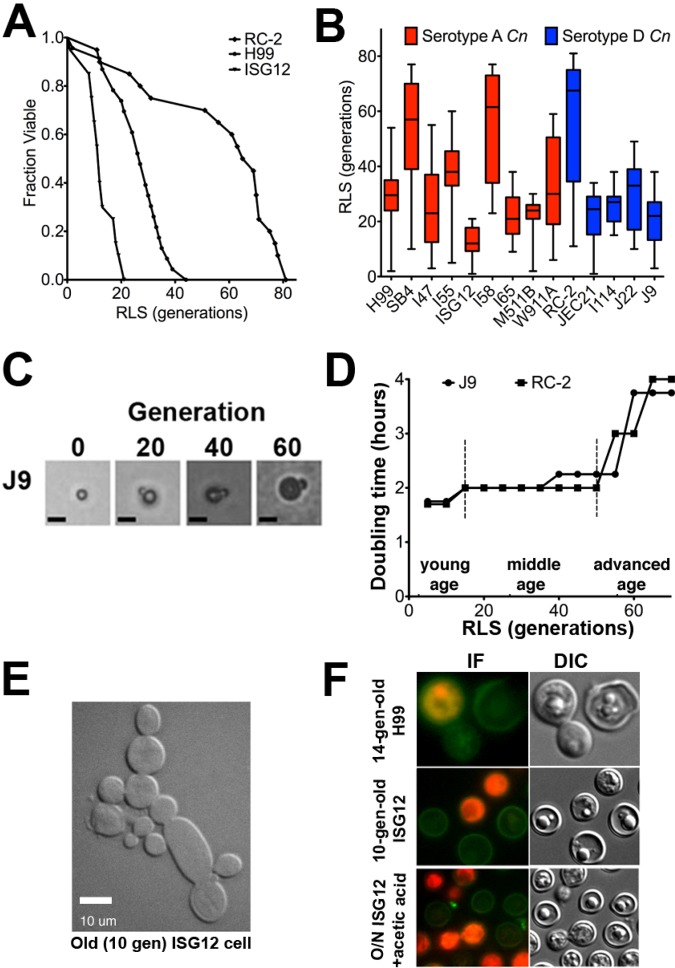
FIG 1
FIG 1
Clinical C. neoformans strains demonstrated variability in their life span. (A) Recording of RLS of individual cells of C. neoformans by generation of survival curves demonstrated short (ISG12), medium (H99), and long (RC-2) RLSs of strains that were statistically different from each other (P < 0.01 by Wilcoxon rank sum test). (B) The median RLSs (short horizontal lines in the boxes) of clinical serotype A and D C. neoformans strains were highly variable (20 to 60 cells per strain). The minimum and maximum values for all data are indicated by the ends of the whiskers of the box plots. (C) Increasing cell size was observed during the RLS shown for C. neoformans strain J9 at 0, 20, 40, and 60 replications. Bars, 10 µm. (D) The RLS of C. neoformans strains (J9 and RC-2) can be divided into young, middle, and advanced age based on changes in DT. (E) 10-generation-old C. neoformans cells (ISG12) manifested abnormal budding. Bar, 10 µm. (F) In order to investigate how cells of advanced age died, 14-generation-old H99 cells or 10-generation-old ISG12 cells were stained with annexin V. Cells undergoing apoptosis stained positive for annexin V (green), those undergoing necrosis stained for propidium iodine (PI) (red), and the cells that had suffered loss of membrane integrity stained for both (red with green boundary). Young cells (overnight [O/N] culture) were treated with acetic acid to induce apoptosis and stained similarly. The cells were examined by immunofluorescence (IF) and differential interference contrast (DIC) microscopy.
FIG 2
FIG 2
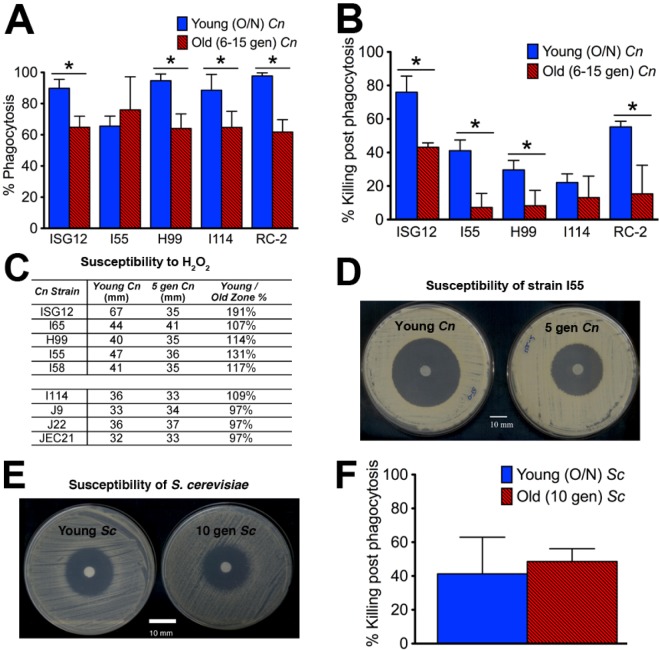
Aging promoted resistance to killing by macrophages and H2O2. (A) Phagocytic uptake by macrophages was inhibited in most older C. neoformans compared to young C. neoformans cells. O/N, overnight; gen, generation. (B) Older cells were more resistant to killing 1 to 3 h after phagocytosis than young C. neoformans cells. The values in panels A and B that are significantly different (P < 0.001) are indicated by a bar and asterisk. (C) Accordingly, 5-generation-old C. neoformans cells were commonly more resistant to H2O2 than young cells. The susceptibility to H2O2 is indicated by the zone of growth inhibition. (D) H2O2 disc diffusion assay with strain I55 showed susceptibility of young cells as demonstrated by a larger zone of growth inhibition. (E) H2O2 assay showed a comparable zone of inhibition for young (36 mm) and 10-generation-old S. cerevisiae cells (34 mm). (F) 10-generation-old S. cerevisiae cells and young cells were comparably susceptible to macrophage killing.
FIG 3
FIG 3
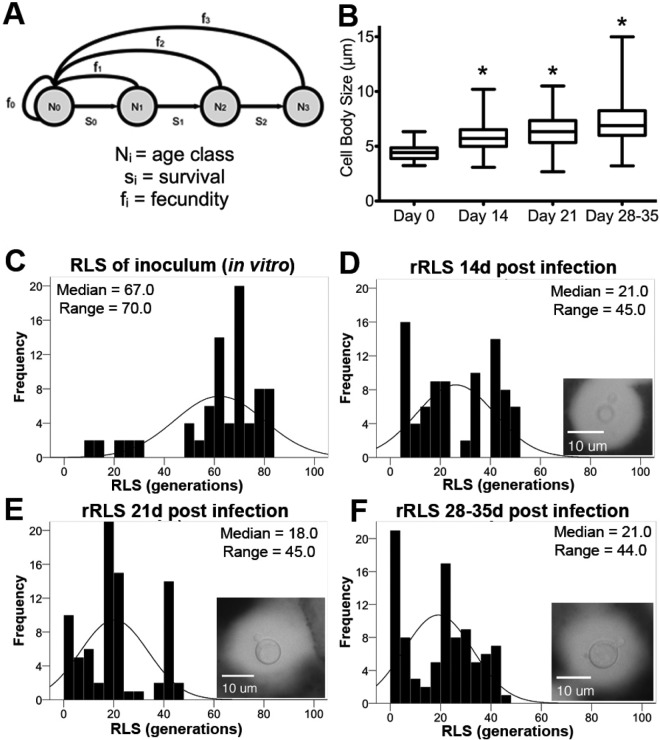
In vivo selection of older cells was observed in rat CME. (A) The ability of virgin cells (No) to age one generation (N1) depends on their survival (si) and on their fecundity (fi), which change with progression to each age class. In a replicating pathogen population, most cells are young (No to N2) and will live their full RLS. To investigate whether selection of older cells occurs in the host, rats were infected with RC-2 cells. (B) Cell body size significantly increased during infection as indicated by the asterisks (P < 0.001 by Kruskal-Wallis test). (C to F) rRLS was determined at 0, 14, 21, and 28 to 35 days postinfection and found to consistently decrease (P < 0.01 by Wilcoxon rank sum test). Note that the cells were budding (insets) and actively growing (increasing CFU [data not shown]). A total of 50 to 100 cells were microdissected in two independent experiments.
FIG 4
FIG 4
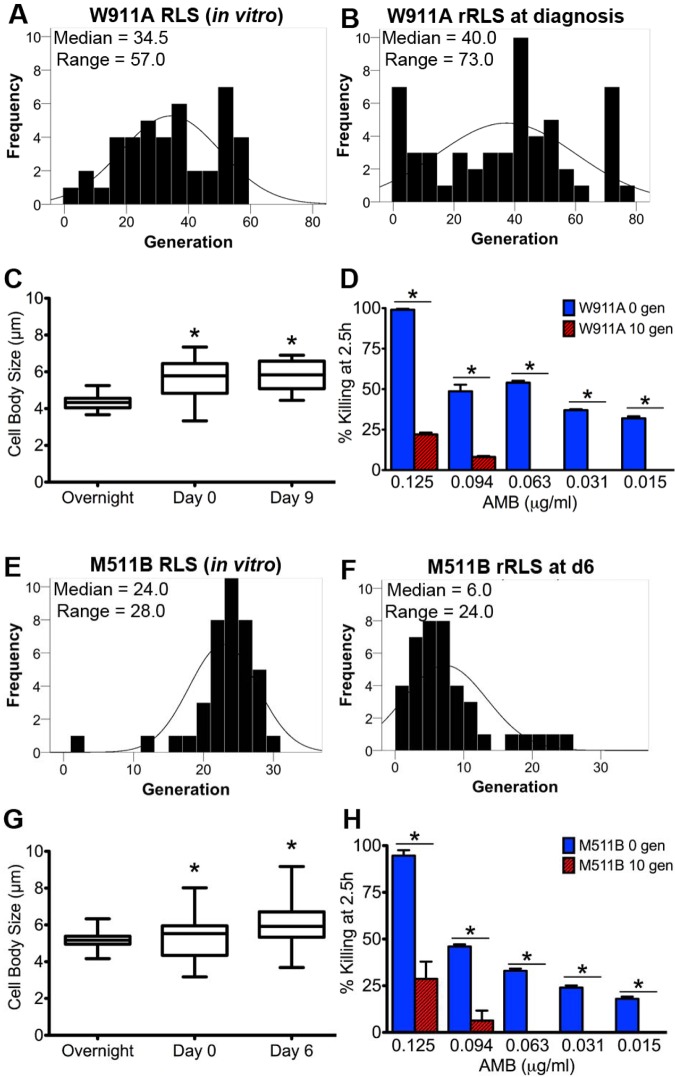
In vivo and in vitro selection of older cells was observed in human CME. (A and B) The rRLS of C. neoformans cells from the first lumbar puncture of patient W911 (W911A cells) showed a trend for selection of older cells with a shortened rRLS (40.0 versus 34.5 generations on average; P > 0.01 by Wilcoxon rank sum test). (C) Cell body size of in vivo cells from patient W911 derived at day 0 and  day 9 was increased, suggesting that they were of advanced age (P < 0.001 by Kruskal-Wallis test). (D) To investigate whether antifungal treatment may explain the selection of older cells in the host, we exposed 0- or 10-generation-old W911A cells to AMB in vitro and found that they were more resistant to antifungal killing (P < 0.01) as indicated by the bars and asterisks. (E and F) Similarly, the rRLS of cells from the second lumbar puncture of patient M511 (M511B cells) was significantly reduced compared to its in vitro RLS (6.0 versus 24.0 generations on average; P < 0.01 by Wilcoxon rank sum test). Unlike the first patient, this patient had been on AMB when the cells were collected, which likely drove the selection of older cells. (G) The size of C. neoformans cells from patient M511 was increased relative to that of in vitro C. neoformans cells (P < 0.001 by Kruskal-Wallis test) as indicated by the asterisks. (H) AMB experiments confirmed that 10-generation-old M511B cells were more resistant to antifungal killing.
FIG 5
FIG 5
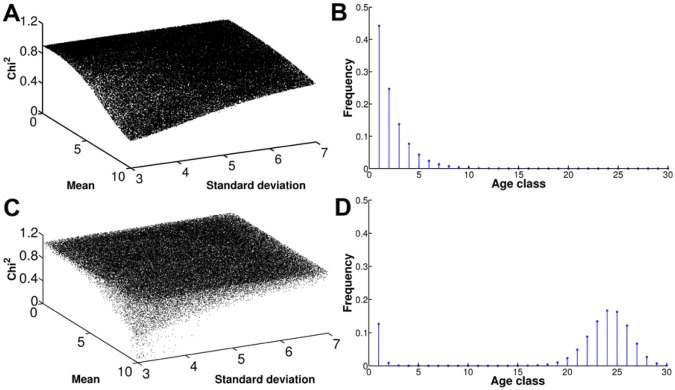
Mathematical modeling explained experimental data showing accumulation of older C. neoformans cells. (A and B) In a neutral scenario that assumed a constant fitness function, the minimum chi-square obtained was high (A), and the distribution did not show a bias toward the older age classes (B). (C and D) When selection was added to the scenario, the minimum chi-square improved substantially (C), obtaining distributions that showed a bias toward the older age classes (D).

References

    1. Park BJ, Wannemuehler KA, Marston BJ, Govender N, Pappas PG, Chiller TM. 2009. Estimation of the current global burden of cryptococcal meningitis among persons living with HIV/AIDS. AIDS 23:525–530 - PubMed
    1. Casadevall A, Spitzer ED, Webb D, Rinaldi MG. 1993. Susceptibilities of serial Cryptococcus neoformans isolates from patients with recurrent cryptococcal meningitis to amphotericin B and fluconazole. Antimicrob. Agents Chemother. 37:1383–1386 - PMC - PubMed
    1. Manosuthi W, Sungkanuparph S, Thongyen S, Chumpathat N, Eampokalap B, Thawornwan U, Foongladda S. 2006. Antifungal susceptibilities of Cryptococcus neoformans cerebrospinal fluid isolates and clinical outcomes of cryptococcal meningitis in HIV-infected patients with/without fluconazole prophylaxis. J. Med. Assoc. Thai. 89:795–802 - PubMed
    1. Spitzer ED, Spitzer SG, Freundlich LF, Casadevall A. 1993. Persistence of initial infection in recurrent Cryptococcus neoformans meningitis. Lancet 341:595–596 - PubMed
    1. Bicanic T, Muzoora C, Brouwer AE, Meintjes G, Longley N, Taseera K, Rebe K, Loyse A, Jarvis J, Bekker LG, Wood R, Limmathurotsakul D, Chierakul W, Stepniewska K, White NJ, Jaffar S, Harrison TS. 2009. Independent association between rate of clearance of infection and clinical outcome of HIV-associated cryptococcal meningitis: analysis of a combined cohort of 262 patients. Clin. Infect. Dis. 49:702–709 - PMC - PubMed

Publication types

LinkOut - more resources