Observational Study
. 2014 May;63(5):736-43.
doi: 10.1136/gutjnl-2013-304786. Epub 2013 Aug 13.

Shanghai fever: a distinct Pseudomonas aeruginosa enteric disease

Affiliations
Free PMC article
Observational Study

Shanghai fever: a distinct Pseudomonas aeruginosa enteric disease

Chih-Hsien Chuang et al. Gut. 2014 May.
Free PMC article

Abstract

Background: Shanghai fever, a community-acquired enteric illness associated with sepsis caused by Pseudomonas aeruginosa, was first described in 1918. The understanding of Shanghai fever is incomplete.

Objective: To delineate the clinical features and to examine the host and microbial factors associated with Shanghai fever.

Methods: We prospectively enrolled 27 consecutive previously healthy children with community-acquired P aeruginosa enteritis and sepsis between July 2003 and June 2012. An immunological investigation, including measurement of serum immunoglobulin levels and lymphocyte subpopulations, was performed. The clonal relationship of bacterial isolates was determined by multilocus sequence typing (MLST) and the virulence of isolates was measured using cellular and animal models.

Results: The median age of the patients was 7 months; 24 (89%) were aged <1 year. The most common clinical manifestations were fever (100%), diarrhoea (96%) and shock (81%). Leucopenia, thrombocytopenia, high C-reactive protein levels, coagulopathy and hypoalbuminaemia were the key laboratory findings. Necrotising enteritis with or without bowel perforation, ecthyma gangrenosum and seizures were main complications. The death rate was 15%. No common primary immune deficiency was identified. MLST genotypes indicated that isolates from Shanghai fever were non-clonal, but they shared similar phenotypes which were invariably cytotoxic, invasive and adhesive in cellular experiments and caused prolonged gut colonisation and more death than respiratory and laboratory control strains in mice.

Conclusions: Shanghai fever is a sporadic community-acquired disease of previously healthy infants that manifests as sepsis associated with P aeruginosa enteric disease. Both host and microbial factors play a role in pathogenesis.

Keywords: Bacterial Infection; Bacterial Pathogenesis; Enteric Infections; Infectious Diarrhoea; Sepsis.


Figures
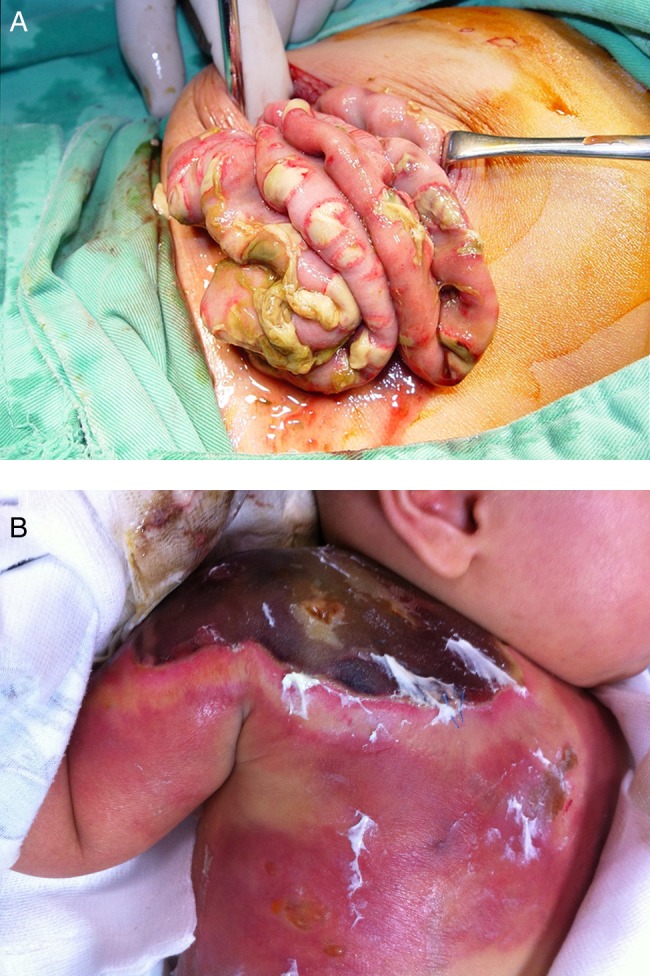
Figure 1
Figure 1
Pictures of necrotising enteritis and ecthyma gangrenosum. (A) Widespread patchy necrosis with fibrin coating on the small intestine. (B) A huge and extensive ecthyma gangrenosum.
Figure 2
Figure 2
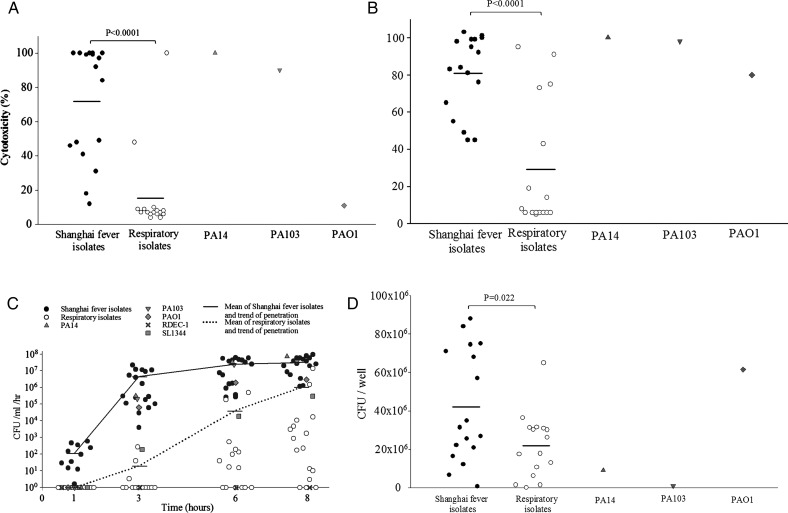
In vitro virulence assays of Pseudomonas aeruginosa strains (17 isolates from patients with Shanghai fever; 16 from patients with nosocomial pneumonia; and PAO1, PA103 and PA14). (A) Cytotoxicity assays to Madin–Darby canine kidney (MDCK) cells. Isolates from patients with Shanghai fever were significantly more cytotoxic than isolates from patients with nosocomial pneumonia (p<0.0001). Horizontal lines represent means. (B) Cytotoxicity assays to neutrophils. Isolates from Shanghai fever were significantly more cytotoxic than respiratory isolates (p<0.0001). Horizontal lines represent means. (C) Penetration assays. Shanghai fever isolates penetrated the MDCK cell monolayer more rapidly than respiratory isolates (p<0.0001). The numbers of bacteria that penetrated the MDCK cell monolayers were significantly higher with Shanghai fever isolates than respiratory isolates (p=0.009) and laboratory strains (p=0.012) 3 h after inoculation. Shanghai fever isolates had significantly higher penetrative capability than the respiratory and laboratory strains. Horizontal lines represent the means at different time points. (D) Adhesion assays. Shanghai fever isolates were more adherent to Caco-2 cells than were respiratory isolates (p=0.022) and cytotoxic laboratory strains (PA103 and PA14) (p=0.001). Horizontal lines represent means. CFU, colony forming units.
Figure 3
Figure 3
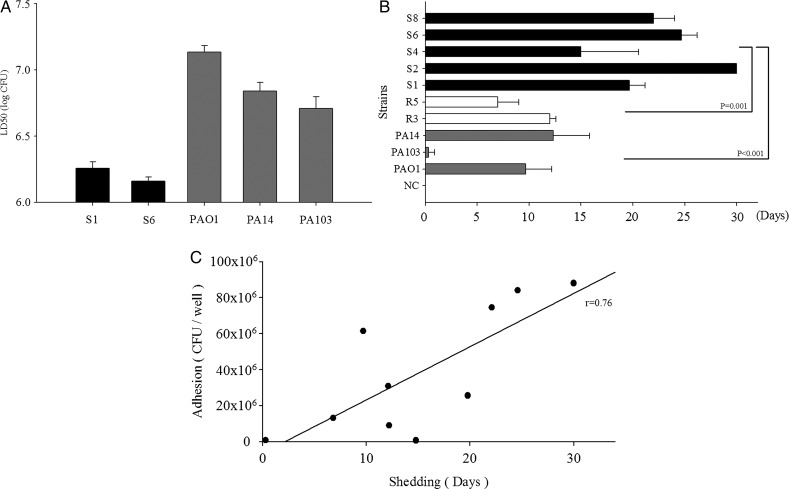
Results of animal experiments. (A) The 50% lethal doses (LD50) of Pseudomonas aeruginosa strains to mice by intravenous challenge. Two Shanghai fever isolates (S1 and S6) and the three laboratory strains (PAO1, PA103 and PA14) were tested. Virulence of Shanghai fever isolates was greater than that of laboratory strains. (B) Duration of fecal shedding of P aeruginosa after oral challenge. Stool collected from each mouse before oral challenge was confirmed negative for P aeruginosa. Negative controls (NC) were mice challenged with normal saline. Mice challenged with Shanghai fever isolates of P aeruginosa (S1, S2, S4, S6 and S8) showed significantly longer shedding time than those challenged with laboratory strains (PAO1, PA103 and PA14) (p<0.001) or respiratory isolates (R3 and R5) (p=0.001). The results are expressed as mean±SD. The study was terminated at day 30, but S2 shed for more than 30 days. (C) The correlation between adhesion in cellular model and fecal shedding in mice was 0.76 (p=0.011).

References

    1. Bodey GP, Bolivar R, Fainstein V, et al. Infections caused by Pseudomonas aeruginosa. Rev Infect Dis 1983;5:279–313 - PubMed
    1. Grisaru-Soen G, Lerner-Geva L, Keller N, et al. Pseudomonas aeruginosa bacteremia in children: analysis of trends in prevalence, antibiotic resistance and prognostic factors. Pediatr Infect Dis J 2000;19:959–63 - PubMed
    1. Adlard PA, Kirov SM, Sanderson K, et al. Pseudomonas aeruginosa as a cause of infectious diarrhoea. Epidemiol Infect 1998;121:237–41 - PMC - PubMed
    1. Kim SW, Peck KR, Jung SI, et al. Pseudomonas aeruginosa as a potential cause of antibiotic-associated diarrhea. J Korean Med Sci 2001;16:742–4 - PMC - PubMed
    1. Dold H. On pyocyaneus sepsis and intestinal infections in Shanghai due to Bacillus pyocyaneus. Chin Med J 1918;32:435

Publication types

MeSH terms