Review
. 2013 Oct;32(10):557-64.
doi: 10.1089/dna.2013.2159. Epub 2013 Aug 14.

Viroporins customize host cells for efficient viral propagation

Affiliations
Review

Viroporins customize host cells for efficient viral propagation

Kristina M Giorda et al. DNA Cell Biol. 2013 Oct.

Abstract

Viruses are intracellular parasites that must access the host cell machinery to propagate. Viruses hijack the host cell machinery to help with entry, replication, packaging, and release of progeny to infect new cells. To carry out these diverse functions, viruses often transform the cellular environment using viroporins, a growing class of viral-encoded membrane proteins that promote viral proliferation. Viroporins modify the integrity of host membranes, thereby stimulating the maturation of viral infection, and are critical for virus production and dissemination. Significant advances in molecular and cell biological approaches have helped to uncover some of the roles that viroporins serve in the various stages of the viral life cycle. In this study, the ability of viroporins to modify the cellular environment will be discussed, with particular emphasis on their role in the stepwise progression of the viral life cycle.


Figures
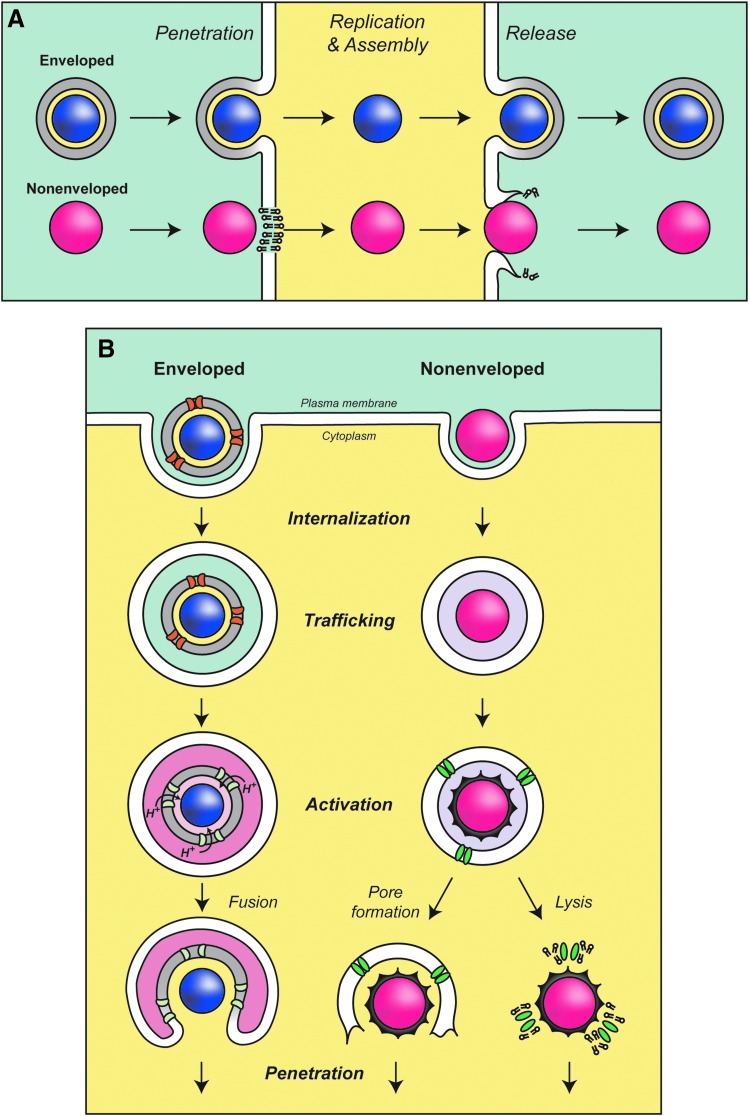
FIG. 1.
FIG. 1.
Models of viral infection and release. (A) Membrane penetration and release of enveloped and nonenveloped viruses. (Top) Fusion of the viral membrane with the host cell membrane is used to overcome the lipid bilayer for enveloped virus infection. Viral replication is facilitated by host cell factors. Enveloped viruses bud from infected cells and are released by membrane fission. (Bottom) Nonenveloped viruses induce host cell lysis for efficient release of particles. (B) Mechanisms of enveloped and nonenveloped viral penetration. (Left) Internalization of influenza virus and trafficking to acidic endosomes leads to activation of the viroporin M2 (green) and proton influx into the virus interior. This is thought to induce structural rearrangements of the virus particle. The penetration of influenza virus is mediated by envelope glycoproteins for delivery of the activated viral particle. (Right) Protease activation or receptor binding induces the release of capsid viroporins from nonenveloped viruses to induce pore formation or membrane lysis for penetration.
FIG. 2.
FIG. 2.
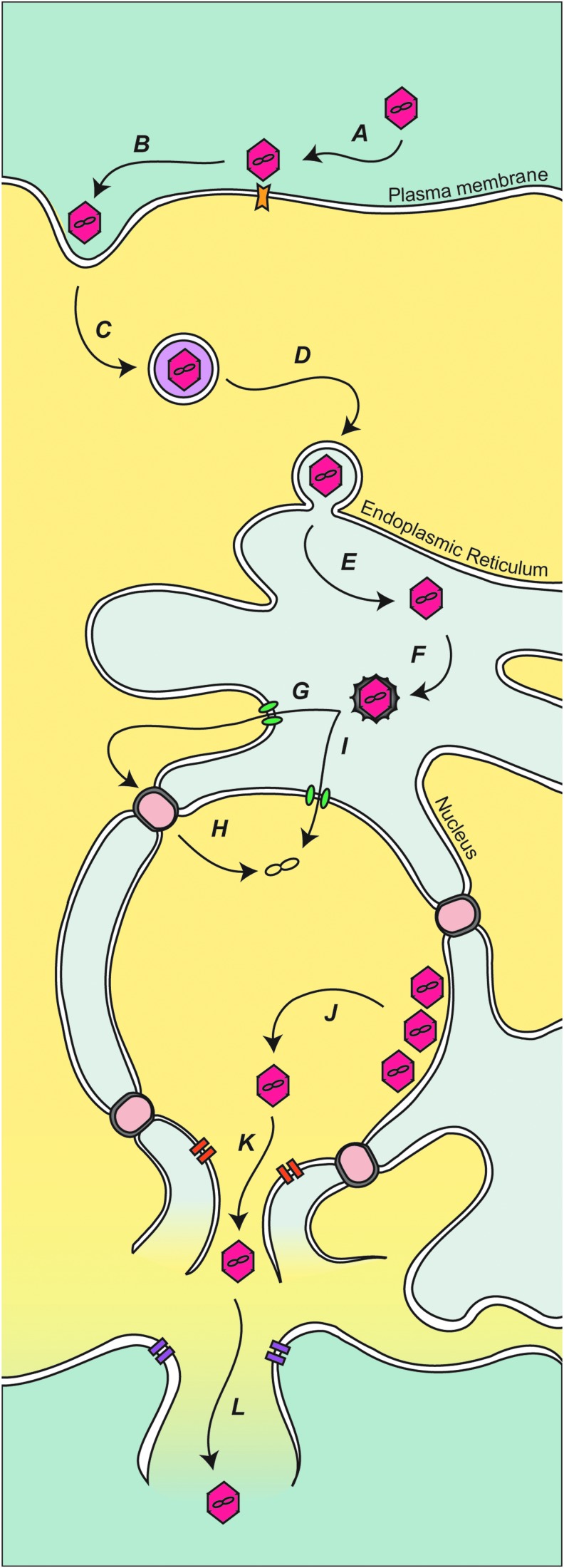
Model for polyomavirus infection and release. (A) Polyomavirus is bound at the plasma membrane by cellular receptors. (B) The virus is taken up by invagination of the plasma membrane. (C) The endocytosed virus is transported and (D) delivered to the ER. (E–F) Once the SV40 is in the ER, it is proposed that the viral protein coat is disassembled, releasing or exposing structural proteins VP2 and VP3. The released or exposed coat proteins aid viral transport to either the cytoplasm (G–H) or nucleus (I). (J) Capsid assembly around the viral minichromosome produces virions in the nucleus. (K) Newly produced VP4, along with (L) agnoprotein, triggers cytolysis of the host cell and release of the viral progeny. ER, endoplasmic reticulum.

References

    1. Agirre A. Barco A. Carrasco L. Nieva J.L. Viroporin-mediated membrane permeabilization. Pore formation by nonstructural poliovirus 2B protein. J Biol Chem. 2002;277:40434–40441. - PubMed
    1. Agosto M.A. Ivanovic T. Nibert M.L. Mammalian reovirus, a nonfusogenic nonenveloped virus, forms size-selective pores in a model membrane. Proc Natl Acad Sci U S A. 2006;103:16496–16501. - PMC - PubMed
    1. Aldabe R. Barco A. Carrasco L. Membrane permeabilization by poliovirus proteins 2B and 2BC. J Biol Chem. 1996;271:23134–23137. - PubMed
    1. Aldabe R. Irurzun A. Carrasco L. Poliovirus protein 2BC increases cytosolic free calcium concentrations. J Virol. 1997;71:6214–6217. - PMC - PubMed
    1. Anderson H.A. Chen Y. Norkin L.C. Bound simian virus 40 translocates to caveolin-enriched membrane domains, and its entry is inhibited by drugs that selectively disrupt caveolae. Mol Biol Cell. 1996;7:1825–1834. - PMC - PubMed

Publication types

Substances

LinkOut - more resources