. 2013 Aug 15:8:20.
doi: 10.1186/1745-6150-8-20.

Novel autoproteolytic and DNA-damage sensing components in the bacterial SOS response and oxidized methylcytosine-induced eukaryotic DNA demethylation systems

Affiliations

Novel autoproteolytic and DNA-damage sensing components in the bacterial SOS response and oxidized methylcytosine-induced eukaryotic DNA demethylation systems

L Aravind et al. Biol Direct. .

Abstract

The bacterial SOS response is an elaborate program for DNA repair, cell cycle regulation and adaptive mutagenesis under stress conditions. Using sensitive sequence and structure analysis, combined with contextual information derived from comparative genomics and domain architectures, we identify two novel domain superfamilies in the SOS response system. We present evidence that one of these, the SOS response associated peptidase (SRAP; Pfam: DUF159) is a novel thiol autopeptidase. Given the involvement of other autopeptidases, such as LexA and UmuD, in the SOS response, this finding suggests that multiple structurally unrelated peptidases have been recruited to this process. The second of these, the ImuB-C superfamily, is linked to the Y-family DNA polymerase-related domain in ImuB, and also occurs as a standalone protein. We present evidence using gene neighborhood analysis that both these domains function with different mutagenic polymerases in bacteria, such as Pol IV (DinB), Pol V (UmuCD) and ImuA-ImuB-DnaE2 and also other repair systems, which either deploy Ku and an ATP-dependent ligase or a SplB-like radical SAM photolyase. We suggest that the SRAP superfamily domain functions as a DNA-associated autoproteolytic switch that recruits diverse repair enzymes upon DNA damage, whereas the ImuB-C domain performs a similar function albeit in a non-catalytic fashion. We propose that C3Orf37, the eukaryotic member of the SRAP superfamily, which has been recently shown to specifically bind DNA with 5-hydroxymethylcytosine, 5-formylcytosine and 5-carboxycytosine, is a sensor for these oxidized bases generated by the TET enzymes from methylcytosine. Hence, its autoproteolytic activity might help it act as a switch that recruits DNA repair enzymes to remove these oxidized methylcytosine species as part of the DNA demethylation pathway downstream of the TET enzymes.


Figures
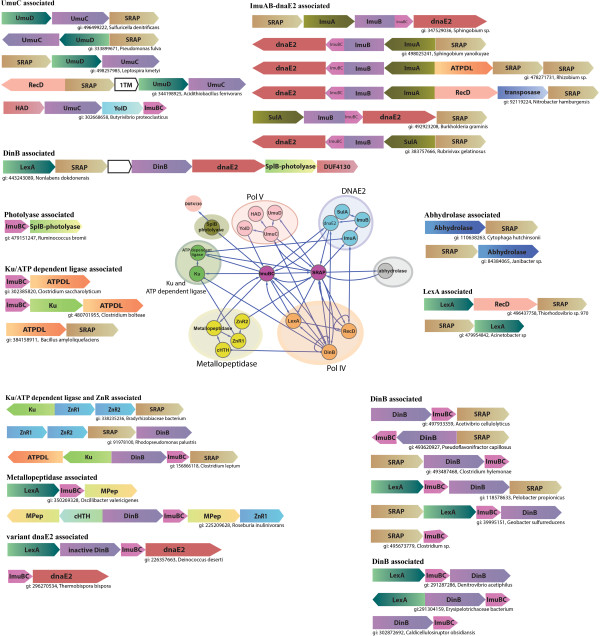
Figure 1
Figure 1
Operons and contextual network graph of the SRAP and ImuB-C containing proteins. Genes are represented as arrows, with the arrow head pointing from the 5’ to the 3’ direction. Operons are labeled with the gi number of the SRAP or ImuB-C gene in the neighborhood followed by the species name. Standard names of encoded domains are used to label genes, the rest being MPep, metallopeptidase; ATPDL, ATP-dependent DNA ligase. In the network graph, genes are represented as nodes, and edges indicate the gene context with the arrow head pointing to the gene in the 3’ direction of the neighborhood. Edges depicting genes arranged in diverging directions are shown with circular ends. Pfam DUF4130 is a predicted mutagenesis-related enzyme that is associated with the SplB-like radical SAM photolyases and uracil DNA glycosylases, which might modify thymines.
Figure 2
Figure 2
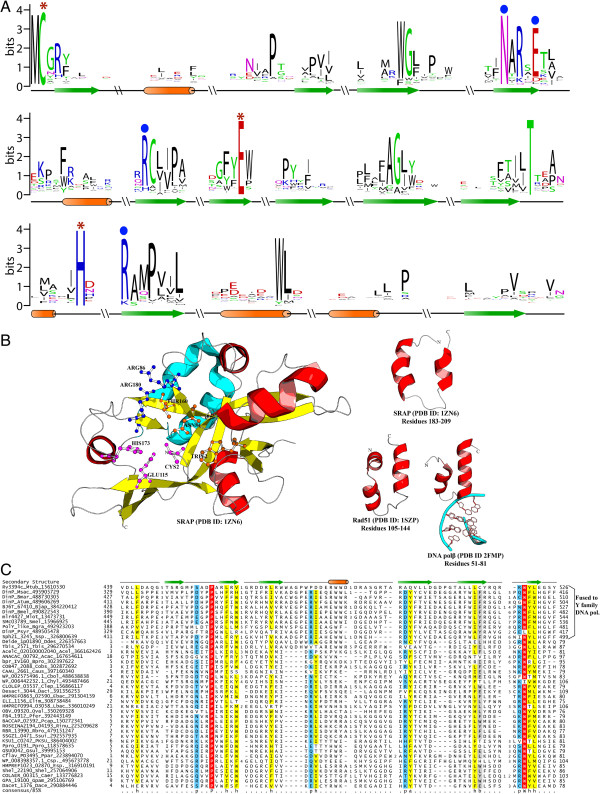
Sequence conservation of the SRAP and ImuB-C domains, and structure of the SRAP domain. A) Sequence logo for SRAP domain obtained from a multiple sequence alignments of representative sequences (See Additional file 1 for complete alignment). Residues predicted to catalyze auto-proteolysis are marked with red asterisks. Other conserved residues described in the text are marked with blue circles. B) A cartoon representation of the predicted active site for the SRAP protein is shown in left panel. The catalytic triad comprising of Cys2, His173 and E115 (PDB: 1zn6) has been depicted in magenta color, the arginine residues predicted to interact with DNA are shown in dark blue color, while the other conserved residues in active site are shown in orange. The predicted Helix-hairpin helix (HhH) region of SRAP domain (cyan) is shown in the right panel separately along with the HhH domains of RecA and the DNA polymerase β for comparison. C) Multiple sequence alignment of the ImuB-C domain. Proteins are labeled to the left of each sequence by their gene names, species abbreviations, and gi numbers separated by underscores. Amino acid residues are colored according to side chain properties and degree of conservation within the alignment, at 85% consensus. The secondary structure is indicated above the alignment with helices shown as orange cylinders and strands as green arrows. The consensus abbreviations and coloring scheme are as follows: h, hydrophobic (ACFGHILMTVWY) and a: aromatic (FYH) residues shaded yellow; polar (CDEHKNQRST) residues colored blue; big residues (QRKEILMWYF) shaded grey; absolutely conserved residues shaded red. Species abbreviations are provided in Additional file 1.

References

    1. Erill I, Campoy S, Barbe J. Aeons of distress: an evolutionary perspective on the bacterial SOS response. FEMS Microbiol Rev. 2007;31(6):637–656. doi: 10.1111/j.1574-6976.2007.00082.x. - DOI - PubMed
    1. Michel B. After 30 years of study, the bacterial SOS response still surprises us. PLoS Biol. 2005;3(7):e255. doi: 10.1371/journal.pbio.0030255. - DOI - PMC - PubMed
    1. Radman M. SOS repair hypothesis: phenomenology of an inducible DNA repair which is accompanied by mutagenesis. Basic Life Sci. 1975;5A:355–367. - PubMed
    1. Sutton MD, Smith BT, Godoy VG, Walker GC. The SOS response: recent insights into umuDC-dependent mutagenesis and DNA damage tolerance. Annu Rev Genet. 2000;34:479–497. doi: 10.1146/annurev.genet.34.1.479. - DOI - PubMed
    1. Keller KL, Overbeck-Carrick TL, Beck DJ. Survival and induction of SOS in Escherichia coli treated with cisplatin, UV-irradiation, or mitomycin C are dependent on the function of the RecBC and RecFOR pathways of homologous recombination. Mutat Res. 2001;486(1):21–29. doi: 10.1016/S0921-8777(01)00077-5. - DOI - PubMed

MeSH terms