. 2014 Jan 1;209(1):150-62.
doi: 10.1093/infdis/jit420. Epub 2013 Aug 14.

New, combined, and reduced dosing treatment protocols cure Trypanosoma cruzi infection in mice

Affiliations

New, combined, and reduced dosing treatment protocols cure Trypanosoma cruzi infection in mice

Juan M Bustamante et al. J Infect Dis. .

Abstract

The development of treatment protocols with reduced toxicity and equivalent or improved efficacy for Trypanosoma cruzi infection is a priority. We tested the effectiveness of benznidazole (BZ), nifurtimox (NFX), other prospective drugs in intermittent and combined treatment protocols to cure T. cruzi infection initiated with susceptible and drug-resistant parasite strains. A 40-day course of BZ, NFX, or the oxaborale AN4169 cured 100% of mice, whereas posaconazole (POS), and NTLA-1 (a nitro-triazole) cured approximately 90% and 20% of mice, respectively. Reducing the overall dosage of BZ or NFX by using an intermittent (once every 5 days) schedule or combining 5 daily doses of POS with 7 intermittent doses of BZ also provided approximately 100% cure. T. cruzi strains resistant to BZ were also found to be resistant to other drugs (POS), and extending the time of treatment or combining drugs did not increase cure rates with these isolates. Thus, dosing schedules for anti-T. cruzi compounds should be determined empirically, and compounds targeting different pathways may be combined to yield effective therapies with reduced toxicity. This work also suggests that standard treatment protocols using BZ and NFX may be significantly overdosing patients, perhaps contributing to the adverse events.

Keywords: Chagas disease; Trypanosoma cruzi; benznidazole; drug discovery; intermittent treatment.


Figures
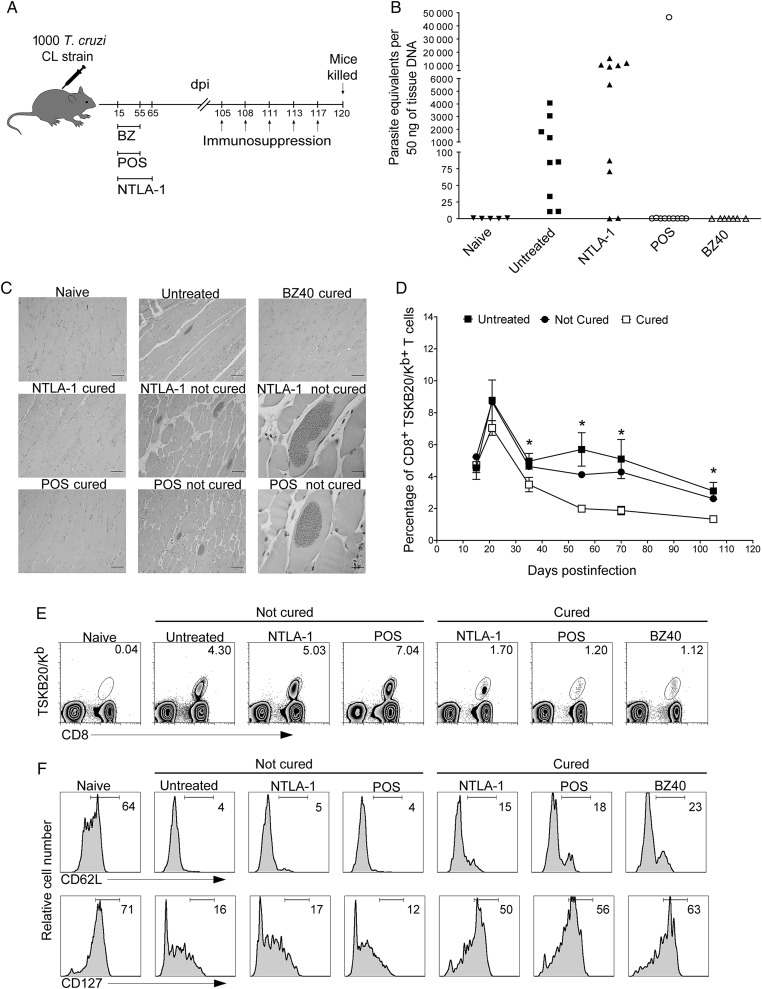
Figure 1.
Figure 1.
A shift to a TCM phenotype in the Trypanosoma cruzi–specific CD8+ T cells is diagnostic of cure in T. cruzi infection. A, Schematic representation of infection, treatment, and immunosuppression. B, T. cruzi DNA isolated from skeletal muscle tissues of untreated or treated mice and suppressed with cyclophosphamide (15 days after suppression started) determined by quantitative real time polymerase chain reaction. C, Histological sections of the skeletal muscle at 120 days postinfection of naive, untreated, benznidazole 40-day–, posaconazole–, and NTLA-1–treated mice that were cyclophosphamide suppressed. Scale bar represents 200 µm in the left and middle columns and in the upper panel of the right column. In the right column middle and bottom row scale bar represents 20 µm. D and E, The MHC-peptide tetramer of the immunodominant TSKB20/Kb epitope was used to detect T. cruzi–specific CD8+ T cells in the blood of untreated (filled squares) and treated mice (cured: open square; not cured: filled circles) during the evolution of the infection (D) and at 105 days postinfection before the immunosuppression (E). Data in (D) are shown as mean ± standard error of the mean. *P < .05 between cured and not cured groups or cured and untreated groups. Numbers in (E) indicate the percentage of tetramer+ cells among the CD8+ T-cells population. F, Expression of classical memory (CD62L) and memory maintenance (CD127) markers in blood on the CD8+ T cells (naive) and on the CD8+ TSKB20-tetramer+ T cells from untreated and treated mice at 105 days postinfection. Data are representative of 2 independent experiments with 5–10 mice per group. Abbreviations: BZ, benznidazole; dpi, days postinfection; POS, posaconazole; T. cruzi, Trypanosoma cruzi.
Figure 2.
Figure 2.
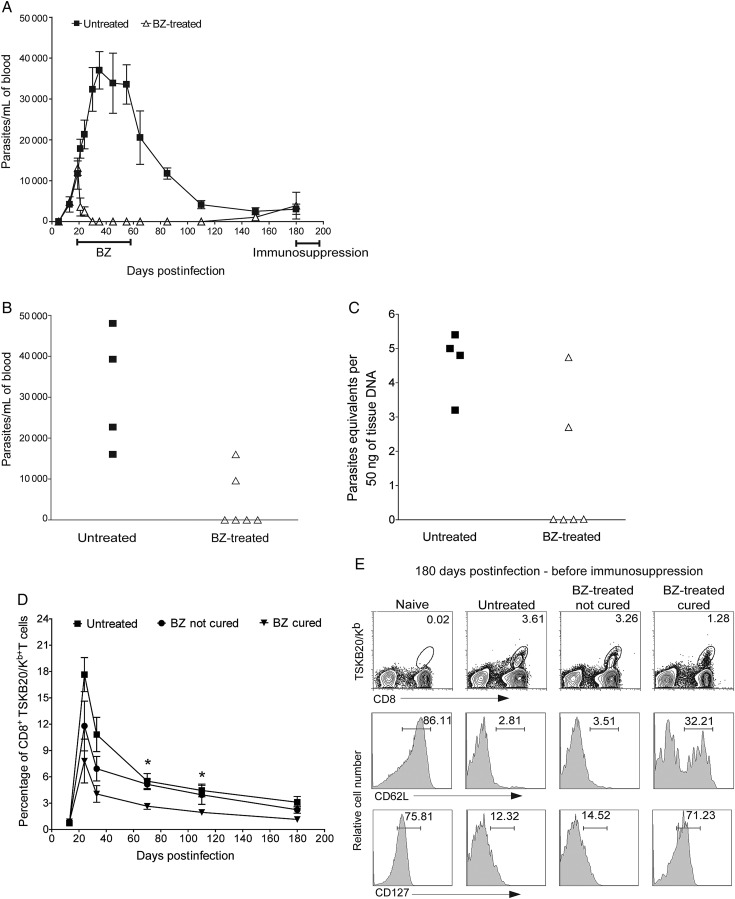
Acute treatment with benznidazole (BZ) in mice infected with Trypanosoma cruzi Colombiana strain. A, Parasitemia profile in untreated (▪), or BZ-treated (Δ) mice (treatment was carried out during 40 days from 15–55 days postinfection) infected with the BZ-resistant Colombiana strain of T. cruzi. B, Parasitemias in untreated (▪) or treated (Δ) mice at 195 days postinfection, after administration of the immunosuppressant cyclophosphamide (days 180, 183, 186, 188, and 192). C, T. cruzi DNA isolated from skeletal muscle tissues of untreated or treated mice and suppressed with cyclophosphamide (15 days after suppression started) determined by quantitative real time polymerase chain reaction. Detection of T. cruzi–specific CD8+ T cells in the blood of untreated and treated mice using the TSKB20-tetramer during the course of infection (D) and at 180 days postinfection (before cyclophosphamide suppression) (E). Data in (D) are shown as mean ± standard error of the mean. *P < .05 between cured and not cured groups or cured and untreated groups. Numbers in (E) indicate the percentage of tetramer+ cells among the CD8+ T-cells population (upper row). Expression of the classical memory (CD62L: middle row) and memory maintenance (CD127: bottom row) markers in blood on the CD8+ T cells (naive) and on the CD8+ TSKB20-tetramer+ T cells from untreated and treated mice at 180 days postinfection. Data are representative of 2 independent experiments with 6–8 mice per group. Abbreviation: BZ, benznidazole.
Figure 3.
Figure 3.
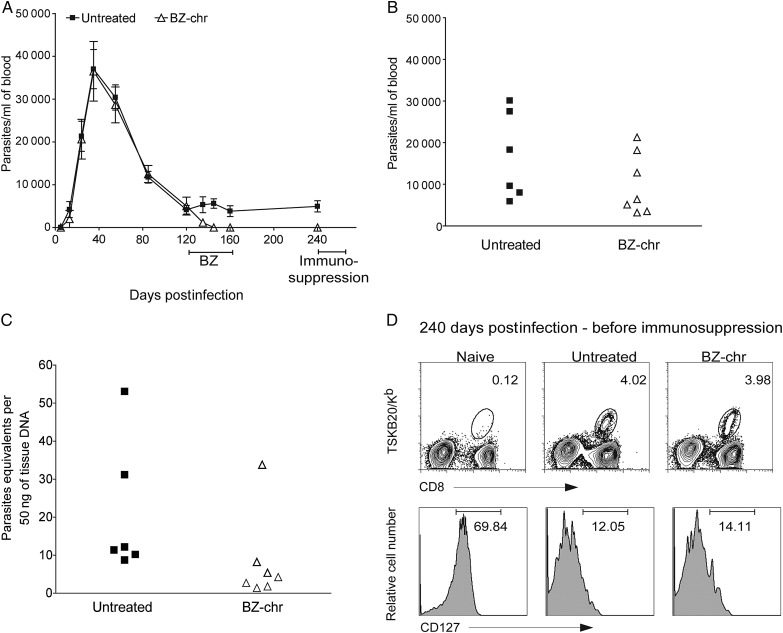
Chronic treatment with benznidazole (BZ) in mice infected with Trypanosoma cruzi Colombiana strain. A, Parasitemia profile in untreated (▪) or BZ-treated (Δ) mice (treatment was carried out during 40 days from 120–160 days postinfection) infected with the BZ-resistant Colombiana strain of T. cruzi. B, Parasitemias in untreated (▪) or treated (Δ) mice at 255 days postinfection, after administration of the immunosuppressant cyclophosphamide (days 240, 243, 246, 248). C, T. cruzi DNA isolated from skeletal muscle tissues of untreated or treated mice and suppressed with cyclophosphamide (15 days after suppression started) determined by quantitative real time polymerase chain reaction. D, Detection of T. cruzi–specific CD8+ T cells in the blood of untreated and treated mice using the TSKB20-tetramer at 240 days postinfection (before cyclophosphamide suppression). Numbers indicate the percentage of tetramer+ cells among the CD8+ T cells population (upper row). Expression of CD127 (bottom row) in blood on the CD8+ T cells (naive) and on the CD8+ TSKB20-tetramer+ T cells from untreated and treated mice at 240 days postinfection. Data are representative of 2 independent experiments each with 5–8 mice per group. Abbreviations: BZ, benznidazole; BZ-chr, chronically infected and treated with benznidazole.
Figure 4.
Figure 4.
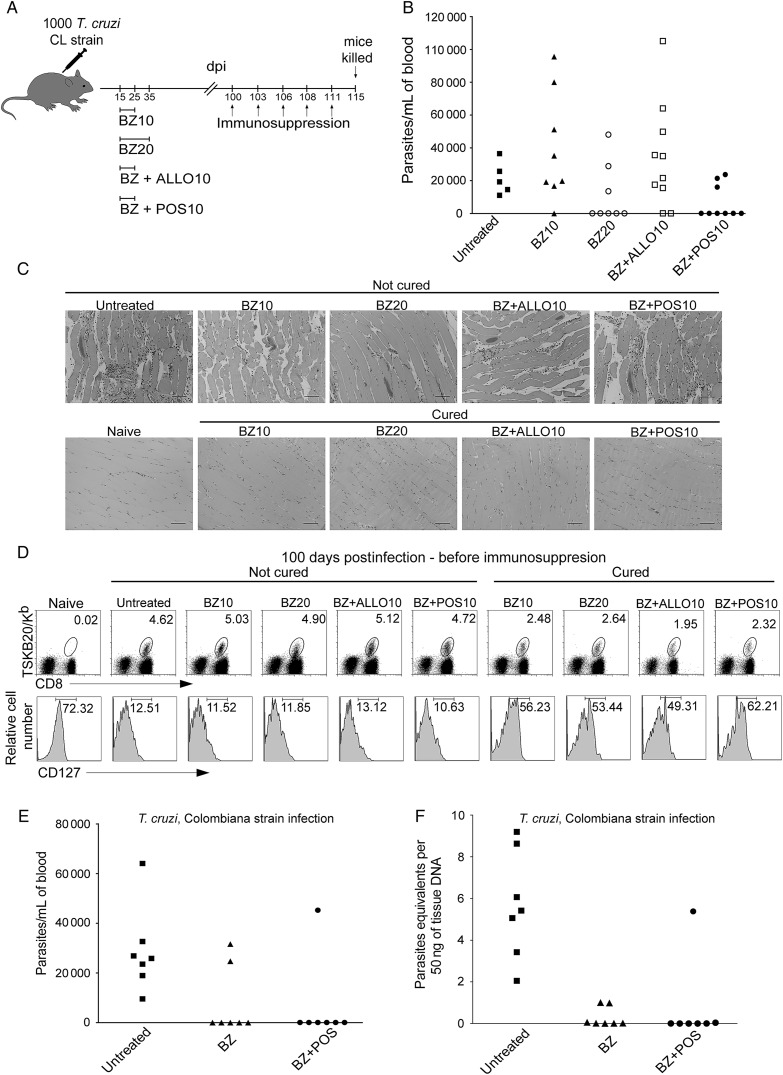
The combination of anti–Trypanosoma cruzi compounds synergize to clear T. cruzi infection. A, Schematic representation of infection, treatment, and immunosuppression. B, Parasitemias in untreated and treated mice at 115 days postinfection, after administration of the immunosuppressant cyclophosphamide (days 100, 103, 106, 108, and 111). C, Histological sections of the skeletal muscle at 115 days postinfection of naive, untreated, and benznidazole (BZ)–treated mice that were cyclophosphamide suppressed. Scale bar represents 200 µm. D, Detection of T. cruzi–specific CD8+ T cells in the blood of untreated and treated mice using the TSKB20-tetramer at 100 days postinfection (before cyclophosphamide suppression) (upper row). Numbers indicate the percentage of tetramer+ cells among the CD8+ T-cells population. Expression of CD127 (bottom row) in blood on the CD8+ T cells (naive) and on the CD8+ TSKB20-tetramer+ T cells from untreated and treated mice at 100 days postinfection of naive, untreated, and BZ-treated mice that were cyclophosphamide suppressed. Data are representative of 2 independent experiments with 5–10 mice per group. E, Parasitemias in mice infected with T. cruzi. Colombiana strain, untreated, BZ-treated, and treated mice with a combination of BZ and posaconazole (treatment was carried out during 40 days from 15–55 days postinfection) at 105, after administration of the immunosuppressant cyclophosphamide (days 90, 93, 96, 98, and 101). F, T. cruzi DNA from untreated or treated mice in (E) suppressed with cyclophosphamide (15 days after suppression started) determined by quantitative real time polymerase chain reaction. Data are representative of 2 independent experiments with 3–7 mice per group. Abbreviations: ALLO, allopurinol; BZ, benznidazole; dpi, days postinfection; POS, posaconazole; T. cruzi, Trypanosoma cruzi.
Figure 5.
Figure 5.
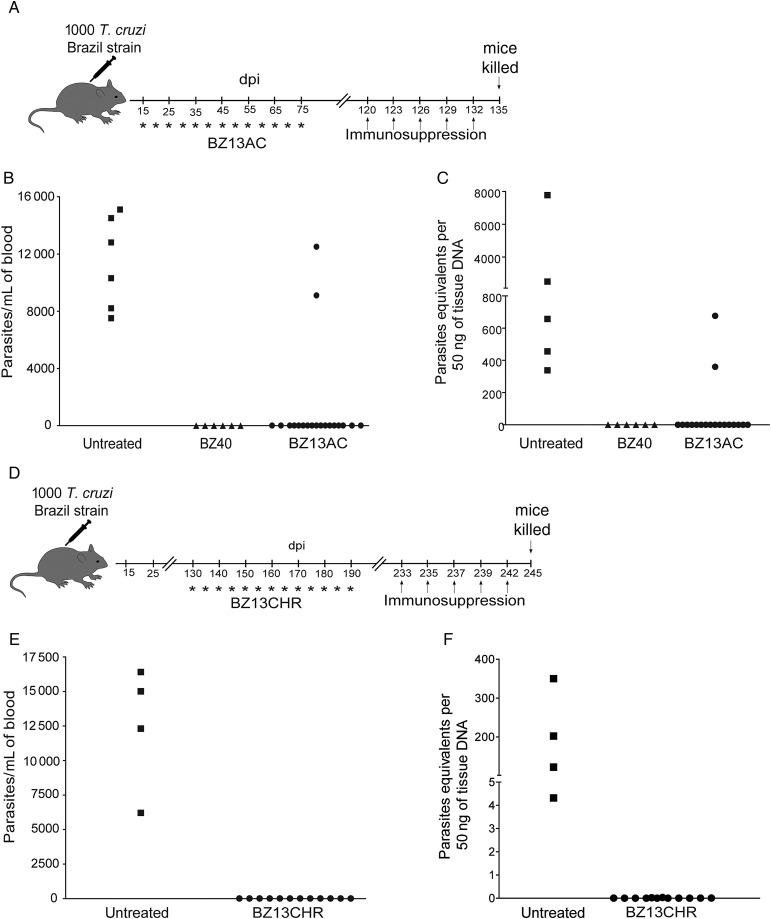
Thirteen doses of benznidazole (BZ) over 60 days in the acute or chronic phase of the infection cures Trypanosoma cruzi–infected mice. A, Schematic representation of infection, acute treatment, and immunosuppression. B, Parasitemias in mice infected with T. cruzi, Brazil strain, untreated and treated mice with 13 doses of BZ over the course of 60 days (15 to 75 days postinfection) at 135 days postinfection, after administration of the immunosuppressant cyclophosphamide (days 120, 123, 126, 129, and 132). C, T. cruzi DNA isolated from skeletal muscle tissues of untreated or treated mice and suppressed with cyclophosphamide (17 days after suppression started) determined by quantitative real time polymerase chain reaction. D, Schematic representation of infection, chronic treatment, and immunosuppression. E, Parasitemias in mice infected with T. cruzi, Brazil strain, untreated and treated mice with 13 doses of BZ over the course of 60 days (130–190 days postinfection) at 245 days postinfection, after administration of the immunosuppressant cyclophosphamide (days 230, 233, 237, 239, and 242). F, T. cruzi DNA isolated from skeletal muscle tissues of untreated or treated mice and suppressed with cyclophosphamide (15 days after suppression started) determined by quantitative real time polymerase chain reaction. Data are representative of 10 mice per group. Abbreviations: AC, acute; BZ, benznidazole; CHR, chronically infected; dpi, days postinfection; POS, posaconazole; T. cruzi, Trypanosoma cruzi.
Figure 6.
Figure 6.
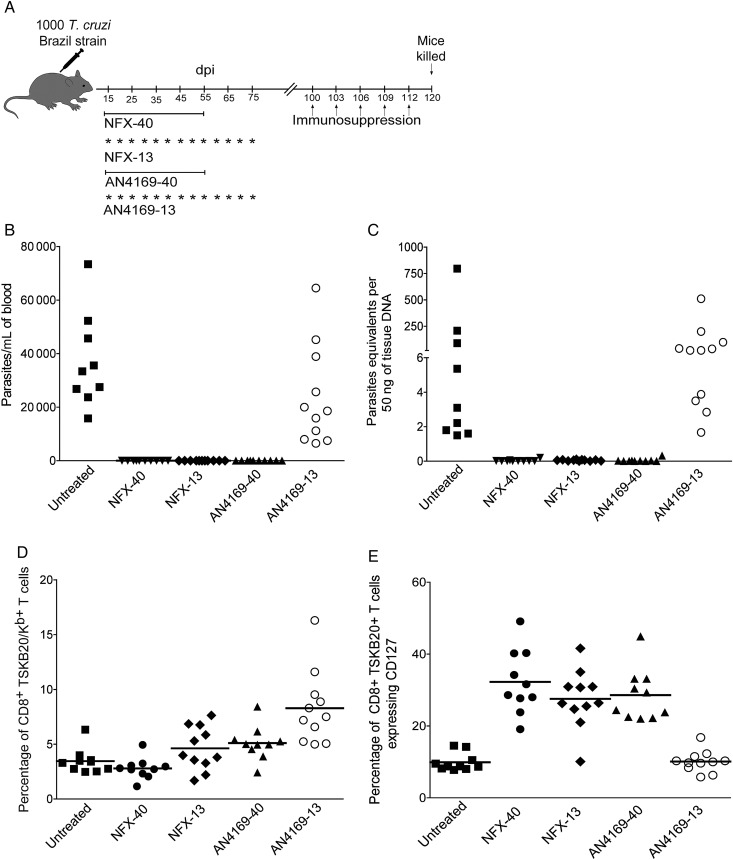
Forty-day consecutive treatment with AN4169 and nifurtimox or intermittent dosing with nifutimox cures mice infected with Trypanosoma cruzi. A, Schematic representation of infection, treatment, and immunosuppression. B, Parasitemias in untreated and treated mice at 120 days postinfection, after administration of the immunosuppressant cyclophosphamide (days 100, 103, 106, 109, and 112). C, T. cruzi DNA isolated from skeletal muscle tissues of untreated or treated mice and suppressed with cyclophosphamide (20 days after suppression started) determined by quantitative reverse-transcription polymerase chain reaction. D, Detection of T. cruzi–specific CD8+ T cells in the blood of untreated and treated mice using the TSKB20-tetramer at 90 days postinfection (before cyclophosphamide suppression). E, Expression of CD127 in blood on the CD8+ T cells (naive) and on the CD8+ TSKB20-tetramer+ T cells from untreated and treated mice at 90 days postinfection. Data are representative of 10–11 mice per group. Abbreviations: dpi, days postinfection; NFX, nifurtimox; T. cruzi, Trypanosoma cruzi.
Figure 7.
Figure 7.
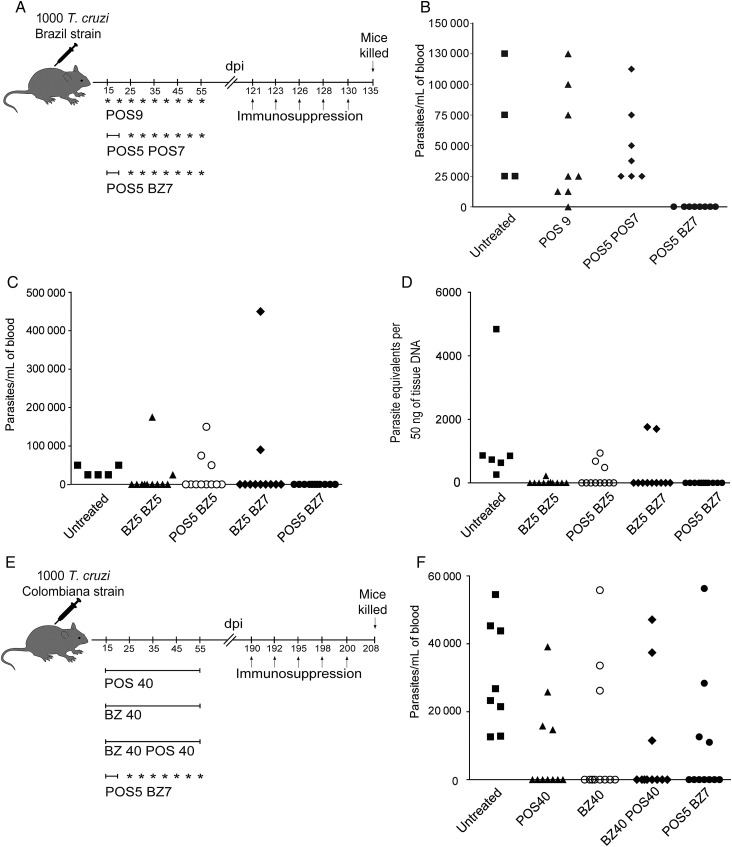
Five consecutive doses of posaconazole (POS) followed by 7 intermittent doses of benznidazole (BZ) cures 100% of the mice infected with Trypanosoma cruzi. A, Schematic representation of infection, treatment, and immunosuppression. B, Parasitemias in mice infected with T. cruzi, Brazil strain, untreated and treated mice with 9 and 12 doses of POS and the combination of 5 doses of POS follow by 7 doses of BZ over the course of 40 days (15–55 days postinfection) at 135 days postinfection, after administration of the immunosuppressant cyclophosphamide (days 121, 123, 126, 128, and 130). C, Parasitemias in mice infected with T. cruzi, Brazil strain, untreated and treated mice with 5 consecutive doses of POS or BZ followed by 5 or 7 intermittent doses of BZ over the course of 40 days (15–55 days postinfection) at 127 days postinfection, after administration of cyclophosphamide (days 110, 112, 115, 117, and 120). D, T. cruzi DNA isolated from skeletal muscle tissues of untreated or treated mice and suppressed with cyclophosphamide (17 days after suppression started) determined by quantitative real time polymerase chain reaction. E, Schematic representation of infection, treatment, and immunosuppression in mice infected with T. cruzi Colombiana strain and treated with combination of BZ and POS on an intermittent and combined treatment regimen. F, Parasitemias in mice infected with T. cruzi, Colombiana strain, untreated and treated mice with a combination of 5 doses of POS follow by 7 doses of BZ over the course of 40 days (15–55 days postinfection) at 208 days postinfection, after administration of cyclophosphamide (days 190, 192, 1195, 198, and 200). Data are representative of 2 independent experiments with 8–10 mice per group. Abbreviations: BZ, benznidazole; dpi, days postinfection; POS, posaconazole; T. cruzi, Trypanosoma cruzi.

References

    1. World Health Organization. Control of Chagas disease. World Health Organ Tech Rep Ser. 2002;905:1–35. - PubMed
    1. Hotez PJ, Molyneux DH, Fenwick A, et al. Control of neglected tropical diseases. N Engl J Med. 2007;357:1018–27. - PubMed
    1. Alvarez MG, Vigliano C, Lococo B, Petti M, Bertocchi G, Viotti R. Seronegative conversion after incomplete benznidazole treatment in chronic Chagas disease. Trans R Soc Trop Med Hyg. 2012;106:636–8. - PubMed
    1. Coura JR, Abreu LLD, Willcox HPF, Petana W. Estudo comparativo controlado com emprego de benznidazole, nifurtimox e placebo, na forma crônica da doença de Chagas, em uma área de campo com transmissão interrompida. I. Avaliação preliminar. Rev Soc Bras Med Trop. 1997;30:139–44. - PubMed
    1. Coura JR, Borges-Pereira J. Chronic phase of Chagas disease: why should it be treated? A comprehensive review. Mem Inst Oswaldo Cruz. 2011;106:641–5. - PubMed

Publication types

MeSH terms