. 2014 Jan 1;209(1):74-82.
doi: 10.1093/infdis/jit435. Epub 2013 Aug 14.

Cryptococcus neoformans ex vivo capsule size is associated with intracranial pressure and host immune response in HIV-associated cryptococcal meningitis

Affiliations

Cryptococcus neoformans ex vivo capsule size is associated with intracranial pressure and host immune response in HIV-associated cryptococcal meningitis

Emma J Robertson et al. J Infect Dis. .

Abstract

Background: The Cryptococcus neoformans polysaccharide capsule is a well-characterized virulence factor with immunomodulatory properties. The organism and/or shed capsule is postulated to raise intracranial pressure (ICP) in cryptococcal meningitis (CM) by mechanical obstruction of cerebrospinal fluid (CSF) outflow. Little is known regarding capsule phenotype in human cryptococcosis. We investigated the relationship of ex vivo CSF capsular phenotype with ICP and CSF immune response, as well as in vitro phenotype.

Methods: In total, 134 human immunodeficiency virus (HIV)-infected Ugandan adults with CM had serial lumbar punctures with measurement of CSF opening pressures, quantitative cultures, ex vivo capsule size and shedding, viscosity, and CSF cytokines; 108 had complete data. Induced capsular size and shedding were measured in vitro for 48 C. neoformans isolates.

Results: Cryptococcal strains producing larger ex vivo capsules in the baseline (pretreatment) CSF correlated with higher ICP (P = .02), slower rate of fungal clearance (P = .02), and paucity of CSF inflammation, including decreased CSF white blood cell (WBC) count (P < .001), interleukin (IL)-4 (P = .02), IL-6 (P = .01), IL-7 (P = .04), IL-8 (P = .03), and interferon γ (P = .03). CSF capsule shedding did not correlate with ICP. On multivariable analysis, capsule size remained independently associated with ICP. Ex vivo capsular size and shedding did not correlate with that of the same isolates grown in vitro.

Conclusions: Cryptococcal capsule size ex vivo is an important contributor to virulence in human cryptococcal meningitis.

Trial registration: ClinicalTrials.gov NCT01075152.

Keywords: CSF; Cryptococcus neoformans; HIV; cryptococcal meningitis; human; immune response; intracranial pressure; polysaccharide capsule.


Figures
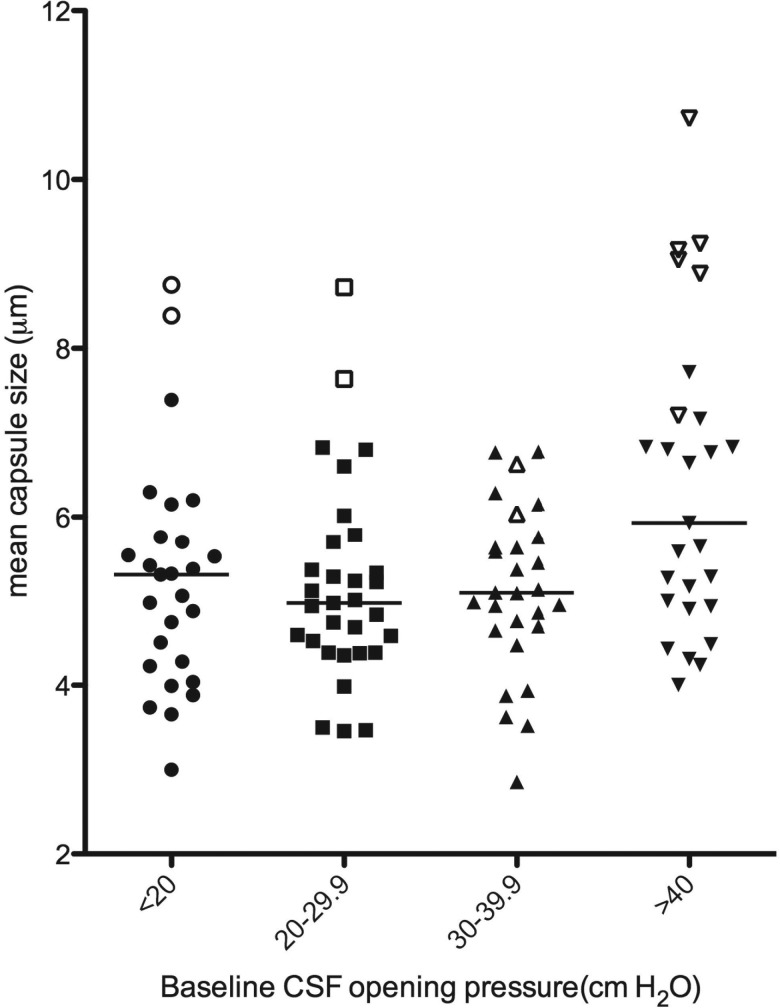
Figure 1.
Figure 1.
Dot plot of intraperson mean capsule size, stratified by CSF opening pressure category, n = 122. For the 4 opening pressure categories, median (IQR) ex vivo capsule sizes were as follows: <20 cm H2O: 5.3 (4.2,5.8) μm; 20–29.9 cm H2O: 5.0 (4.4,5.7) μm, 30–39.9 cm H2O: 5.1 (4.7,5.7) μm and >40 cm H2O: 5.9 (4.9,7.2) μm (Kruskal-Wallis P = .02). The 15 patients with large cells (>5 cells with total diameter >30 μm) are indicated by open symbols. Abbreviations: CSF, cerebrospinal fluid; IQR, interquartile range.
Figure 2.
Figure 2.
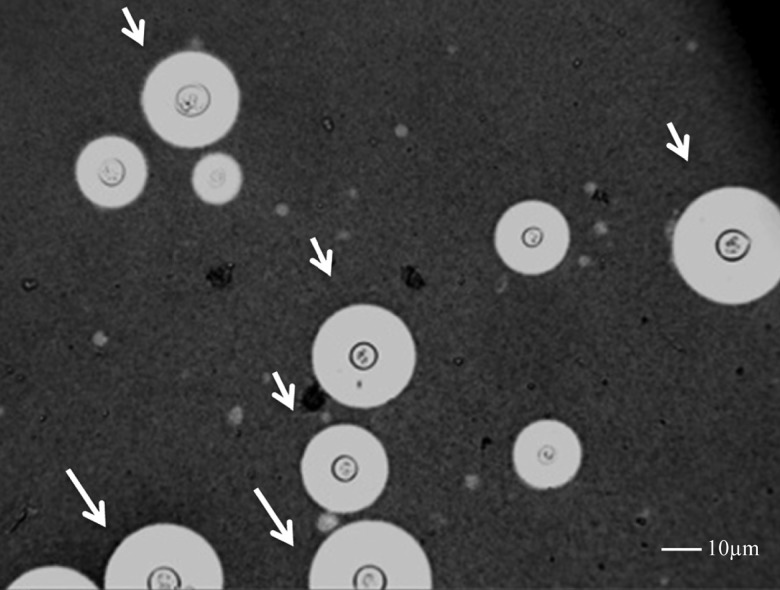
Microscopy of CSF (India Ink counterstain, ×40 objective), in a patient with CSF opening pressure > 55 cm H2O. White arrows indicate large cells (total diameter > 30 µm), ranging between 30.5 and 41.5 µm in diameter. Scale bar 10 µm. Abbreviation: CSF, cerebrospinal fluid.
Figure 3.
Figure 3.
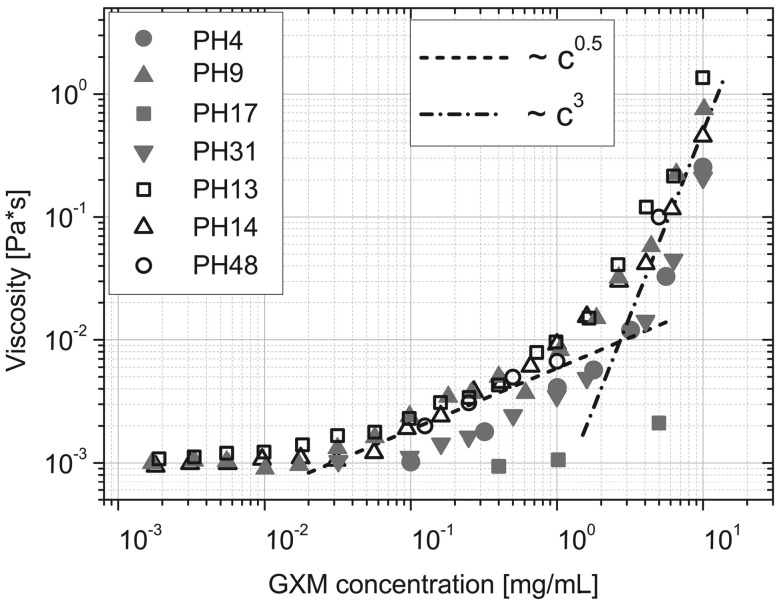
Log-log plot of viscosity (using optical tweezers) vs concentration of purified GXM exopolysaccharide dissolved in distilled water, from 7 clinical Cryptococcus neoformans strains [raised ICP (>20 cm H2O) filled symbols; normal ICP (≤20 cmH2O) open symbols, isolate ID in legend]. In all strains, the increase in viscosity with increasing concentration was non-linear, with viscosity increasing in proportion to the square root of concentration in the range of 0.02–2 mg/mL (gradient c0.5), and in proportion to the cube of the concentration in the range of 2–10 mg/mL (c3), typical of rod-like macromolecules in concentrated solutions [23]. Abbreviations: GXM, glucuronoxylomannan; ICP, intracranial pressure.
Figure 4.
Figure 4.
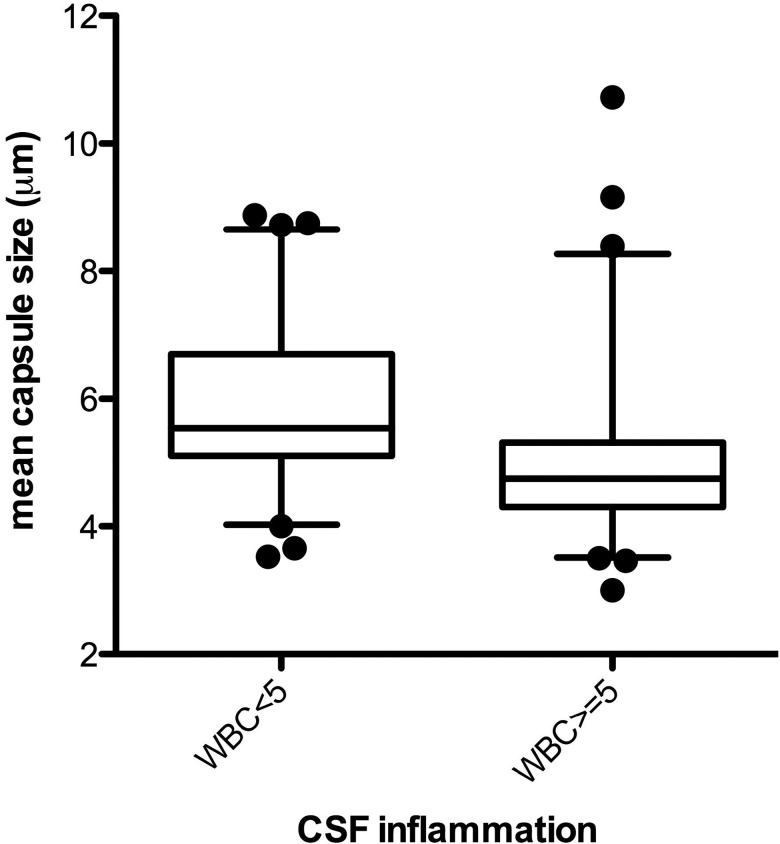
Box plot (median, IQR, 5–95th percentile) of ex vivo mean capsule size, stratified by absence or presence of CSF inflammation (WBC ≥5 cells/μL), n = 115, P < .001. Persons without a CSF WBC pleocytosis had Cryptococcus with larger capsules in CSF. Abbreviations: CSF, cerebrospinal fluid; IQR, interquartile range; WBC, white blood cell.
Figure 5.
Figure 5.
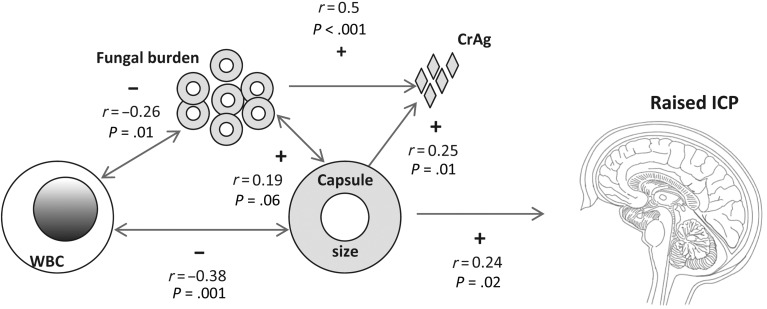
Schema of proposed inter-relationships between CSF fungal burden, capsule size, CrAg, CSF inflammation (WBC count) and raised intracranial pressure (Correlations shown as positive (+) or negative (−) by Spearman ρ). The arrows show possible directionality of these associations, which interact to produce mechanical obstruction and raised ICP. An example might be a highly encapsulated strain that elicits less CSF inflammation and thus also replicates more effectively, producing higher CSF fungal burden and antigen shedding. The combination of these factors results in raised ICP. Abbreviations: CrAg, cryptococcal antigen shedding; CSF, cerebrospinal fluid; ICP, intracranial pressure; WBC, white blood cell.

References

    1. Cohen DB, Zijlstra EE, Mukaka M, et al. Diagnosis of cryptococcal and tuberculous meningitis in a resource-limited African setting. Trop Med Int Health. 2010;15:910–7. - PubMed
    1. Jarvis JN, Meintjes G, Williams A, Brown Y, Crede T, Harrison TS. Adult meningitis in a setting of high HIV and TB prevalence: findings from 4961 suspected cases. BMC Infect Dis. 2010;10:67. - PMC - PubMed
    1. Park BJ, Wannemuehler KA, Marston BJ, Govender N, Pappas PG, Chiller TM. Estimation of the current global burden of cryptococcal meningitis among persons living with HIV/AIDS. AIDS. 2009;23:525–30. - PubMed
    1. McClelland EE, Bernhardt P, Casadevall A. Estimating the relative contributions of virulence factors for pathogenic microbes. Infect Immun. 2006;74:1500–4. - PMC - PubMed
    1. Cherniak R, Reiss E, Slodki M, Plattner R, Blumer S. Structure and antigenic activity of the capsular polysaccharide of Cryptococcus neoformans serotype A. Mol Immunol. 1980;17:1025–32. - PubMed

Publication types

MeSH terms

Associated data