


Vicariance across major marine biogeographic barriers: temporal concordance and the relative intensity of hard versus soft barriers
- PMID: 23945690
- PMCID: PMC3757981
- DOI: 10.1098/rspb.2013.1541
Vicariance across major marine biogeographic barriers: temporal concordance and the relative intensity of hard versus soft barriers
Abstract
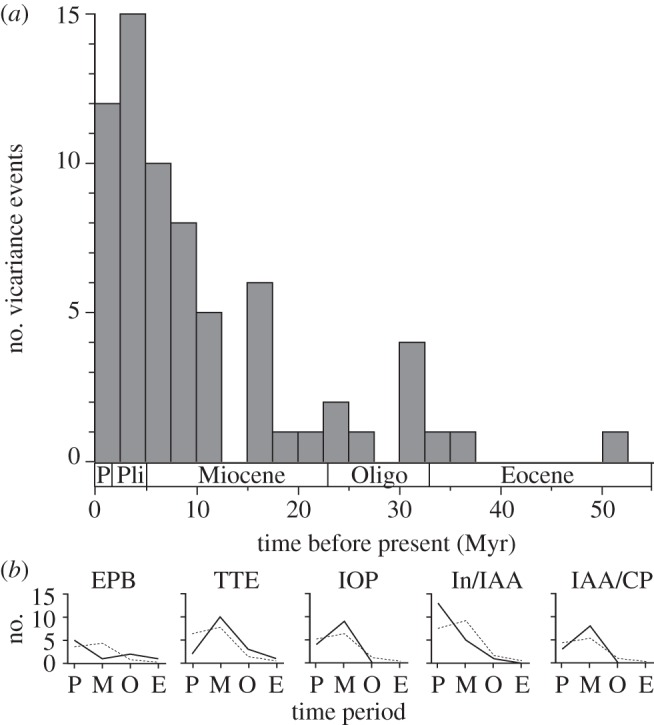
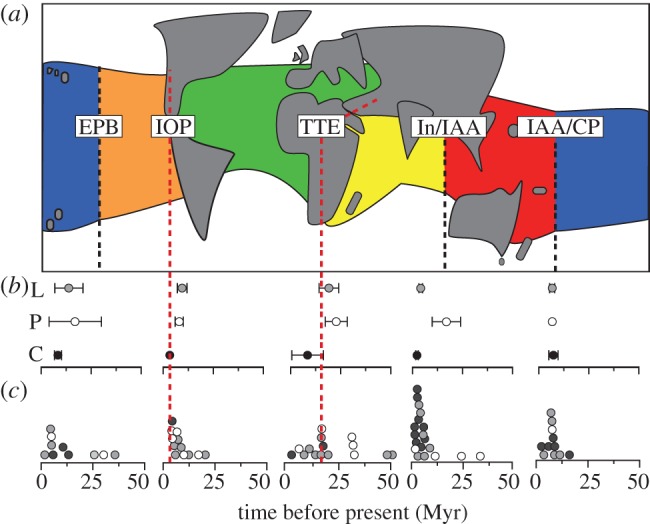
The marine tropics contain five major biogeographic regions (East Pacific, Atlantic, Indian Ocean, Indo-Australian Archipelago (IAA) and Central Pacific). These regions are separated by both hard and soft barriers. Reconstructing ancestral vicariance, we evaluate the extent of temporal concordance in vicariance events across three major barriers (Terminal Tethyan Event (TTE), Isthmus of Panama (IOP), East Pacific Barrier, EPB) and two incomplete barriers (either side of the IAA) for the Labridae, Pomacentridae and Chaetodontidae. We found a marked lack of temporal congruence within and among the three fish families in vicariance events associated with the EPB, TTE and IOP. Vicariance across hard barriers separating the Atlantic and Indo-Pacific (TTE, IOP) is temporally diffuse, with many vicariance events preceding barrier formation. In marked contrast, soft barriers either side of the IAA hotspot support tightly concordant vicariance events (2.5 Myr on Indian Ocean side; 6 Myr on Central Pacific side). Temporal concordance in vicariance points to large-scale temporally restricted gene flow during the Late Miocene and Pliocene. Despite different and often complex histories, both hard and soft barriers have comparably strong effects on the evolution of coral reef taxa.
Keywords: DEC model; Lagrange; ancestral biogeography; barriers; coral reef fishes; vicariance.
Figures
References
-
- Kamp P, Waghorn D, Nelson C. 1990. Late Eocene–Early Oligocene integrated isotope stratigraphy and biostratigraphy for paleoshelf sequences in southern Australia: paleoceanographic implications. Palaeogeogr. Palaeoclim. Palaeoecol. 80, 311–323 (doi:10.1016/0031-0182(90)90140-3) - DOI
-
- Luiz OJ, Madin JS, Robertson DR, Rocha LA, Wirtz P, Floeter SR. 2012. Ecological traits influencing range expansion across large oceanic dispersal barriers: insights from tropical Atlantic reef fishes. Proc. R. Soc. B 279, 1033–1040 (doi:10.1098/rspb.2011.1525) - DOI - PMC - PubMed
-
- Barber PH, Bellwood DR. 2005. Biodiversity hotspots: evolutionary origins of biodiversity in wrasses (Halichoeres: Labridae) in the Indo-Pacific and new world tropics . Mol. Phylogenet. Evol. 35, 235–253 (doi:10.1016/j.ympev.2004.10.004) - DOI - PubMed
-
- Lessios HA. 2008. The great American schism: divergence of marine organisms after the rise of the Central American Isthmus. Annu. Rev. Ecol. Evol. Syst. 39, 63–91 (doi:10.1146/annurev.ecolsys.38.091206.095815) - DOI
-
- Floeter SR, et al. 2007. Atlantic reef fish biogeography and evolution. J. Biogeogr. 35, 22–47 (10.1111/j.1365-2699.2007.01790.x) - DOI
Publication types
MeSH terms
LinkOut - more resources
Full Text Sources
Other Literature Sources
Research Materials
