. 2013 Dec;26(12):1696-704.
doi: 10.1002/nbm.3005. Epub 2013 Aug 15.

Hyperpolarized singlet lifetimes of pyruvate in human blood and in the mouse

Affiliations

Hyperpolarized singlet lifetimes of pyruvate in human blood and in the mouse

Irene Marco-Rius et al. NMR Biomed. 2013 Dec.

Abstract

Hyperpolarized NMR is a promising technique for non-invasive imaging of tissue metabolism in vivo. However, the pathways that can be studied are limited by the fast T1 decay of the nuclear spin order. In metabolites containing pairs of coupled nuclear spins-1/2, the spin order may be maintained by exploiting the non-magnetic singlet (spin-0) state of the pair. This may allow preservation of the hyperpolarization in vivo during transport to tissues of interest, such as tumors, or to detect slower metabolic reactions. We show here that in human blood and in a mouse in vivo at millitesla fields the (13)C singlet lifetime of [1,2-(13)C2]pyruvate was significantly longer than the (13)C T1, although it was shorter than the T1 at field strengths of several tesla. We also examine the singlet-derived NMR spectrum observed for hyperpolarized [1,2-(13)C2]lactate, originating from the metabolism of [1,2-(13)C2]pyruvate.

Keywords: blood; dynamic nuclear polarization; hyperpolarization; lactate; long-lived states; longitudinal relaxation time; pyruvate; relaxation.


Figures

Figure 1
Figure 1
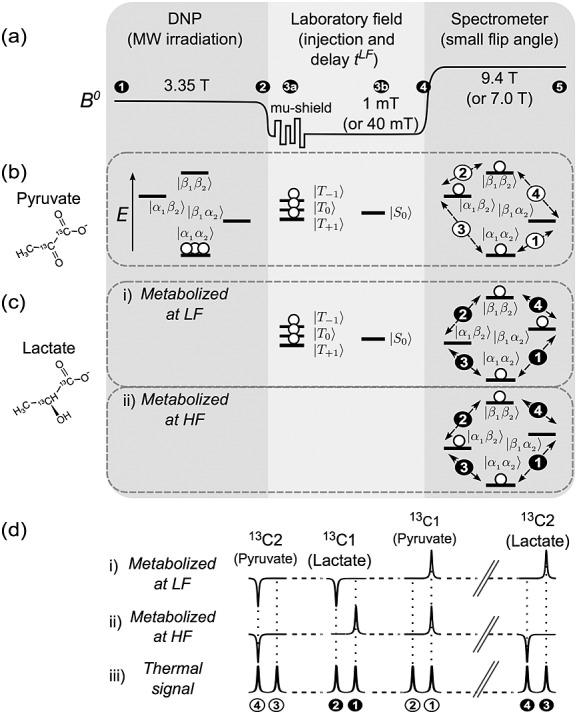
(a) Experimental sequence for hyperpolarized singlet NMR of [1,2-13C2]pyruvate. (1, 2) Dissolution DNP of the sample is followed by manipulations in low magnetic field. (3a) Option of shaking the sample inside a magnetically shielded chamber, which rapidly dephases non-singlet spin order. (3b) Injection into the biological system at low field. (4, 5) After waiting in the low field, the sample is then shuttled into a high-field spectrometer for NMR signal readout. (b) Illustration of the excess in |α1α2〉 population of the hyperpolarized substrate, which generates singlet depletion order upon dissolution and transfer to low magnetic field. Pure singlet order remains after the triplet states equilibrate via rapid T1 relaxation in the low field, or are dephased using a mu-metal chamber. Following a small-tip-angle excitation pulse, the resulting spectrum contains a pair of peaks in anti-phase. (c) Fate of the singlet order in [1,2-13C2]pyruvate after metabolism to [1,2-13C2]lactate. Different outcomes are predicted depending on whether metabolism takes place at high or low magnetic field, since the chemical shift difference has opposite sign in the two molecules. (d) The resulting spectral patterns. For reference, the peak pattern of a sample in thermal equilibrium is shown in (iii).
Figure 2
Figure 2
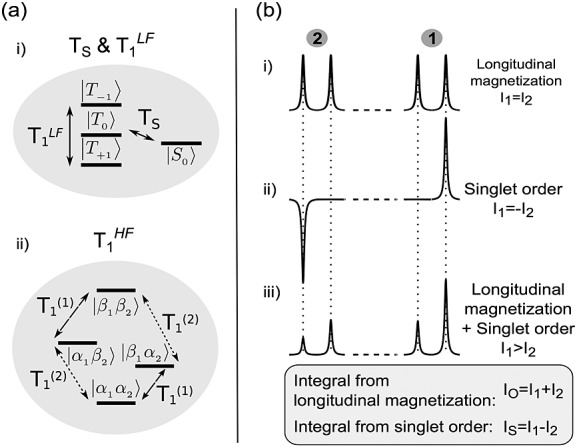
(a) Relaxation of a spin-1/2 pair at high and low magnetic fields. (i) At low field (triplet–singlet configuration, or near-magnetic-equivalence regime), the triplet populations relax with a single exponential time constant T1LF, while the singlet population relaxes with a potentially slower time constant TS. (ii) At high magnetic field (Zeeman configuration, or weak-coupling regime), each nucleus of the pair relaxes with its own distinct T1. (b) Illustration of the spectral signatures obtained after placing the system in high field, arising from (i) longitudinal spin order, (ii) singlet order or (iii) both. By adding or subtracting the peak integrals I1 and I2, one may distinguish the contribution of each of (i) and (ii) to the spectrum (see text).
Figure 3
Figure 3
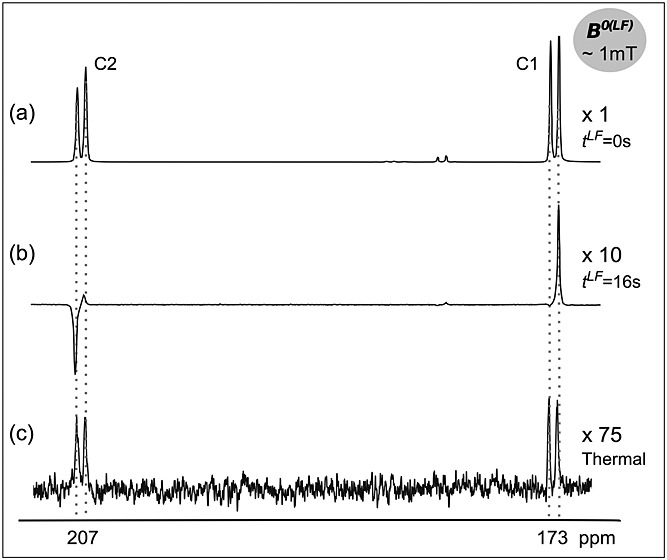
13C NMR spectra of 13.5 mM hyperpolarized [1,2-13C2]pyruvate in oxygenated, whole human blood (a) immediately after injection (1 scan) and (b) 16 s after injection and maintenance at 1 mT (1 scan); (c) the same sample at thermal equilibrium (128 scans, TR = 1 s). Spectra were acquired at 9.4 T and 37 °C using a 6º flip angle pulse.
Figure 4
Figure 4
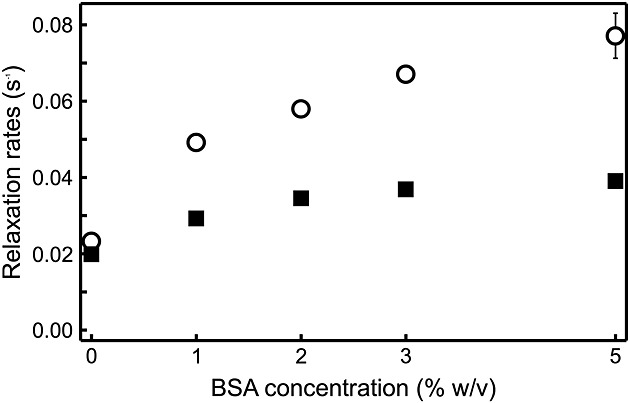
Dependence of relaxation rates R1LF = 1/T1LF (○) and RS = 1/TS (▄) on the concentration of BSA in aqueous solution (data from Table 2).
Figure 5
Figure 5
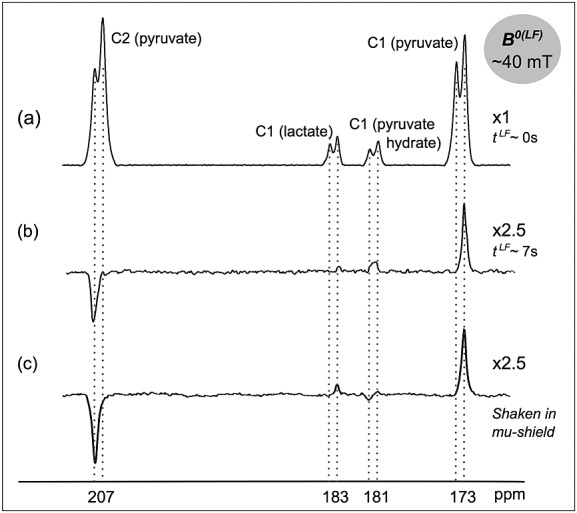
13C NMR spectra from a mouse tumor in vivo at 7.0 T following i.v. injection of hyperpolarized [1,2-13C2]pyruvate, acquired (a) immediately following injection (∼18 s after dissolution), (b) after maintaining the animal for ∼7 s at ∼40 mT after injection and (c) following injection of hyperpolarized pyruvate prepared with negative singlet order (∼30 s after dissolution; the longitudinal magnetization of the sample was destroyed by shaking the hyperpolarized substrate in a mu-metal chamber immediately after dissolution). In all three experiments the spectra were acquired with a single scan.

References

    1. Vander Heiden MG, Cantley LC, Thompson CB. Understanding the Warburg effect: the metabolic requirements of cell proliferation. Science. 2009;324(5930):1029–1033. - PMC - PubMed
    1. Brindle KM, Bohndiek SE, Gallagher FA, Kettunen MI. Tumor imaging using hyperpolarized 13C magnetic resonance. Magn. Reson. Med. 2011;66:505–519. - PubMed
    1. Brindle K. New approaches for imaging tumour responses to treatment. Nat Rev Cancer. 2008;8(2):94–107. - PubMed
    1. Day SE, Kettunen MI, Cherukuri MK, Mitchell JB, Lizak MJ, Morris HD, Matsumoto S, Koretsky AP, Brindle KM. Detecting response of rat C6 glioma tumors to radiotherapy using hyperpolarized [1-13C]pyruvate and 13C magnetic resonance spectroscopic imaging. Magn. Reson. Med. 2011;65:557–563. - PMC - PubMed
    1. Day SE, Kettunen MI, Gallagher FA, Hu D-E, Lerche M, Wolber J, Golman K, Ardenkjaer-Larsen JH, Brindle KM. Detecting tumor response to treatment using hyperpolarized 13C magnetic resonance imaging and spectroscopy. Nat. Med. 2007;13:1382–1387. - PubMed

Publication types

LinkOut - more resources