


A double-blind placebo-controlled randomized trial of varenicline for smokeless tobacco dependence in India
- PMID: 23946326
- PMCID: PMC3864491
- DOI: 10.1093/ntr/ntt115
A double-blind placebo-controlled randomized trial of varenicline for smokeless tobacco dependence in India
Abstract
Introduction: The rate of smokeless tobacco use in India is 20%; its use causes serious health problems, and no trial has assessed behavioral or pharmacological treatments for this public health concern. This trial evaluated varenicline for treating smokeless tobacco dependence in India.
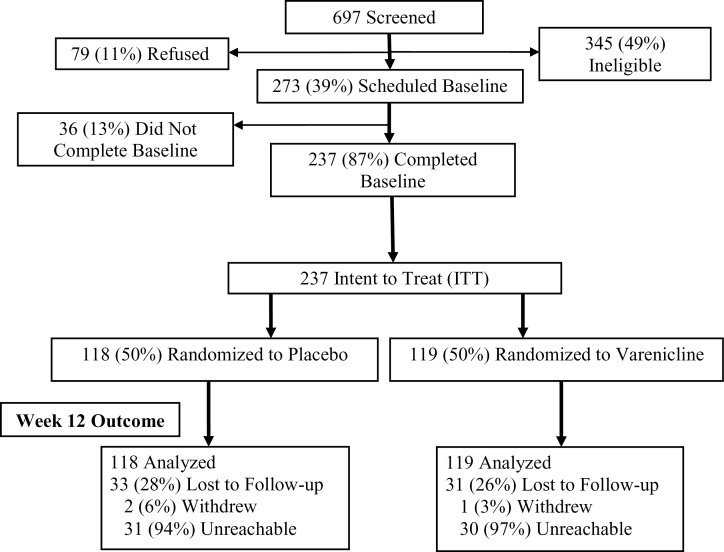
Methods: This was a double-blind placebo-controlled randomized trial of varenicline (12 weeks, 1mg, twice per day) with 237 smokeless tobacco users in India. All participants received behavioral counseling. Outcomes included self-reported and biochemically verified abstinence at the end of treatment (EOT), lapse and recovery events, safety, and medication adherence.
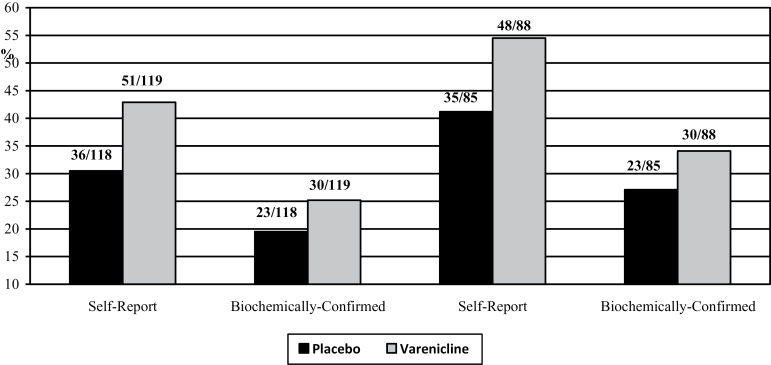
Results: Self-reported EOT abstinence was significantly greater for varenicline (43%) versus placebo (31%; adjusted odds ratio [AOR] = 2.6, 95% CI = 1.2-4.2, p = .009). Biochemically confirmed EOT abstinence was greater for varenicline versus placebo (25.2% vs. 19.5%), but this was not statistically different (AOR = 1.6, 95% CI = 0.84-3.1, p = .15). Compared with placebo, varenicline did not reduce the risk for a lapse (hazard ratio [HR] = 0.86, 95% CI = 0.69-1.1, p = .14), but it did increase the likelihood of recovery to abstinence (HR = 1.2, 95% CI = 1.02-1.4, p = .02). Greater adherence increased EOT cessation rates for varenicline (39% vs. 18%, p = .003) but not for placebo (28% vs. 14%, p = .06). There were no significant differences between varenicline and placebo in rate of side effects, serious adverse events, hypertension, or stopping or reducing medication.
Conclusions: Varenicline is safe for treating smokeless tobacco dependence in India, and further examination of this medication for this important public health problem is warranted.
Figures
References
-
- Anton R. F., O’Malley S. S., Ciraulo D. A., Cisler R. A., Couper D., Donavan D. M, … COMBINE Study Research Group (2006). Combined pharmacotherapies and behavioral interventions for alcohol dependence: The COMBINE study: A randomized controlled trial. Journal of the American Medical Association, 295, 2003–2017 Retrieved from http://www.ncbi.nlm.nih.gov/pubmed/16670409 - PubMed
-
- Blak B. T., Wilson K., Metcalfe M., Maguire A., Hards M. (2010). Evaluation of varenicline as an aid to smoking cessation in UK general practice - A THIN database study. Current Medical Research and Opinion, 26, 861–870.10.1185/03007990903526461 - PubMed
-
- Benowitz N. L., Jacob P., Ahijevych K., Jarvis M. J., Hall S., LeHouezec J. (2002). Biochemical verification of tobacco use and cessation. Nicotine & Tobacco Research, 4, 149–159 Retrieved from http://www.ncbi.nlm.nih.gov/pubmed/12028847
-
- Buchanan T. S., Berg C. J., Cox L. S., Nazir N., Benowitz N. L., Yu L, … Nollen N. A. (2012). Adherence to varenicline among African American smokers: An exploratory analysis comparing plasma concentration, pill count, and self-report. Nicotine & Tobacco Research, 14, 1083–1091.10.1093/ntr/ntr333 - PMC - PubMed
Publication types
MeSH terms
Substances
Grants and funding
LinkOut - more resources
Full Text Sources
Other Literature Sources
Medical
