


Genetic variants associated with colorectal cancer risk: comprehensive research synopsis, meta-analysis, and epidemiological evidence
- PMID: 23946381
- PMCID: PMC4020522
- DOI: 10.1136/gutjnl-2012-304121
Genetic variants associated with colorectal cancer risk: comprehensive research synopsis, meta-analysis, and epidemiological evidence
Abstract
Objective: In the past two decades, approximately 1000 reports have been published regarding associations between genetic variants in candidate genes and risk of colorectal cancer (CRC). Study results are inconsistent. We aim to provide a synopsis of the current understanding of genetic factors for CRC risk through systematically evaluating results from previous studies.
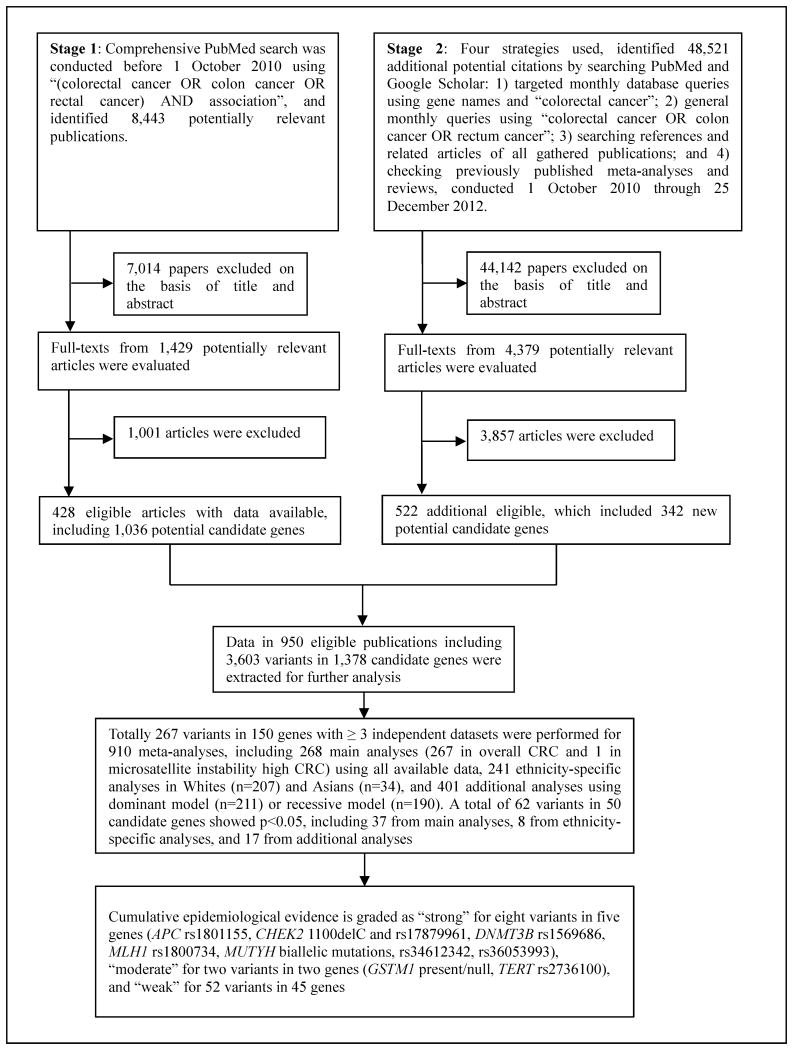
Design: We searched PubMed and Google Scholar to identify papers that investigated associations between genetic variants and CRC risk and published through 25 December 2012. With data from 950 papers, we conducted 910 meta-analyses for 267 genetic variants in 150 candidate genes with at least three data sources. We used Venice criteria and false-positive report probability tests to grade levels of cumulative epidemiological evidence of significant associations with CRC risk.
Results: Sixty-two variants in 50 candidate genes showed a nominally significant association with CRC risk (p<0.05). Cumulative epidemiological evidence for a significant association with CRC risk was graded strong for eight variants in five genes (adenomatous polyposis coli (APC), CHEK2, DNMT3B, MLH1 and MUTYH), moderate for two variants in two genes (GSTM1 and TERT), and weak for 52 variants in 45 genes. Additionally, 40 variants in 33 genes showed convincing evidence of no association with CRC risk in meta-analyses including at least 5000 cases and 5000 controls.
Conclusions: Approximately 4% of genetic variants evaluated to date in candidate-gene association studies showed moderate to strong cumulative epidemiological evidence of an association with CRC risk. These genetic variants, if confirmed, may explain approximately 5% of familial CRC risk.
Keywords: Colorectal Cancer; Meta-Analysis.
Conflict of interest statement
Figures
Comment in
-
Exome sequencing identifies MUTYH mutations in a family with colorectal cancer and an atypical phenotype.Gut. 2015 Feb;64(2):355-6. doi: 10.1136/gutjnl-2014-307084. Epub 2014 Apr 1. Gut. 2015. PMID: 24691292 No abstract available.
-
Functional annotation of colorectal cancer susceptibility loci identifies MLH1 rs1800734 associated with MSI patients.Gut. 2016 Jul;65(7):1227-8. doi: 10.1136/gutjnl-2016-311543. Epub 2016 Feb 24. Gut. 2016. PMID: 26911399 No abstract available.
References
-
- Jemal A, Bray F, Center MM, et al. Global cancer statistics. CA Cancer J Clin. 2011;61(2):69–90. - PubMed
-
- Lichtenstein P, Holm NV, Verkasalo PK, et al. Environmental and heritable factors in the causation of cancer--analyses of cohorts of twins from Sweden, Denmark, and Finland. N Engl J Med. 2000;343(2):78–85. - PubMed
-
- Jass JR. Familial colorectal cancer: pathology and molecular characteristics. Lancet Oncol. 2000;1:220–6. - PubMed
-
- Cunningham D, Atkin W, Lenz HJ, et al. Colorectal cancer. Lancet. 2010;375(9719):1030–47. - PubMed
-
- Tenesa A, Dunlop MG. New insights into the aetiology of colorectal cancer from genome-wide association studies. Nat Rev Genet. 2009;10(6):353–8. - PubMed
Publication types
MeSH terms
Grants and funding
LinkOut - more resources
Full Text Sources
Other Literature Sources
Medical
Research Materials
Miscellaneous
