


Tracking the roots of reading ability: white matter volume and integrity correlate with phonological awareness in prereading and early-reading kindergarten children
- PMID: 23946384
- PMCID: PMC3742917
- DOI: 10.1523/JNEUROSCI.4383-12.2013
Tracking the roots of reading ability: white matter volume and integrity correlate with phonological awareness in prereading and early-reading kindergarten children
Abstract
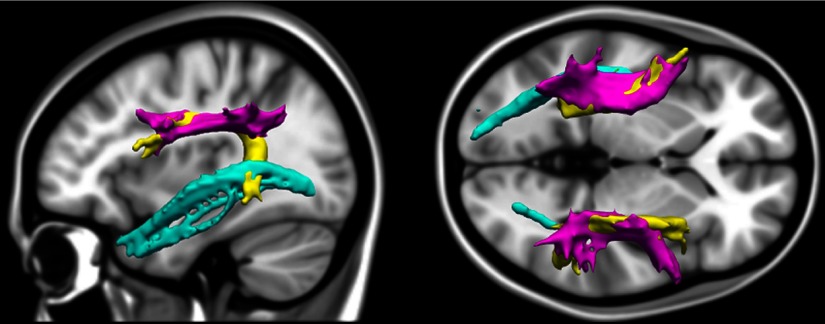
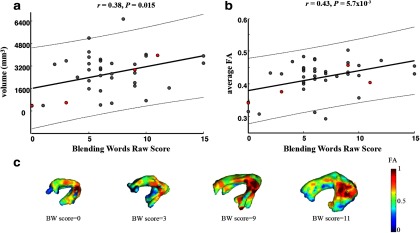
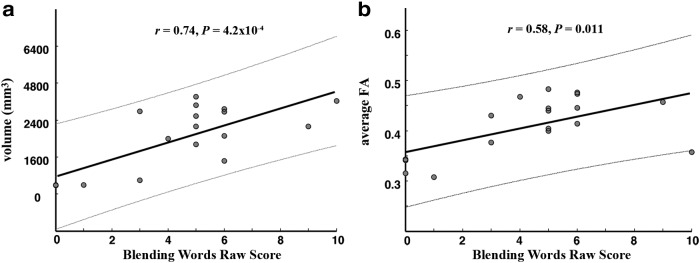
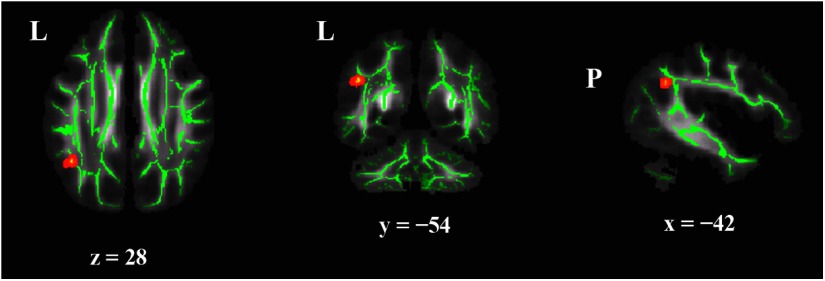
Developmental dyslexia, an unexplained difficulty in learning to read, has been associated with alterations in white matter organization as measured by diffusion-weighted imaging. It is unknown, however, whether these differences in structural connectivity are related to the cause of dyslexia or if they are consequences of reading difficulty (e.g., less reading experience or compensatory brain organization). Here, in 40 kindergartners who had received little or no reading instruction, we examined the relation between behavioral predictors of dyslexia and white matter organization in left arcuate fasciculus, inferior longitudinal fasciculus, and the parietal portion of the superior longitudinal fasciculus using probabilistic tractography. Higher composite phonological awareness scores were significantly and positively correlated with the volume of the arcuate fasciculus, but not with other tracts. Two other behavioral predictors of dyslexia, rapid naming and letter knowledge, did not correlate with volumes or diffusion values in these tracts. The volume and fractional anisotropy of the left arcuate showed a particularly strong positive correlation with a phoneme blending test. Whole-brain regressions of behavioral scores with diffusion measures confirmed the unique relation between phonological awareness and the left arcuate. These findings indicate that the left arcuate fasciculus, which connects anterior and posterior language regions of the human brain and which has been previously associated with reading ability in older individuals, is already smaller and has less integrity in kindergartners who are at risk for dyslexia because of poor phonological awareness. These findings suggest a structural basis of behavioral risk for dyslexia that predates reading instruction.
Figures
References
-
- Andersson JLR, Jenkinson M, Smith S. Non-linear optimisation. FMRIB technical report TR07JA1. 2007a. [Accessed Sept. 3, 2012]. www.fmrib.ox.ac.uk/analysis/techrep.
-
- Andersson JLR, Jenkinson M, Smith S. Non-linear registration, aka spatial normalisation. FMRIB technical report TR07JA2. 2007b. [Accessed Sept. 3, 2012]. www.fmrib.ox.ac.uk/analysis/techrep.
-
- Burgess SR. The influence of speech perception, oral language ability, the home literacy environment, and pre-reading knowledge on the growth of phonological sensitivity: a one-year longitudinal investigation. Reading and Writing. 2002;15:709–737. doi: 10.1023/A:1020954606695. - DOI
Publication types
MeSH terms
Grants and funding
LinkOut - more resources
Full Text Sources
Other Literature Sources
