


T cell Receptor Signal Transduction in T lymphocytes
- PMID: 23946894
- PMCID: PMC3740441
- DOI: 10.4172/2155-9899.S12-005
T cell Receptor Signal Transduction in T lymphocytes
Abstract
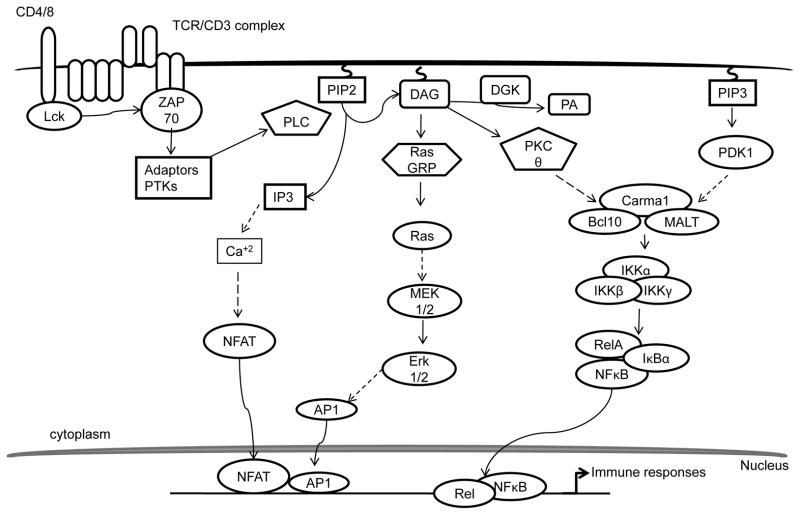
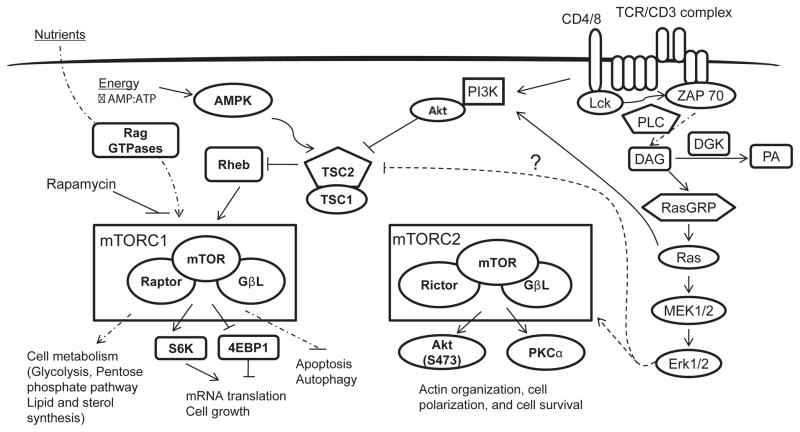
The T cell receptor (TCR) recognizes self or foreign antigens presented by major histocompatibility complex (MHC) molecules. Engagement of the TCR triggers the formation of multi-molecular signalosomes that lead to the generation of second messengers and subsequent activation of multiple distal signaling cascades, such as the Ca+2-calcineurin-NFAT, RasGRP1-Ras-Erk1/2, PKCθ-IKK-NFκB, and TSC1/2-mTOR pathways. These signaling cascades control many aspects of T cell biology. Mechanisms have been evolved to fine-tune TCR signaling to maintain T cell homeostasis and self-tolerance, and to properly mount effective responses to microbial infection. Defects or deregulation of TCR signaling has been implicated in the pathogenesis of multiple human diseases.
Keywords: Diacylglycerol kinase; Mammalian target of rapamycin; T cell activation; T cell anergy; T cell development; T cell receptor; T cell tolerance.
Figures
References
-
- Hayes SM, Love PE. Strength of signal: a fundamental mechanism for cell fate specification. Immunol Rev. 2006;209:170–175. - PubMed
-
- Takahama Y, Nitta T, Mat Ripen A, Nitta S, Murata S, et al. Role of thymic cortex-specific self-peptides in positive selection of T cells. Semin Immunol. 2010;22:287–293. - PubMed
-
- Takahama Y. Journey through the thymus: stromal guides for T-cell development and selection. Nat Rev Immunol. 2006;6:127–135. - PubMed
Grants and funding
LinkOut - more resources
Full Text Sources
Other Literature Sources
Research Materials
Miscellaneous