Review
. 2013 Sep;255(1):25-39.
doi: 10.1111/imr.12101.

Interferon induction and function at the mucosal surface

Affiliations
Review

Interferon induction and function at the mucosal surface

Russell K Durbin et al. Immunol Rev. 2013 Sep.

Abstract

Interferons (IFNs) are produced in response to virus infection and induce an antiviral state in virtually all cell types. In addition to upregulating the transcription of genes that inhibit virus replication, type I (or -α/β) IFNs also act to orchestrate the adaptive immune response to virus infection. Recently a new family of antiviral cytokines, the type III (or -λ) IFNs, has been identified that activate the same antiviral pathways via a distinct receptor. Although the identical transcription factor, IFN-stimulated gene factor 3 is activated by either IFN-α/β or IFN-λ signaling, differences in the induction and action of these two cytokine families are beginning to be appreciated. In this article, we review this emerging body of literature on the differing roles these cytokines play in host defense of the mucosal surface. Although many viruses enter the body through the respiratory and gastrointestinal tracts, we have focused the discussion on influenza A virus, respiratory syncytial virus, and rotavirus, three ubiquitous human pathogens that target the epithelial lining and are associated with a major disease burden.

Keywords: IFN induction; Stat signaling; influenza A virus; interferon; respiratory syncytial virus; rotavirus.


Figures

Figure 1
Figure 1. Type I IFN signaling pathways
All known IFN signaling pathways are initiated by Jak kinase tyrosine phosphorylation of substrate proteins. In the canonical Jak-STAT pathway (pink), Jak kinases phosphorylate STAT1 and STAT2 promoting formation of ISGF3. Phosphorylation of STAT1, 3, 4 and 5 also generates pSTAT homo- and heterodimers (SIFs). Activation of the MAPK-p38 pathway (yellow) is initiated by phosphorylation of vav or another GEF. Activation of PI3K pathways (blue), including mTOR is initiated by phosphorylation of IRS1/2.
Figure 2
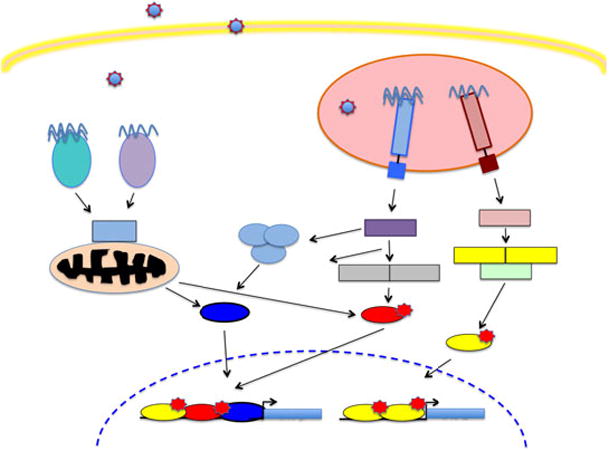
Figure 2. IFN-α/β induction
Although additional PRRs beyond those shown here participate in the IFN induction pathway, only the components known to recognize the RNA viruses discussed in this review are pictured here. Viral nucleic acids are recognized by both TLRs and RLRs. TLR7 is located in the endosomal compartment of DCs, and encounters ssRNA following virus infection or uptake of viral components by phagocytosis. Signaling by TLR 7 requires the adaptor molecule MyD88 which forms a complex with IRAK1, IRAK4 and TRAF6. TLR3 is expressed in the endosomal compartment of many cell types including DCs, macrophages and epithelial cells, and is activated by binding its ligand, dsRNA. TRIF is the adaptor protein required for TLR3 signaling, mediating activation of NF-κB by the canonical IKK kinases α, β and γ, and phosphorylation of IRF3 by the noncanonical IKK kinases TBK1 and IKKε. Alternatively, these IKK kinases can be activated by binding of ssRNA or dsRNA to the intracytoplasmic sensors RIG-I and MDA5.. RNA binding by either RIG-I or MDA-5 results in recruitment of the adaptor mitochondrial antiviral-signaling protein (MAVS) which dimerizes, and recruits additional adaptor proteins that activate the transcription factors NF-κB, IRF3 and IRF7. These activated transcription factors then translocate to the nucleus where they bind to promoter elements upstream of IFN-α and IFN-β gene leading to their transcriptional upregulation.
Figure 3
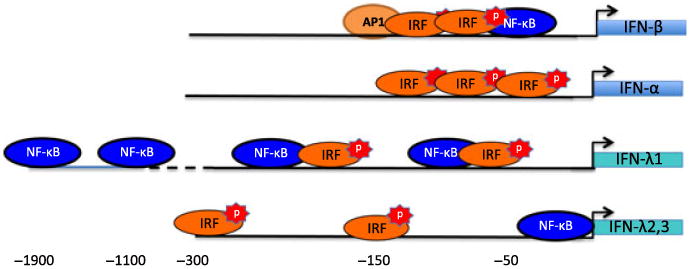
Figure 3. Promoter/enhancer recognition sequences associated with type I and type III IFN genes
The promoters directing IFN-β, -α, -λ1, and λ2,3 have binding sites for IRFs and NF-κB, but are not as similar as was originally thought. IFN-β gene activation requires binding of IRF3 and/or IRF7 as well as NF-κB and AP1, while the analogous IFN-λ1 promoter can be activated by either stimulus. Upegulation of IFN-α or –λ2,3 gene transcription is largely IRF7 mediated.
Figure 4
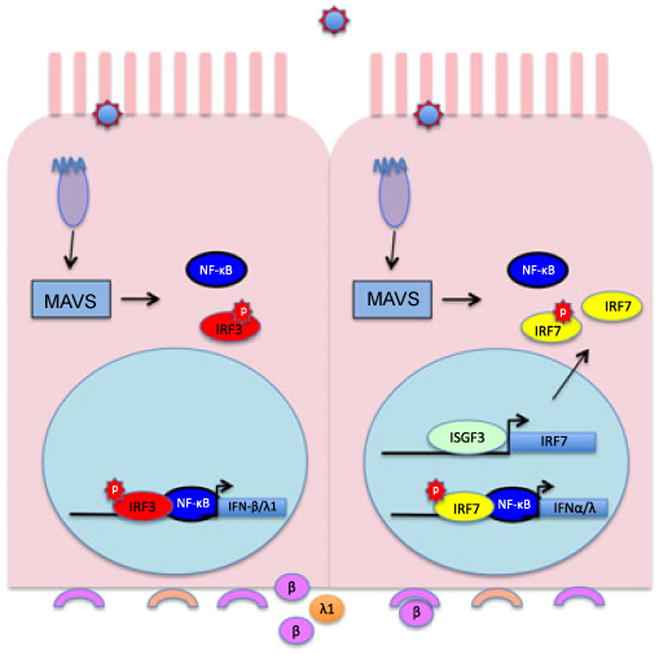
Figure 4. Two-step induction of type I and type III IFNs
, Upregulation of IFN mRNA synthesis requires the availability of activated NF-κB and IRFs. When an epithelial cell or fibroblast is infected by virus, RLRs activate NF-κB and IRF3, which then move into the nucleus and upregulate IFN-β and IFN-λ1 transcription. These ligands are then secreted from the basolateral surface of the cell. IFNAR and IFNLR on adjacent cells bind secreted IFNs, leading to synthesis of ISGs including IRF7. The availability of IRF7 allows amplification of the IFN response when infection of the IFN-exposed cell triggers its activation, translocation, dimerization, and IFN promoter binding. Although IFN-α synthesis by fibroblasts (which lack the IFNLR) requires prior IFN-β synthesis (or IFN-α/β treatment), this is not true for IFN-λ responsive epithelial cells. In the absence of IRF3 activation and IFN-β production, alternative pathways allow IFN-λ induction in the absence of IRF3 activation.

References

    1. Isaacs A, Lindenmann J. Virus interference. I. The interferon. Proceedings of the Royal Society of London Series B, Containing papers of a Biological character. 1957;147:258–267. - PubMed
    1. Weissenbach J, et al. Two interferon mRNAs in human fibroblasts: in vitro translation and Escherichia coli cloning studies. Proceedings of the National Academy of Sciences of the United States of America. 1980;77:7152–7156. - PMC - PubMed
    1. Taniguchi T, Fujii-Kuriyama Y, Muramatsu M. Molecular cloning of human interferon cDNA. Proceedings of the National Academy of Sciences of the United States of America. 1980;77:4003–4006. - PMC - PubMed
    1. Weck PK, Apperson S, May L, Stebbing N. Comparison of the antiviral activities of various cloned human interferon-alpha subtypes in mammalian cell cultures. The Journal of general virology. 1981;57:233–237. - PubMed
    1. Streuli M, Hall A, Boll W, Stewart WE, 2nd, Nagata S, Weissmann C. Target cell specificity of two species of human interferon-alpha produced in Escherichia coli and of hybrid molecules derived from them. Proceedings of the National Academy of Sciences of the United States of America. 1981;78:2848–2852. - PMC - PubMed

Publication types