


Modulation of the oscillatory mechanics of lung tissue and the oxidative stress response induced by arginase inhibition in a chronic allergic inflammation model
- PMID: 23947680
- PMCID: PMC3751598
- DOI: 10.1186/1471-2466-13-52
Modulation of the oscillatory mechanics of lung tissue and the oxidative stress response induced by arginase inhibition in a chronic allergic inflammation model
Abstract
Background: The importance of the lung parenchyma in the pathophysiology of asthma has previously been demonstrated. Considering that nitric oxide synthases (NOS) and arginases compete for the same substrate, it is worthwhile to elucidate the effects of complex NOS-arginase dysfunction in the pathophysiology of asthma, particularly, related to distal lung tissue. We evaluated the effects of arginase and iNOS inhibition on distal lung mechanics and oxidative stress pathway activation in a model of chronic pulmonary allergic inflammation in guinea pigs.
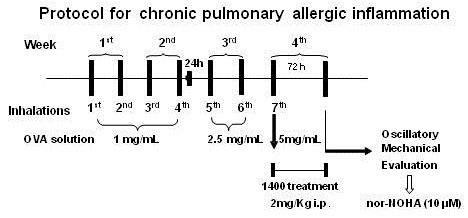
Methods: Guinea pigs were exposed to repeated ovalbumin inhalations (twice a week for 4 weeks). The animals received 1400 W (an iNOS-specific inhibitor) for 4 days beginning at the last inhalation. Afterwards, the animals were anesthetized and exsanguinated; then, a slice of the distal lung was evaluated by oscillatory mechanics, and an arginase inhibitor (nor-NOHA) or vehicle was infused in a Krebs solution bath. Tissue resistance (Rt) and elastance (Et) were assessed before and after ovalbumin challenge (0.1%), and lung strips were submitted to histopathological studies.
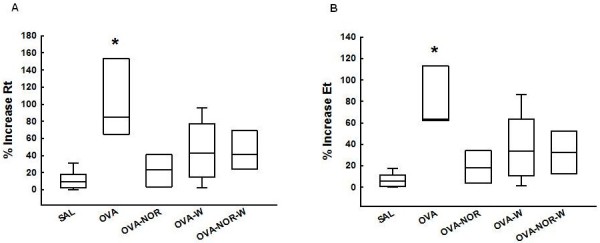
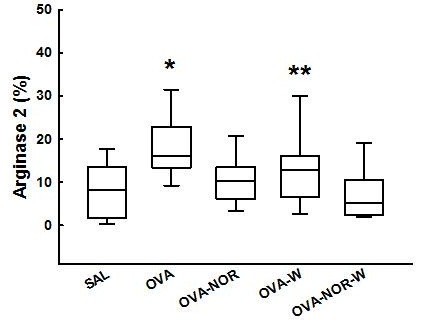
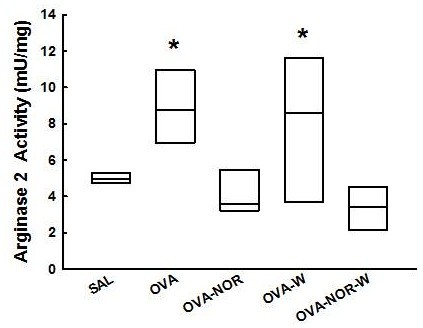
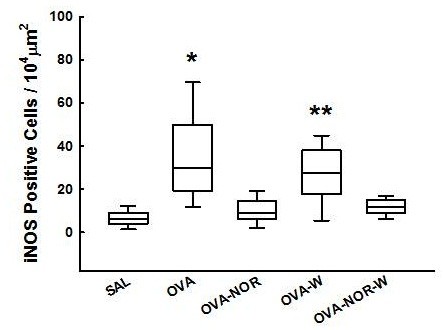
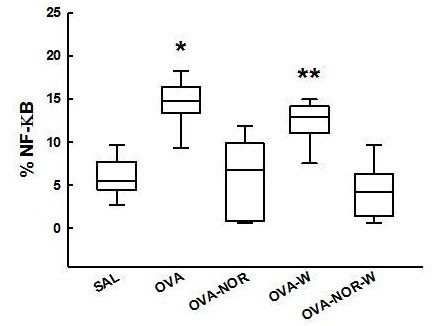
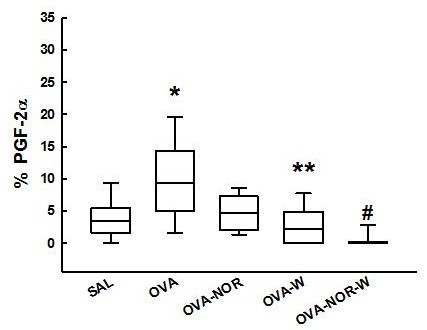
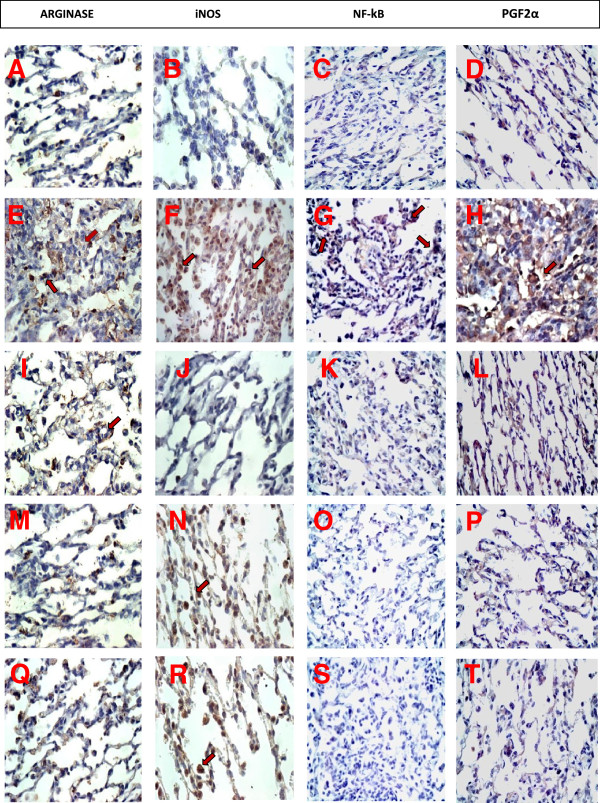
Results: Ovalbumin-exposed animals presented an increase in the maximal Rt and Et responses after antigen challenge (p<0.001), in the number of iNOS positive cells (p<0.001) and in the expression of arginase 2, 8-isoprostane and NF-kB (p<0.001) in distal lung tissue. The 1400 W administration reduced all these responses (p<0.001) in alveolar septa. Ovalbumin-exposed animals that received nor-NOHA had a reduction of Rt, Et after antigen challenge, iNOS positive cells and 8-isoprostane and NF-kB (p<0.001) in lung tissue. The activity of arginase 2 was reduced only in the groups treated with nor-NOHA (p <0.05). There was a reduction of 8-isoprostane expression in OVA-NOR-W compared to OVA-NOR (p<0.001).
Conclusions: In this experimental model, increased arginase content and iNOS-positive cells were associated with the constriction of distal lung parenchyma. This functional alteration may be due to a high expression of 8-isoprostane, which had a procontractile effect. The mechanism involved in this response is likely related to the modulation of NF-kB expression, which contributed to the activation of the arginase and iNOS pathways. The association of both inhibitors potentiated the reduction of 8-isoprostane expression in this animal model.
Figures
References
-
- Starling CM, Prado CM, Leick-Maldonado EA, Lanças T, Reis FG, Aristóteles LR, Dolhnikoff M, Martins MA, Tibério IF. Inducible nitric oxide synthase inhibition attenuates lung tissue responsiveness and remodeling in a model of chronic pulmonary inflammation in guinea pigs. Respir Physiol Neurobiol. 2009;165:185–194. doi: 10.1016/j.resp.2008.11.011. - DOI - PubMed
-
- Angeli P, Prado CM, Xisto DG, Silva PL, Passaro CP, Nakazato HD, Leick-Maldonado EA, Martins MA, Rocco PR, Tiberio IF. Effects of chronic L-NAME treatment lung tissue mechanics, eosinophilic and extracellular matrix responses induced by chronic pulmonary inflammation. Am J Physiol Lung Cell Mol Physiol. 2008;294:L1197-05. - PubMed
-
- Tibério IF, Turco GMG, Leick-Maldonado EA, Sakae RS, Paiva SO, do Patrocínio M, Warth TN, Silva JR L e, Saldiva PH, Martins MA. Effects of neurokinin depletion on airway inflammation induced by chronic antigen exposure. Am J Respir Crit Care Med. 1997;155:1739–1747. doi: 10.1164/ajrccm.155.5.9154886. - DOI - PubMed
-
- Prado CM, Leick EA, Lopes FDTQS, Martins MA, Tibério IFLC. In: Different Modulators of Airways and Distal Lung Parenchyma Contractile Responses in the Physiopathology of Asthma, Current Basic and Pathological Approaches to the Function of Muscle Cells and Tissues. From Molecules to Humans, Haruo Sugi, editor. 2012. 978-953-51-0679-1.
MeSH terms
Substances
LinkOut - more resources
Full Text Sources
Other Literature Sources
Medical
Research Materials
