


Differences in risk factors for neurophysiologically confirmed carpal tunnel syndrome and illness with similar symptoms but normal median nerve function: a case-control study
- PMID: 23947720
- PMCID: PMC3765327
- DOI: 10.1186/1471-2474-14-240
Differences in risk factors for neurophysiologically confirmed carpal tunnel syndrome and illness with similar symptoms but normal median nerve function: a case-control study
Abstract
Background: To explore whether risk factors for neurophysiologically confirmed carpal tunnel syndrome (CTS) differ from those for sensory symptoms with normal median nerve conduction, and to test the validity and practical utility of a proposed definition for impaired median nerve conduction, we carried out a case-control study of patients referred for investigation of suspected CTS.
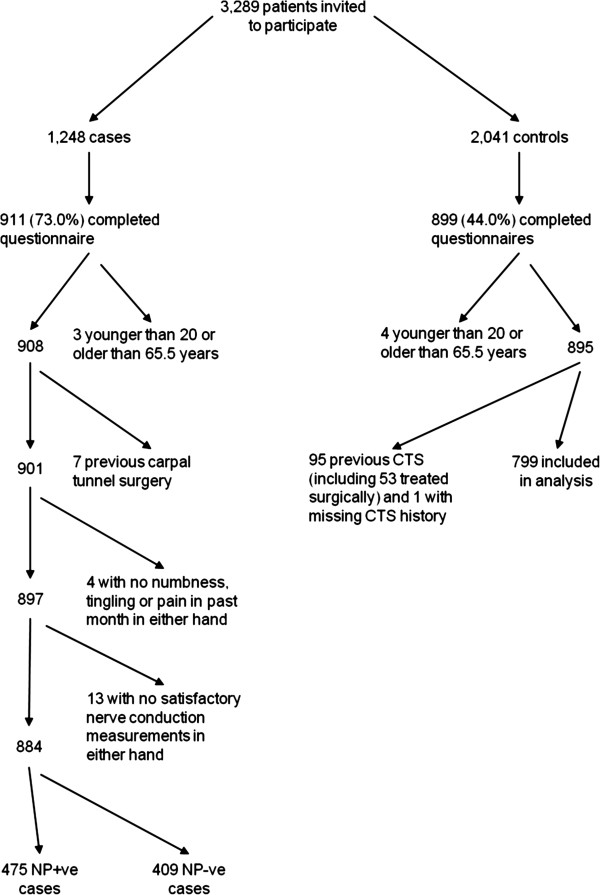
Methods: We compared 475 patients with neurophysiological abnormality (NP+ve) according to the definition, 409 patients investigated for CTS but classed as negative on neurophysiological testing (NP-ve), and 799 controls. Exposures to risk factors were ascertained by self-administered questionnaire. Odds ratios (ORs) and 95% confidence intervals (95% CIs) were estimated by logistic regression.
Results: NP+ve disease was associated with obesity, use of vibratory tools, repetitive movement of the wrist or fingers, poor mental health and workplace psychosocial stressors. NP-ve illness was also related to poor mental health and occupational psychosocial stressors, but differed from NP+ve disease in showing associations also with prolonged use of computer keyboards and tendency to somatise, and no relation to obesity. In direct comparison of NP+ve and NP-ve patients (the latter being taken as the reference category), the most notable differences were for obesity (OR 2.7, 95 % CI 1.9-3.9), somatising tendency (OR 0.6, 95% CI 0.4-0.9), diabetes (OR 1.6, 95% CI 0.9-3.1) and work with vibratory tools (OR 1.4, 95% CI 0.9-2.2).
Conclusions: When viewed in the context of earlier research, our findings suggest that obesity, diabetes, use of hand-held vibratory tools, and repeated forceful movements of the wrist and hand are causes of impaired median nerve function. In addition, sensory symptoms in the hand, whether from identifiable pathology or non-specific in origin, may be rendered more prominent and distressing by hand activity, low mood, tendency to somatise, and psychosocial stressors at work. These differences in associations with risk factors support the validity of our definition of impaired median nerve conduction.
Figures
References
-
- Health and Safety Executive. Self-reported work-related illness and workplace injuries in 2007/08: Results from the Labour Force Survey. 2009. (Health and Safety Executive). http://www.hse.gov.uk/statistics/lfs/lfs0708.pdf.
-
- Buckle P, Devereux J. Work-related neck and upper limb musculoskeletal disorders. : European Agency for Safety and Health at Work; 1999. http://osha.europa.eu/en/publications/reports/201.
Publication types
MeSH terms
Grants and funding
LinkOut - more resources
Full Text Sources
Other Literature Sources
Medical
Research Materials
Miscellaneous
