


Comment
doi: 10.1016/j.ccr.2013.07.019.
The kinase-independent, second life of CDK6 in transcription
Affiliations
- PMID: 23948293
- PMCID: PMC3809765
- DOI: 10.1016/j.ccr.2013.07.019
Item in Clipboard
Comment
The kinase-independent, second life of CDK6 in transcription
Cancer Cell.
.
Abstract
CDK6 is an oncogenic kinase regulating the cell cycle. In this issue of Cancer Cell, Kollmann and colleagues demonstrate that CDK6 performs a kinase-independent transcriptional function in regulating expression of VEGF-A and p16INK4a. These observations link the cell cycle machinery and angiogenesis and reveal the presence of a fail-safe antiproliferative mechanism.
Copyright © 2013 Elsevier Inc. All rights reserved.
Figures
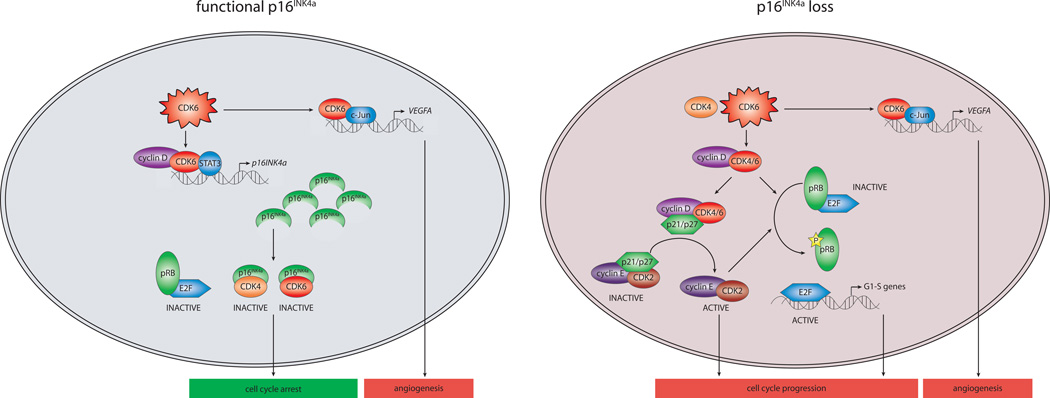
Regulation of cell cycle and proliferation by CDK6 depends on the functionality of the p16INK4a protein. CDK6 overexpression can either cause cell cycle arrest in a cell with functional p16INK4a by activating p16INK4a transcription in a kinase-independent manner (left) or promote cell cycle progression if p16INK4a function is lost (right). In addition to regulating cell cycle, CDK6 also induces angiogenesis by activating transcription of VEGF-A, a known angiogenic factor, in a kinase-independent manner.
Comment on
-
A kinase-independent function of CDK6 links the cell cycle to tumor angiogenesis.Cancer Cell. 2013 Aug 12;24(2):167-81. doi: 10.1016/j.ccr.2013.07.012. Cancer Cell. 2013. PMID: 23948297 Free PMC article.
References
Publication types
MeSH terms
Substances
Grants and funding
LinkOut - more resources
Full Text Sources
Other Literature Sources
Molecular Biology Databases
