Parental socialization and children's susceptibility to alcohol use initiation
- PMID: 23948528
- PMCID: PMC3749312
- DOI: 10.15288/jsad.2013.74.694
Parental socialization and children's susceptibility to alcohol use initiation
Abstract
Objective: This study examined relations between children's susceptibility to alcohol use initiation and parents' alcohol-specific beliefs, attitudes, and practices and whether these relations vary by parental alcohol use.
Method: The sample comprised 1,050 pairs of mothers or mother surrogates and their third-grade children (51.8% female) recruited for a 4-year intervention trial. Families were recruited from school districts located primarily in North Carolina; the school districts provided permission for study recruitment materials to be distributed to families but were not otherwise involved in the research. Data are from the baseline cross-sectional telephone interviews conducted with the mothers and children. Children's susceptibility to alcohol use initiation is based on child reports, and parental alcohol-specific beliefs, attitudes, and practices are based on maternal reports.
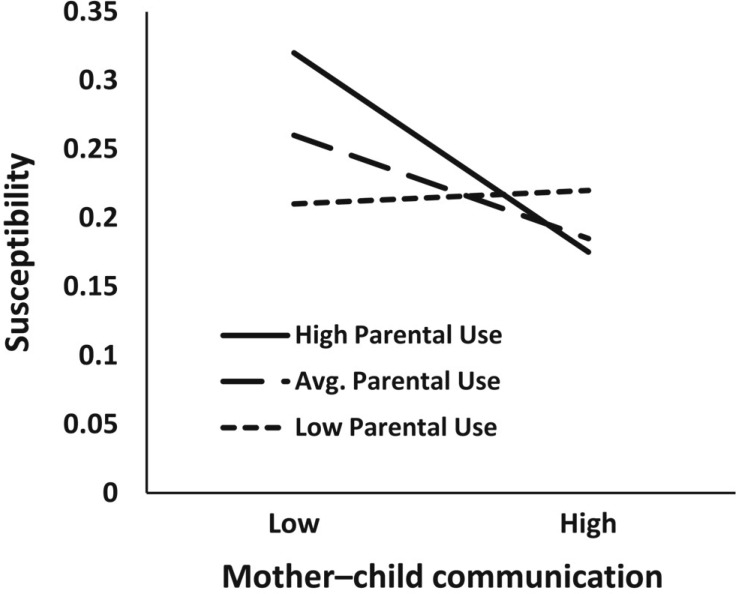
Results: All parental alcohol socialization attributes were statistically significantly associated as hypothesized with child susceptibility to alcohol use initiation. In the final full model, the mother's disapproving attitude about child sipping and the interaction between mother-child communication and parental alcohol use frequency were uniquely significantly associated with child susceptibility. Talking with the child about harmful consequences of alcohol use was associated with reduced child susceptibility in families where parents drank alcohol more frequently but had no relationship with child susceptibility in families where parents drank infrequently.
Conclusions: The normative interactions that parents have with their elementary school children may inhibit or facilitate children's susceptibility to alcohol use. To the extent that child susceptibility leads to early onset of use, prevention programs directed at parents to reduce child susceptibility are indicated.
Figures
References
-
- Aiken LS, West SG. Multiple regression: Testing and interpreting interactions. Newbury Park, CA: Sage; 1991.
-
- Ajzen I, Fishbein M. Understanding attitudes and predicting social behavior. Englewood Cliffs, NJ: Prentice-Hall; 1985.
-
- Andrews JA, Hops H, Ary D, Tildesley E, Harris J. Parental influence on early adolescent substance use: Specific and nonspecific effects. The Journal of Early Adolescence. 1993;13:285–310.
Publication types
MeSH terms
Grants and funding
LinkOut - more resources
Full Text Sources
Medical