


Through thick and thin: a circulating growth factor inhibits age-related cardiac hypertrophy
- PMID: 23948581
- PMCID: PMC3800187
- DOI: 10.1161/CIRCRESAHA.113.302239
Through thick and thin: a circulating growth factor inhibits age-related cardiac hypertrophy
Abstract
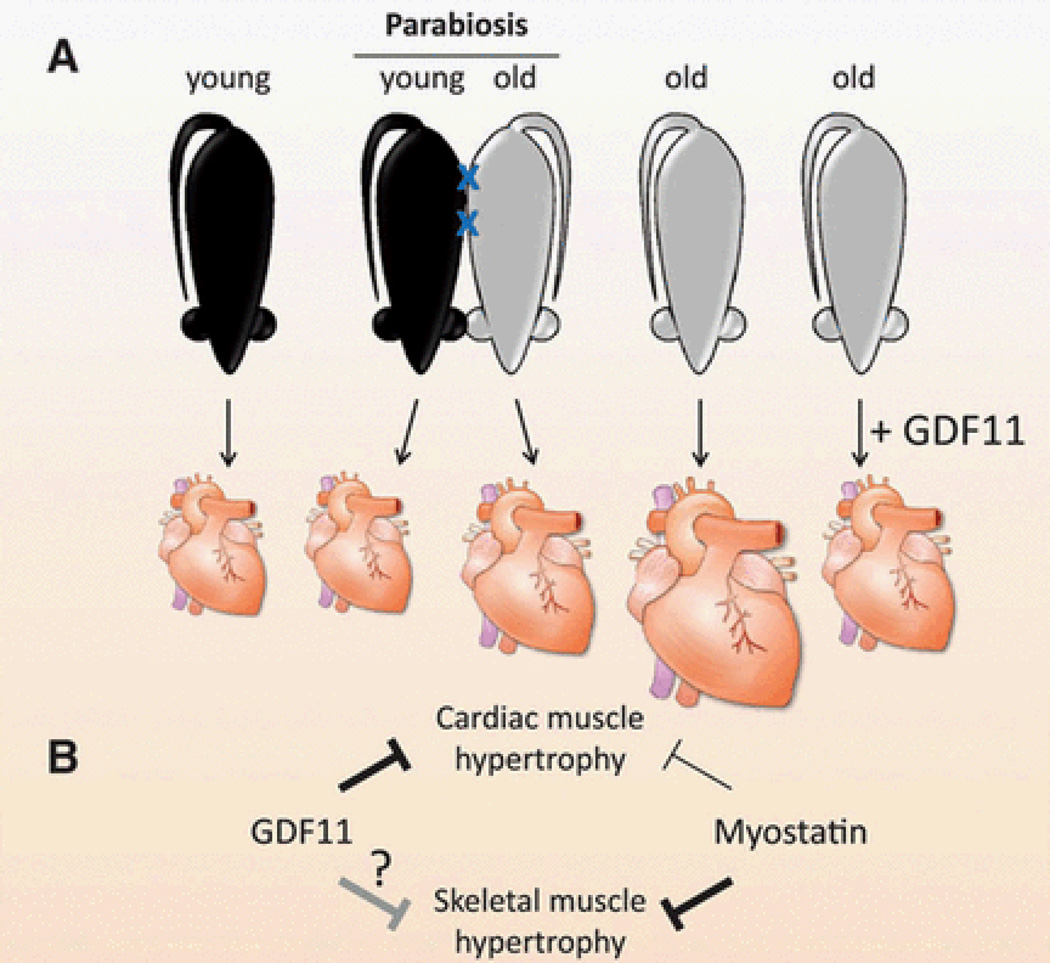
In an intriguing new study, Loffredo et al report that joining the circulation of old mice with that of young mice reduces age-related cardiac hypertrophy. They also found that the growth factor growth/differentiation factor 11 is a circulating negative regulator of cardiac hypertrophy which suggests that raising growth/differentiation factor 11 levels may be useful to treat cardiac hypertrophy associated with aging.
Conflict of interest statement
Under a licensing agreement between Pfizer and the Johns Hopkins University, A. C. M. is entitled to a share of royalty received by the University on sales of myostatin. A.C.M. also is a co-inventor on a GDF11 patent. The terms of these arrangements are being managed by the University in accordance with its conflict of interest policies.
Figures
Comment on
-
Growth differentiation factor 11 is a circulating factor that reverses age-related cardiac hypertrophy.Cell. 2013 May 9;153(4):828-39. doi: 10.1016/j.cell.2013.04.015. Cell. 2013. PMID: 23663781 Free PMC article.
References
-
- Schocken DD, Benjamin EJ, Fonarow GC, et al. Prevention of Heart Failure A Scientific Statement From the American Heart Association Councils on Epidemiology and Prevention, Clinical Cardiology, Cardiovascular Nursing, and High Blood Pressure Research; Quality of Care and Outcomes Research Interdisciplinary Working Group; and Functional Genomics and Translational Biology Interdisciplinary Working Group. Circulation. 2008;117(19):2544–2565. - PubMed
-
- Lakatta EG, Levy D. Arterial and Cardiac Aging: Major Shareholders in Cardiovascular Disease Enterprises Part II: The Aging Heart in Health: Links to Heart Disease. Circulation. 2003;107(2):346–354. - PubMed
-
- Levy D, Garrison RJ, Savage DD, Kannel WB, Castelli WP. Prognostic Implications of Echocardiographically Determined Left Ventricular Mass in the Framingham Heart Study. N Engl J Med. 1990;322(22):1561–1566. - PubMed
-
- Meyer T, Shih J, Aurigemma G. Heart Failure With Preserved Ejection Fraction (Diastolic Dysfunction) Ann Intern Med. 2013;158(1) ITC1–1. - PubMed
Publication types
MeSH terms
Substances
Grants and funding
LinkOut - more resources
Full Text Sources
Other Literature Sources
Medical
