


Review
doi: 10.1038/cddis.2013.300.
Defining the role of the Bcl-2 family proteins in Huntington's disease
Affiliations
- PMID: 23949221
- PMCID: PMC3763461
- DOI: 10.1038/cddis.2013.300
Item in Clipboard
Review
Defining the role of the Bcl-2 family proteins in Huntington's disease
Cell Death Dis.
.
Abstract
B-cell lymphoma 2 (Bcl-2) family proteins regulate survival, mitochondria morphology dynamics and metabolism in many cell types including neurons. Huntington's disease (HD) is a neurodegenerative disorder caused by an expanded CAG repeat tract in the IT15 gene that encodes for the protein huntingtin (htt). In vitro and in vivo models of HD and HD patients' tissues show abnormal mitochondrial function and increased cell death rates associated with alterations in Bcl-2 family protein expression and localization. This review aims to draw together the information related to Bcl-2 family protein alterations in HD to decipher their potential role in mutated htt-related cell death and mitochondrial dysfunction.
Figures
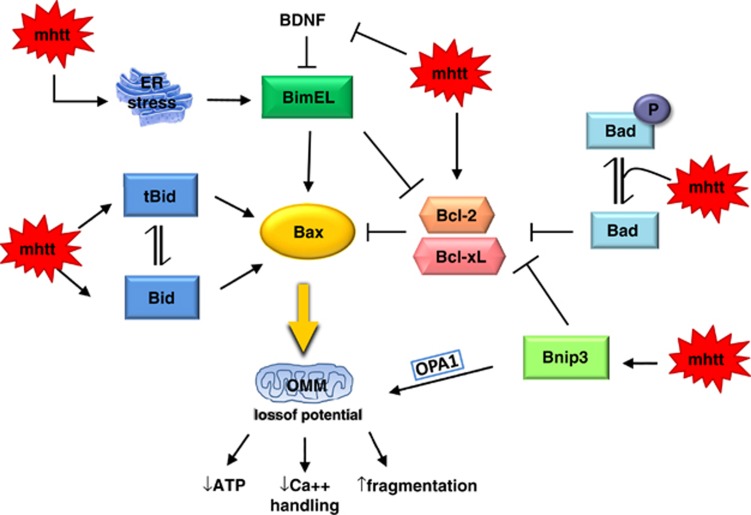
Hypothetical model explaining the pathway through which mutated htt (mhtt) causes OMM permeabilization. Bax activation in HD may depend on the ‘activators' BH3-only proteins and the ‘sensitizers' that bind only to pro-survival proteins Bcl-2 and Bcl-xL. Mutated htt may interact with the Bcl-2 protein network at multiple levels by modulating Bcl-2 expression, inducing Bid accumulation and Bid cleavage, promoting BNip3 activation and increasing non-pBad levels. BimEL accumulation/activation may depend on htt control over BDNF expression or ER stress-induced UPR or both mechanisms
References
-
- Karbowski M, Norris KL, Cleland MM, Jeong SY, Youle RJ. Role of Bax and Bak in mitochondrial morphogenesis. Nature. 2006;443:658–662. - PubMed
-
- Sheridan C, Delivani P, Cullen SP, Martin SJ. Bax- or Bak-induced mitochondrial fission can be uncoupled from cytochrome C release. Mol Cell. 2008;31:570–585. - PubMed
-
- Danial NN, Gramm CF, Scorrano L, Zhang CY, Krauss S, Ranger AM, et al. BAD and glucokinase reside in a mitochondrial complex that integrates glycolysis and apoptosis. Nature. 2003;424:952–956. - PubMed
-
- Trettel F, Rigamonti D, Hilditch-Maguire P, Wheeler VC, Sharp AH, Persichetti F, et al. Dominant phenotypes produced by the HD mutation in STHdh(Q111) striatal cells. Hum Mol Genet. 2000;9:2799–2809. - PubMed
Publication types
MeSH terms
Substances
LinkOut - more resources
Full Text Sources
Other Literature Sources
Medical
