


Development of a high efficiency dry powder inhaler: effects of capsule chamber design and inhaler surface modifications
- PMID: 23949304
- PMCID: PMC3946921
- DOI: 10.1007/s11095-013-1165-6
Development of a high efficiency dry powder inhaler: effects of capsule chamber design and inhaler surface modifications
Abstract
Purpose: The objective of this study was to explore the performance of a high efficiency dry powder inhaler (DPI) intended for excipient enhanced growth (EEG) aerosol delivery based on changes to the capsule orientation and surface modifications of the capsule and device.
Methods: DPIs were constructed by combining newly designed capsule chambers (CC) with a previously developed three-dimensional (3D) rod array for particle deagglomeration and a previously optimized EEG formulation. The new CCs oriented the capsule perpendicular to the incoming airflow and were analyzed for different air inlets at a constant pressure drop across the device. Modifications to the inhaler and capsule surfaces included use of metal dispersion rods and surface coatings. Aerosolization performance of the new DPIs was evaluated and compared with commercial devices.
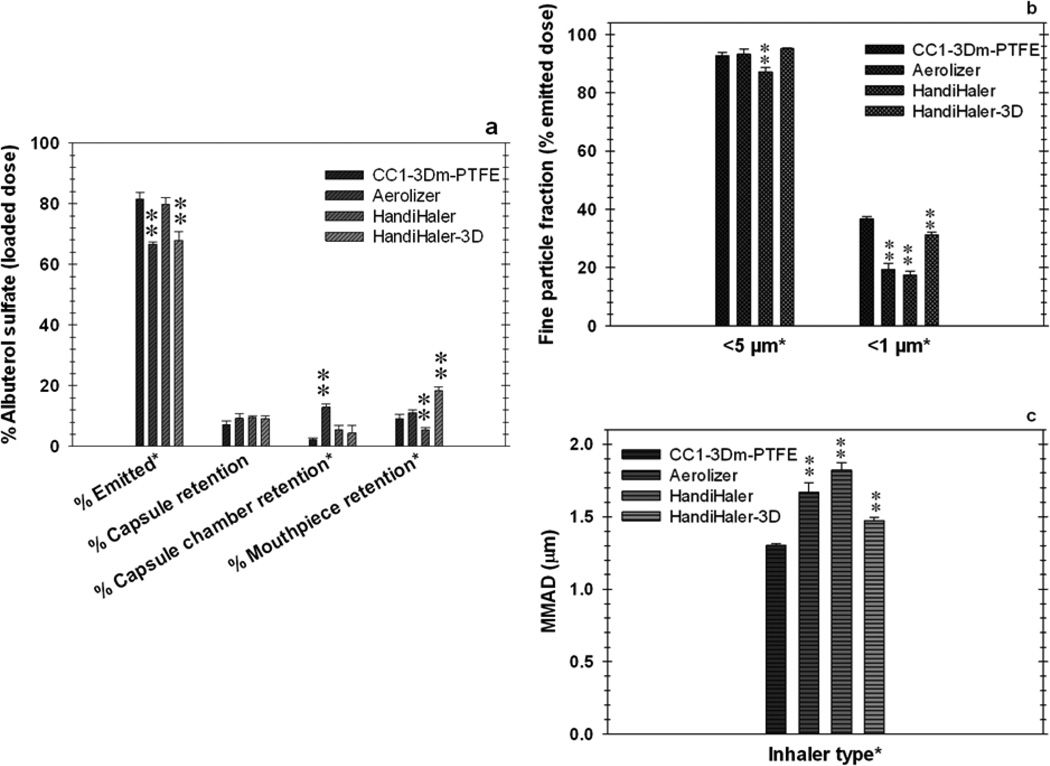
Results: The proposed capsule orientation and motion pattern increased capsule vibrational frequency and reduced the aerosol MMAD compared with commercial/modified DPIs. The use of metal rods in the 3D array further improved inhaler performance. Coating the inhaler and capsule with PTFE significantly increased emitted dose (ED) from the optimized DPI.
Conclusions: High efficiency performance is achieved for EEG delivery with the optimized DPI device and formulation combination producing an aerosol with MMAD < 1.5 μm, FPF<5 μm/ED > 90%, and ED > 80%.
Figures
References
-
- Islam N, Cleary MJ. Developing an efficient and reliable dry powder inhaler for pulmonary drug delivery - A review for multidisciplinary researchers. Med Eng Phys. 2012;34:409–427. - PubMed
-
- Newman SP, Busse WW. Evolution of dry powder inhaler design, formulation, and performance. Respir Med. 2002;96:293–304. - PubMed
-
- Smith IJ, Bell J, Bowman N, Everard M, Stein S, Weers JG. Inhaler Devices: What Remains to be Done? J Aerosol Med Pulm D. 2010;23:S25–S37. - PubMed
-
- Brain JD, Blanchard JD. Mechanisms of particle deposition and clearance. In: More'n F, Dolovich MB, Newhouse MT, Newman SP, editors. Aerosols in Medicine: Principles, Diagnosis and Therapy. New York, USA: Elsevier; 1993. pp. 117–156.
-
- DeHaan WH, Finlay WH. Predicting extrathoracic deposition from dry powder inhalers. J Aerosol Sci. 2004;35:309–331.
Publication types
MeSH terms
Substances
Grants and funding
LinkOut - more resources
Full Text Sources
Other Literature Sources
Medical
