


Phenotype/genotype correlation in a case series of Stargardt's patients identifies novel mutations in the ABCA4 gene
- PMID: 23949494
- PMCID: PMC3831132
- DOI: 10.1038/eye.2013.176
Phenotype/genotype correlation in a case series of Stargardt's patients identifies novel mutations in the ABCA4 gene
Abstract
Purpose: To investigate phenotypic variability in terms of best-corrected visual acuity (BCVA) in patients with Stargardt disease (STGD) and confirmed ABCA4 mutations.
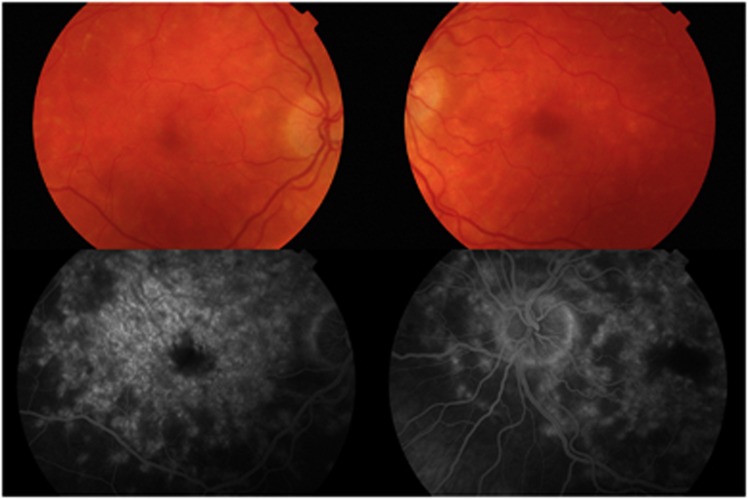
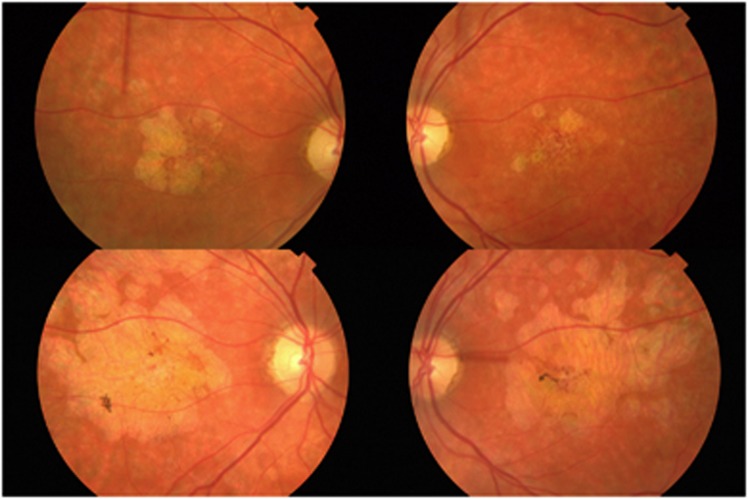
Methods: Entire coding region analysis of the ABCA4 gene by direct sequencing of seven patients with clinical findings of STGD seen in the Retina Clinics of Southampton Eye Unit between 2002 and 2011.Phenotypic variables recorded were BCVA, fluorescein angiographic appearance, electrophysiology, and visual fields.
Results: All patients had heterozygous amino acid-changing variants (missense mutations) in the ABCA4 gene. A splice sequence change was found in a 30-year-old patient with severly affected vision. Two novel sequence changes were identified: a missense mutation in a mildly affected 44-year-old patient and a frameshift mutation in a severly affected 34-year-old patient.
Conclusion: The identified ABCA4 mutations were compatible with the resulting phenotypes in terms of BCVA. Higher BCVAs were recorded in patients with missense mutations. Sequence changes, predicted to have more deleterious effect on protein function, resulted in a more severe phenotype. This case series of STGD patients demonstrates novel genotype/phenotype correlations, which may be useful to counselling of patients. This information may prove useful in selection of candidates for clinical trials in ABCA4 disease.
Figures
References
-
- Allikmets R, Singh N, Sun H, Shroyer NF, Hutchinson A, Chidambaram A, et al. A photoreceptor cell-specific ATP-binding transporter gene (ABCR) is mutated in recessive Stargardt macular dystrophy. Nat Genet. 1997;15:236–246. - PubMed
-
- Shroyer NF, Lewis RA, Yatsenko AN, Lupski JR. Null missense ABCR (ABCA4) mutations in a family with stargardt disease and retinitis pigmentosa. IOVS. 2001;42:2757–2761. - PubMed
-
- Webster A, Héon E, Lotery AJ, Vandenburgh K, Casavant TL, Oh KT, et al. An analysis of allelic variation in the ABCA4 gene. IOVS. 2001;42:1179–1189. - PubMed
-
- Maugeri A, van Driel MA, van de Pol DJ, Klevering BJ, van Haren FJ, Tijmes N, et al. The 2588 G—>C mutation in the ABCR gene is a mild frequent founder mutation in the Western European population and allows the classification of ABCR mutations in patients with Stargardt disease. Am J Hum Genet. 1999;64:1024–1035. - PMC - PubMed
-
- Jaakson K, Zernant J, Külm M, Hutchinson A, Tonisson N, Glavac D, et al. Genotyping microarray (gene chip) for the ABCR (ABCA4) gene. Hum Mutat. 2003;22:395–403. - PubMed
Publication types
MeSH terms
Substances
LinkOut - more resources
Full Text Sources
Other Literature Sources
