


Combining Transition Metal Catalysis with Radical Chemistry: Dramatic Acceleration of Palladium-Catalyzed C-H Arylation with Diaryliodonium Salts
- PMID: 23950736
- PMCID: PMC3740597
- DOI: 10.1002/adsc.201200738
Combining Transition Metal Catalysis with Radical Chemistry: Dramatic Acceleration of Palladium-Catalyzed C-H Arylation with Diaryliodonium Salts
Abstract
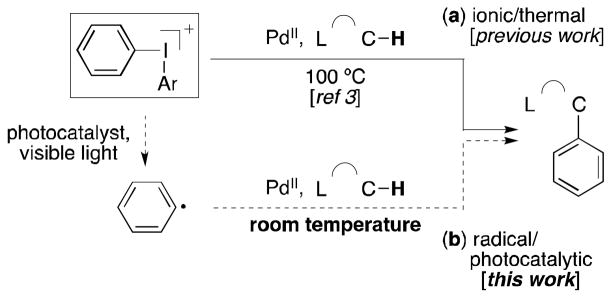
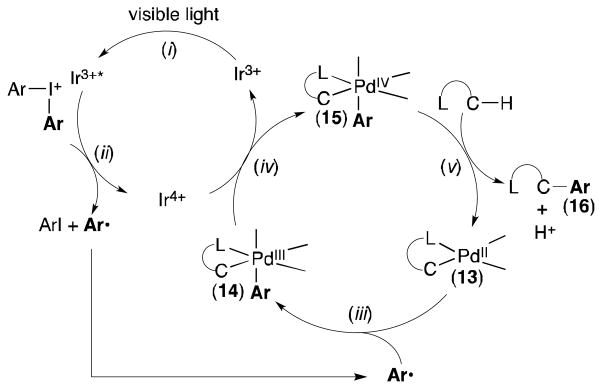
This paper describes a photoredox palladium/iridium-catalyzed C-H arylation with diaryliodonium reagents. Details of the reaction optimization, substrate scope, and mechanism are presented along with a comparison to a related method in which aryldiazonium salts are used in place of diaryliodonium reagents. The unprecedentedly mild reaction conditions (25 ºC in methanol), the requirement for light and a photocatalyst, the inhibitory effect of radical scavengers, and the observed chemoselectivity trends are all consistent with a radical-thermal reaction with diaryliodonium reagents that is believed to proceed via an 'ionic' 2e- pathway and requires a much higher reaction temperature (100 ºC).
Keywords: C–H activation; diaryliodonium salts; palladium; photochemistry; radicals.
Figures
References
-
-
For recent reviews, see Ford L, Jahn U. Angew Chem. 2009;121:6504–6507.Angew Chem Int Ed. 2009;48:6386–6389.Jahn U. Top Curr Chem. 2012;320:121–189.Jahn U. Top Curr Chem. 2012;320:191–322.Jahn U. Top Curr Chem. 2012;320:323–451.
-
-
-
Manolikakes G, Knochel P. Angew Chem. 2009;121:211–215.Angew Chem Int Ed. 2009;48:205–209.For a related Negishi coupling see: Kienle M, Knochel P. Org Lett. 2010;12:2702–2705.
-
-
-
Other Pd-catalyzed C–H arylations using Ar2I+: Daugulis O, Zaitsev V. Angew Chem. 2005;117:4114–4116.Angew Chem Int Ed. 2005;44:4046–4048.Deprez NR, Kalyani D, Krause A, Sanford MS. J Am Chem Soc. 2006;128:4972–4973.Spencer J, Chowdhry BZ, Mallet AI, Rathnam RP, Adatia T, Bashall A, Rominger F. Tetrahedron. 2008;64:6082–6089.Xiao B, Fu Y, Xu J, Gong TJ, Dai JJ, Yi J, Liu L. J Am Chem Soc. 2010;132:468–469.Wagner A, Sanford MS. Org Lett. 2011;13:288–291.Hickman AJ, Sanford MS. ACS Catal. 2011;1:170–174.
-
-
-
For Cu-catalyzed C–H arylation reactions with Ar2I+ see: Phipps RJ, Grimster NP, Gaunt MJ. J Am Chem Soc. 2008;130:8172–8174.Phipps RJ, Gaunt MJ. Science. 2009;323:1593–1597.Ciana CL, Phipps RJ, Brandt JR, Meyer FM, Gaunt MJ. Angew Chem. 2011;123:478–482.Angew Chem Int Ed. 2011;50:458–462.Duong HA, Gilligan RE, Cooke ML, Phipps RJ, Gaunt MJ. Angew Chem. 2011;123:483–486.Angew Chem Int Ed. 2011;50:463–466.
-
Grants and funding
LinkOut - more resources
Full Text Sources