


Small, dense LDL particles predict changes in intima media thickness and insulin resistance in men with type 2 diabetes and prediabetes--a prospective cohort study
- PMID: 23951331
- PMCID: PMC3738563
- DOI: 10.1371/journal.pone.0072763
Small, dense LDL particles predict changes in intima media thickness and insulin resistance in men with type 2 diabetes and prediabetes--a prospective cohort study
Abstract
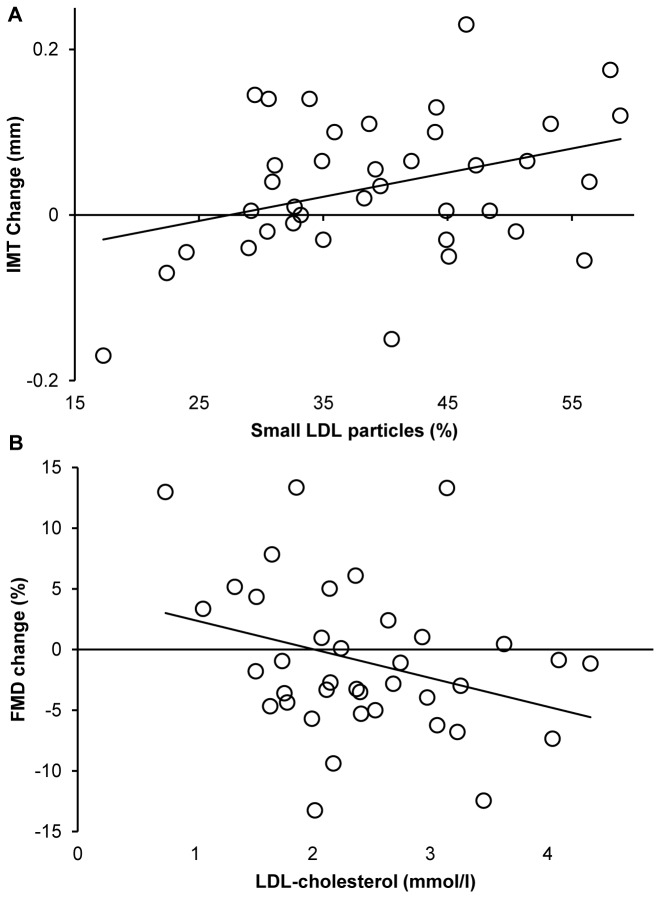
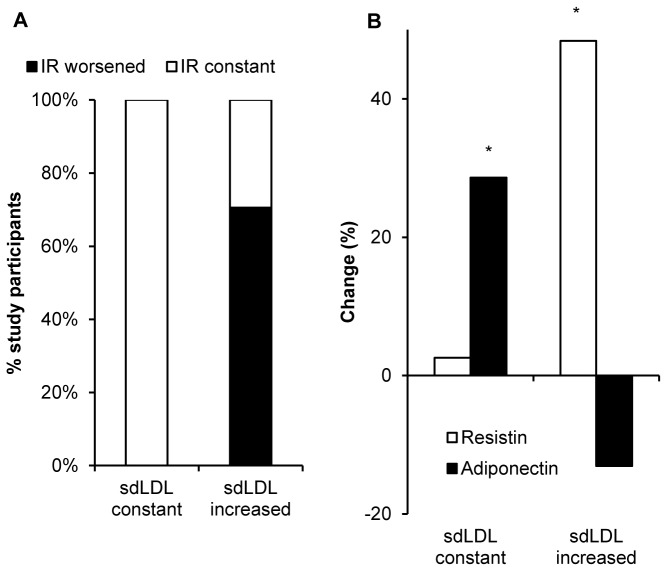
The association of small, dense low-density lipoprotein (sdLDL) particles with an increased cardiovascular risk is well established. However, its predictive value with regard to glucose metabolism and arterial disease in patients with type 2 diabetes has not been thoroughly investigated. We conducted a prospective longitudinal cohort study in patients with (pre)diabetes who were seen at baseline and after two years. sdLDL particles were determined by gradient gel electrophoresis. Insulin resistance was estimated by using the homeostatic model assessment 2 (HOMA2). Intima media thickness (IMT) and flow-mediated dilation (FMD) were assessed by ultrasound measurements. Fifty-nine patients (mean age 63.0 ± 12.2 years) were enrolled and 39 were seen at follow-up. IMT increased in the whole cohort during follow-up. The change in IMT was predicted by the proportion of sdLDL particles at baseline (p=0.03), and the change in FMD was predicted by LDL-cholesterol levels at baseline (p=0.049). HOMA2 and changes in HOMA2 correlated with the proportion of sdLDL particles and changes in this proportion, respectively (p<0.05 for both). Serum resistin levels increased in parallel with the increasing sdLDL particle number, while serum adiponectin increased only in patients with unaltered sdLDL particle number at follow-up (p<0.01 for both). In conclusion, the proportion of small, dense LDL particles and changes in this proportion are predictive of changes in intima media thickness and insulin resistance, and are closely associated with other determinants of an adverse metabolic status. Thus, this parameter extends the individual risk assessment beyond the limitations of traditional risk markers in patients with dysglycemia.
Conflict of interest statement
Figures
References
-
- Haffner SM, Lehto S, Rönnemaa T, Pyörälä K, Laakso M (1998) Mortality from coronary heart disease in subjects with type 2 diabetes and in nondiabetic subjects with and without prior myocardial infarction. N Engl J Med 339: 229-234. doi:10.1056/NEJM199807233390404. PubMed: 9673301. - DOI - PubMed
-
- Thalhammer C, Balzuweit B, Busjahn A, Walter C, Luft FC et al. (1999) Endothelial cell dysfunction and arterial wall hypertrophy are associated with disturbed carbohydrate metabolism in patients at risk for cardiovascular disease. Arterioscler Thromb Vasc Biol 19: 1173-1179. doi:10.1161/01.ATV.19.5.1173. PubMed: 10323767. - DOI - PubMed
-
- Juutilainen A, Lehto S, Rönnemaa T, Pyörälä K, Laakso M (2008) Similarity of the impact of type 1 and type 2 diabetes on cardiovascular mortality in middle-aged subjects. Diabetes Care 31: 714-719. doi:10.2337/dc07-2124. PubMed: 18083789. - DOI - PubMed
-
- Hu FB, Stampfer MJ, Haffner SM, Solomon CG, Willett WC et al. (2002) Elevated risk of cardiovascular disease prior to clinical diagnosis of type 2 diabetes. Diabetes Care 25: 1129-1134. doi:10.2337/diacare.25.7.1129. PubMed: 12087009. - DOI - PubMed
-
- Isomaa B, Almgren P, Tuomi T, Forsén B, Lahti K et al. (2001) Cardiovascular morbidity and mortality associated with the metabolic syndrome. Diabetes Care 24: 683-689. doi:10.2337/diacare.24.4.683. PubMed: 11315831. - DOI - PubMed
Publication types
MeSH terms
Substances
LinkOut - more resources
Full Text Sources
Other Literature Sources
Medical
