


Population-based analysis of Alzheimer's disease risk alleles implicates genetic interactions
- PMID: 23954108
- PMCID: PMC3867586
- DOI: 10.1016/j.biopsych.2013.07.008
Population-based analysis of Alzheimer's disease risk alleles implicates genetic interactions
Abstract
Background: Reported odds ratios and population attributable fractions (PAF) for late-onset Alzheimer's disease (LOAD) risk loci (BIN1, ABCA7, CR1, MS4A4E, CD2AP, PICALM, MS4A6A, CD33, and CLU) come from clinically ascertained samples. Little is known about the combined PAF for these LOAD risk alleles and the utility of these combined markers for case-control prediction. Here we evaluate these loci in a large population-based sample to estimate PAF and explore the effects of additive and nonadditive interactions on LOAD status prediction performance.
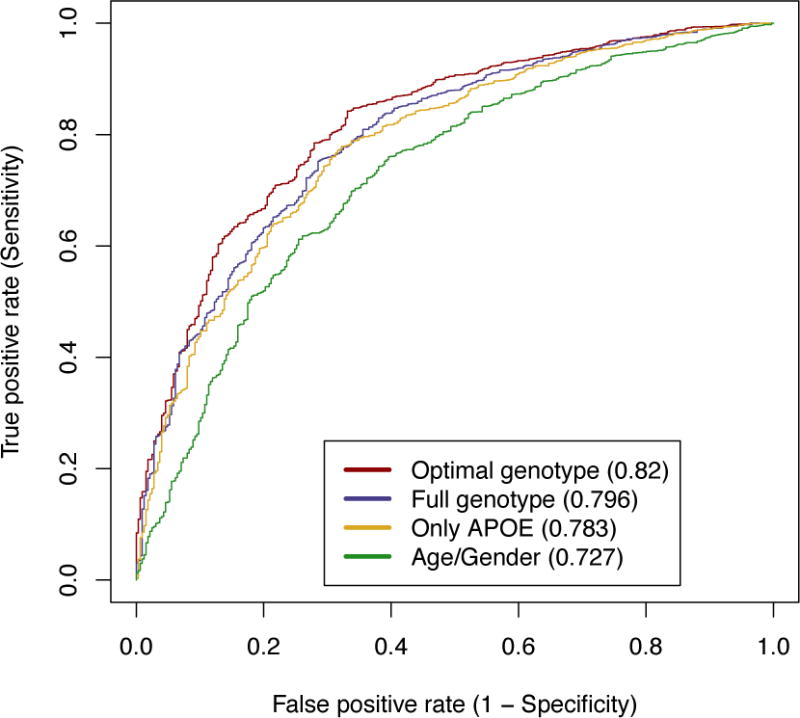
Methods: 2419 samples from the Cache County Memory Study were genotyped for APOE and nine LOAD risk loci from AlzGene.org. We used logistic regression and receiver operator characteristic analysis to assess the LOAD status prediction performance of these loci using additive and nonadditive models and compared odds ratios and PAFs between AlzGene.org and Cache County.
Results: Odds ratios were comparable between Cache County and AlzGene.org when identical single nucleotide polymorphisms were genotyped. PAFs from AlzGene.org ranged from 2.25% to 37%; those from Cache County ranged from .05% to 20%. Including non-APOE alleles significantly improved LOAD status prediction performance (area under the curve = .80) over APOE alone (area under the curve = .78) when not constrained to an additive relationship (p < .03). We identified potential allelic interactions (p values uncorrected): CD33-MS4A4E (synergy factor = 5.31; p < .003) and CLU-MS4A4E (synergy factor = 3.81; p < .016).
Conclusions: Although nonadditive interactions between loci significantly improve diagnostic ability, the improvement does not reach the desired sensitivity or specificity for clinical use. Nevertheless, these results suggest that understanding gene-gene interactions may be important in resolving Alzheimer's disease etiology.
Keywords: Alzheimer’s disease; epistasis; genetic interactions; odds ratio; population attributable fraction; risk.
Copyright © 2014 Society of Biological Psychiatry. Published by Elsevier Inc. All rights reserved.
Conflict of interest statement
No authors report biomedical financial interests or potential conflicts of interest.
Figures
References
-
- Corder EH, Saunders AM, Strittmatter WJ, Schmechel DE, Gaskell PC, Small GW, et al. Gene dose of apolipoprotein E type 4 allele and the risk of Alzheimer’s disease in late onset families. Science. 1993;261:921–923. - PubMed
-
- Saunders AM, Strittmatter WJ, Schmechel D, George-Hyslop PH, Pericak-Vance MA, Joo SH, et al. Association of apolipoprotein E allele epsilon 4 with late-onset familial and sporadic Alzheimer’s disease. Neurology. 1993;43:1467–1472. - PubMed
-
- Bertram L, McQueen MB, Mullin K, Blacker D, Tanzi RE. Systematic meta-analyses of Alzheimer disease genetic association studies: the AlzGene database. Nat Genet. 2007;39:17–23. - PubMed
Publication types
MeSH terms
Substances
Grants and funding
LinkOut - more resources
Full Text Sources
Other Literature Sources
Medical
Research Materials
Miscellaneous
